
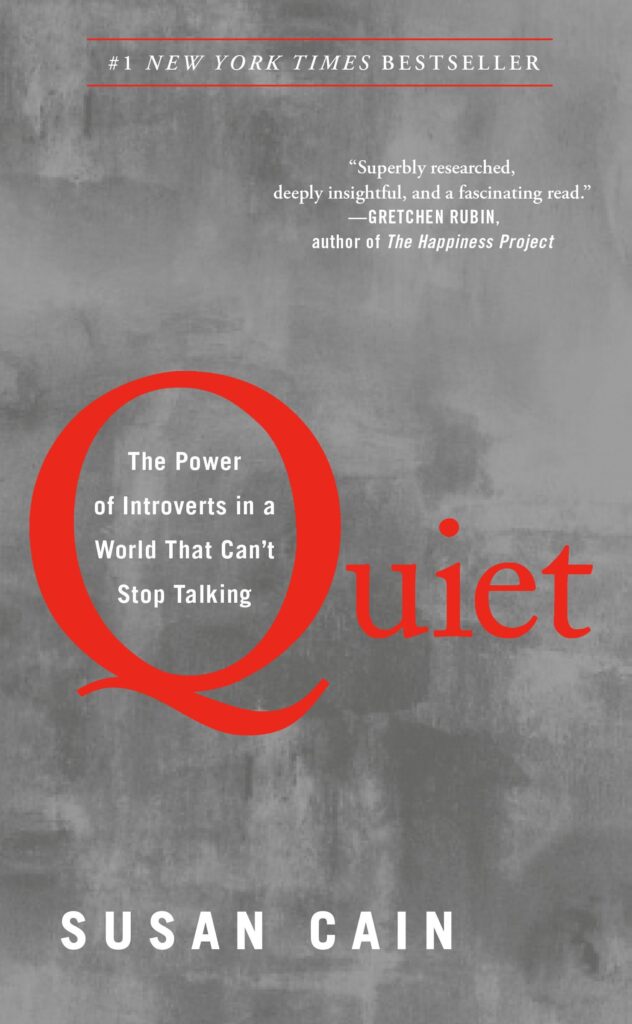
Quiet: The Power of Introverts in a World That Can't Stop Talking
At least one-third of the people around you are introverts. They're the ones who prefer listening to speaking, who innovate and create but dislike self-promotion, who favor working alone over brainstorming in teams. Yet in a world that celebrates the Extrovert Ideal, these quiet thinkers are dramatically undervalued.
In this book, Susan Cain reveals how Western culture transformed from valuing character to worshipping personality, creating a society where charisma trumps substance. She takes you inside the rise of the Extrovert Ideal throughout the twentieth century and exposes the colossal waste of talent, energy, and happiness it has caused.
Drawing on cutting-edge research in biology, psychology, and neuroscience, Cain introduces you to successful introverts who have harnessed their quiet strengths. From a high-octane public speaker who recharges in solitude to a record-breaking salesman who quietly taps into the power of questions, these stories prove that introversion is a superpower, not a limitation.
Passionately argued and impeccably researched, Quiet will permanently change how you see introverts and, if you're one yourself, how you see your own potential. It's to introverts like Rosa Parks, Chopin, Dr. Seuss, and Steve Wozniak that we owe many of society's greatest contributions.
Interesting Facts
Seven Years in the Making: Susan Cain spent seven years researching and writing Quiet before it was published in January 2012, transforming from a Wall Street lawyer who felt like she was living in a foreign country to a writer working from home. Her extreme difficulty with public speaking actually inspired her to explore introversion, and she patiently built her expertise while supporting herself through negotiation consulting work.
Four Million Copies Sold: By 2022, Quiet had sold over four million copies worldwide and been translated into 40 languages, spending an astonishing eight years on the New York Times bestseller list. The book became a number one bestseller and was voted the top nonfiction book of 2012 in the Goodreads Choice Awards.
Over 30 Million Views: Susan Cain's 2012 TED Talk about the power of introverts has been viewed more than 30 million times, making it one of the most popular TED Talks of all time. This is particularly remarkable given that Cain identifies as an introvert and found giving the talk deeply uncomfortable, yet she pushed through because the message mattered so much.
Started a Cultural Movement: Within three weeks of publication, Time magazine featured Quiet as its February 6, 2012 cover story, and by 2015, The New York Times noted that Cain had started a bona fide publishing trend about introverts. Scientific American reported in 2019 that introverts have been having their moment since Quiet's 2012 publication, with the book sparking what became known as the Quiet Revolution.
Rosa Parks Opens the Book: The book begins with the powerful story of Rosa Parks on that Montgomery bus in December 1955, celebrating her as an introvert whose quiet strength changed history. Parks titled her own autobiography Quiet Strength and was described as timid and shy yet having the courage of a lion, perfectly embodying Cain's thesis about introverted power.
Famous Introverts Featured: Cain showcases an impressive roster of introverted world changers including Eleanor Roosevelt, Gandhi, Chopin, Dr. Seuss, Steve Wozniak, Abraham Lincoln, Charles Darwin, and Marcel Proust. She argues that we owe many of our greatest contributions to society to these quiet, contemplative individuals who knew how to tune into their inner worlds.
One Third to One Half: According to the research Cain presents, one third to one half of all people are introverts, meaning one out of every two or three people you know. Yet you would never guess this because introverts learn from an early age to act like pretend extroverts, trying to pass in a culture that prizes the outgoing and gregarious.
Culture of Character to Personality: Cain traces how Western culture transformed from a culture of character to a culture of personality in the late 19th century, driven by what she calls a perfect storm of big business, urbanization, and mass immigration. This shift aligned with the rise of the salesman and moved society from valuing morals to valuing magnetism, fundamentally changing who we admire and how we raise our children.
Brainstorming Doesn't Work: One of the book's most surprising revelations is that 40 years of research shows brainstorming in groups is actually a terrible way to produce creative ideas. Organizational psychologist Adrian Furnham bluntly stated that business people must be insane to use brainstorming groups, and that talented, motivated people should be encouraged to work alone when creativity or efficiency is the highest priority.
Introverts Salivate More: Cain shares fascinating physiological research showing that introverts even salivate more than extroverts when you place a drop of lemon juice on their tongues. This demonstrates that introversion is fundamentally about sensitivity to stimulation, not about being antisocial or shy, which is actually about fear of social judgment rather than preference for quieter environments.
Harvard Law School Graduate: Susan Cain graduated from both Princeton University and Harvard Law School before becoming a negotiations consultant, training everyone from corporate lawyers to hedge fund managers. She spent over ten years helping people figure out their natural personalities and how to make the most of them, drawing on this rich experience throughout the book.
Quotes
"There's zero correlation between being the best talker and having the best ideas."
"Introverts, in contrast, may have strong social skills and enjoy parties and business meetings, but after a while wish they were home in their pajamas."
"Spend your free time the way you like, not the way you think you’re supposed to."
"The secret to life is to put yourself in the right lighting. For some, it’s a Broadway spotlight; for others, a lamplit desk."
"Don’t think of introversion as something that needs to be cured."
"We have two ears and one mouth and we should use them proportionally."
"Everyone shines, given the right lighting."
"Solitude matters, and for some people, it's the air they breathe."
"The key to maximizing our talents is to put ourselves into the zone of stimulation that is right for us."
"Use your natural powers—of persistence, concentration, insight, and sensitivity—to do work you love and work that matters."
"Shyness is the fear of social disapproval or humiliation, while introversion is a preference for environments that are not overstimulating."
"Love is essential; gregariousness is optional."
"Introverts prefer to work independently, and solitude can be a catalyst to innovation."
"A species in which everyone was General Patton would not succeed, any more than a race in which everyone was Vincent Van Gogh."
“Sometimes it helps to be a pretend extrovert. There’s always time to be quiet later.”
Ratings & Reviews
What do you think?
There are no reviews yet. Be the first one to write one.