
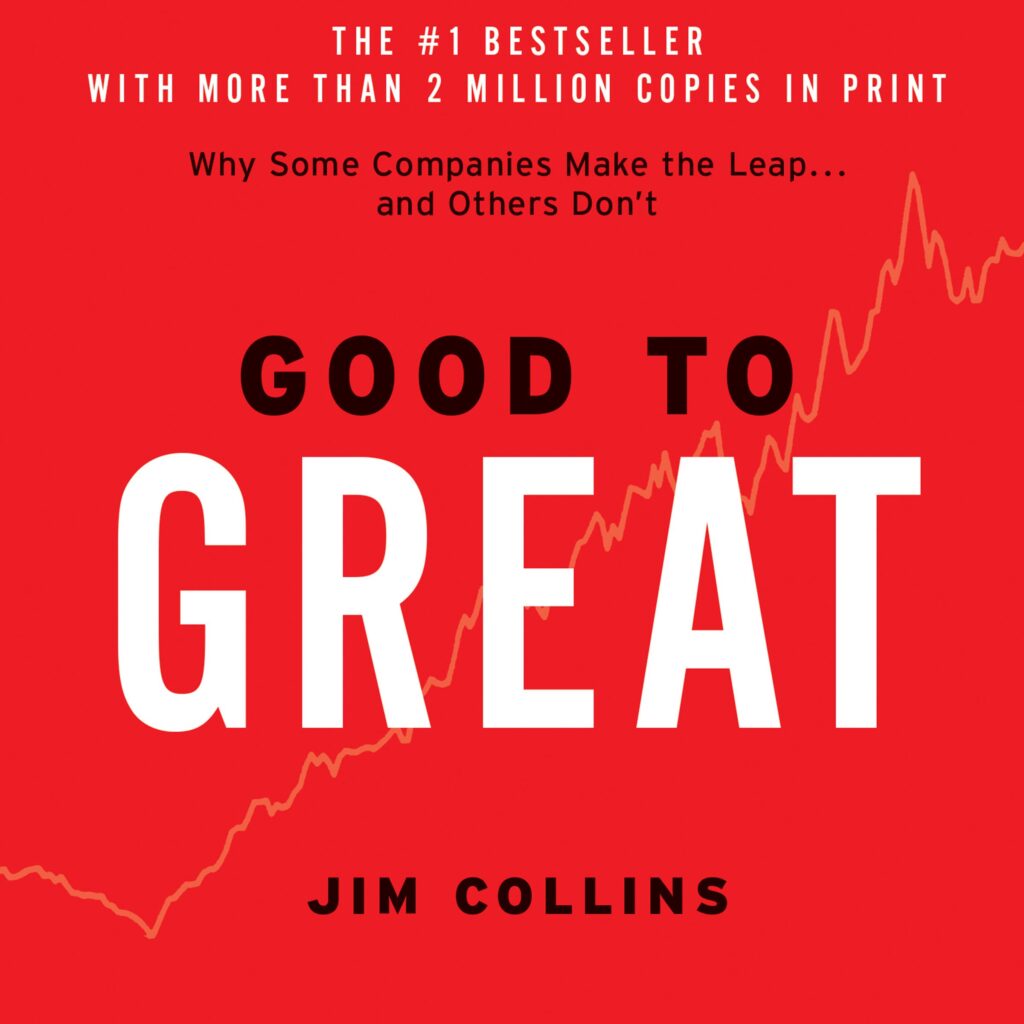
Good to Great Why Some Companies Make the Leap...And Others Don't
Can a good company become truly great? After five years of rigorous research analyzing 1,435 companies, Jim Collins and his team discovered that only eleven made the leap to greatness and sustained it for at least fifteen years. The answer isn't what you'd expect.
Forget charismatic CEOs, cutting-edge technology, or dramatic restructuring. Collins reveals that greatness comes from disciplined people engaging in disciplined thought and taking disciplined action. The companies that beat the stock market by an average of seven times shared surprising characteristics that fly in the face of modern business culture.
Discover the power of Level 5 Leadership, where personal humility meets fierce resolve. Learn why getting the right people on the bus matters more than having a vision. Understand the Hedgehog Concept, a deceptively simple framework that helps you focus on what you can be best at in the world.
This groundbreaking study examines companies like Walgreens, Wells Fargo, and Gillette to uncover timeless principles that work across any industry. Collins introduces the Flywheel Effect, showing how sustained momentum builds breakthrough results. He explains why good is the enemy of great and how a Culture of Discipline creates the magical alchemy of extraordinary performance.
Whether you lead a Fortune 500 company or a small team, these research-backed insights will transform how you think about success. Good to Great isn't just a business book. It's a blueprint for turning any organization from mediocre to exceptional.
Interesting Facts
Five Years of Research: Jim Collins and his team spent five full years conducting the research for this book, working with 21 research associates in Boulder, Colorado to analyze mountains of data and uncover what separates great companies from merely good ones.
Started with 1,435 Companies: The research team began by examining every company that ever appeared in the Fortune 500 from 1965 to 1995, systematically screening 1,435 established companies to find the rare few that made a sustained leap to greatness.
Only 11 Made the Cut: Out of those 1,435 companies, only 11 met the rigorous criteria for greatness, which required 15 years of cumulative stock returns at or below the market, followed by returns at least three times the market for the next 15 years.
Four Million Copies Sold: This business book became a massive bestseller, selling over four million copies worldwide and reaching far beyond the traditional business book audience, making it one of the best-selling management books of all time.
Published After the Dot-Com Bust: The book hit shelves on October 16, 2001, arriving just after the dot-com bubble burst when business leaders were hungry for solid, research-based wisdom rather than internet hype and quick-fix promises.
Read Over 6,000 Articles: The research team coded more than 6,000 articles, generated over 2,000 pages of interview transcripts, conducted 84 interviews with senior managers, and created 384 megabytes of computer data during their exhaustive investigation.
The Hedgehog Gets Its Name: The famous Hedgehog Concept draws its name from an ancient Greek parable popularized by philosopher Isaiah Berlin in his essay "The Hedgehog and the Fox," which states that the fox knows many things but the hedgehog knows one big thing.
Actually a Prequel: Though published seven years after Built to Last, Collins considers Good to Great to be more of a prequel, explaining how to build a good company into a great one, while Built to Last describes how to sustain greatness once achieved.
Anonymous CEOs Performed Better: The research revealed a surprising pattern: CEOs who took their companies from good to great were largely anonymous and humble, with a direct relationship between the absence of celebrity status and the presence of outstanding results.
Examined 28 Companies Total: The study analyzed 28 companies in depth, including the 11 good-to-great companies plus 17 carefully selected comparison companies that failed to make the leap, allowing researchers to identify what truly made the difference.
Took Four Years for Breakthrough: The research found that on average, it took four years for the flywheel to build enough momentum for companies to crystallize their Hedgehog Concept and begin experiencing breakthrough results, proving that greatness is a marathon, not a sprint.
Challenged Six Major Myths: Collins debunks common business myths including the need for celebrity CEOs, technology-driven change, dramatic restructuring, acquisitions as a path to greatness, the burning platform crisis, and stock options as primary motivators for transformation.
Quotes
"Good is the enemy of great."
"Great vision without great people is irrelevant."
"Level 5 leaders channel their ego needs away from themselves and into the larger goal of building a great company."
"Confront the brutal facts, yet never lose faith."
"The Hedgehog Concept requires a deep understanding of three intersecting circles: what you are deeply passionate about, what you can be the best in the world at, and what best drives your economic engine."
"Technology accelerates momentum, it doesn't create it."
"Who then what: get the right people on the bus, then figure out where to drive it."
"The moment you feel the need to tightly manage someone, you’ve made a hiring mistake."
"Great companies foster a culture of discipline with an ethic of entrepreneurship."
"Stop doing lists are more important than to do lists."
"The right people don’t need to be tightly managed or fired up; they will be self-motivated by the inner drive to produce the best results and to be part of creating something great."
"Visionary companies do not ask, 'What should we value?' They ask, 'What do we actually value deeply?'"
"A culture of discipline is not a principle of business; it is a principle of greatness."
"Good-to-great companies first got the right people on the bus, the wrong people off the bus, and the right people in the right seats."
"If you have the right people on the bus, the problem of how to motivate and manage people largely goes away."
Ratings & Reviews
What do you think?
There are no reviews yet. Be the first one to write one.