
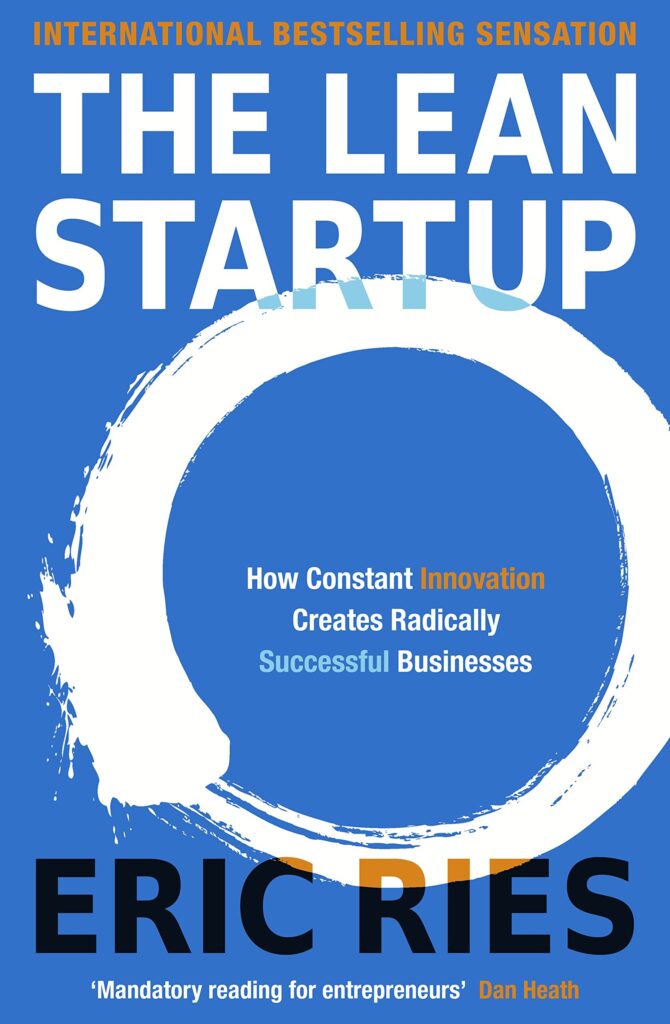
The Lean Startup How Constant Innovation Creates Radically Successful Businesses
Most startups fail.
But what if those failures were preventable? What if there was a proven method to dramatically improve your odds of building a successful business? Eric Ries reveals the revolutionary approach that's transforming how companies are built and new products are launched around the world.
The Lean Startup introduces a scientific methodology for creating and managing successful startups in an age of uncertainty. Drawing from his experience as co-founder and CTO of IMVU, Ries shows how to shorten product development cycles through rapid experimentation, validated learning, and iterative product releases. This isn't just theory, it's a battle-tested approach used by companies like Google, Toyota, and Facebook.
At the heart of this methodology is the Build-Measure-Learn feedback loop. You'll discover how to build a minimum viable product, test your fundamental business hypotheses, and make data-driven decisions about whether to pivot or persevere. Ries demonstrates how startups can achieve more by doing less, focusing relentlessly on what customers actually want rather than what you think they need.
Whether you're launching a tech startup in your garage or driving innovation inside a Fortune 500 company, The Lean Startup provides the tools to reduce waste, increase speed, and build sustainable businesses. This book will fundamentally change how you think about entrepreneurship and innovation.
Interesting Facts
Born from Real Failure: Eric Ries developed the Lean Startup methodology after experiencing multiple startup failures himself, including a company called There.com and Catalyst Recruiting, which gave him firsthand insight into what makes new ventures crash and burn.
Toyota Meets Silicon Valley: The book draws heavily from Toyota's manufacturing system, adapting principles from car factories to tech startups by applying concepts like eliminating waste and continuous improvement to building software products.
IMVU's Wild Experiment: At IMVU, Ries's company deployed code to production nearly 50 times per day, an extraordinarily fast pace that flew in the face of traditional software development wisdom and became the laboratory for his theories.
Published in 2011: The book became a New York Times bestseller and international sensation, transforming how entrepreneurs worldwide think about building companies and launching products.
Not Just for Startups: Despite the title, the book explicitly states its principles apply to organizations of all sizes, from solo entrepreneurs in garages to Fortune 500 boardrooms, making it relevant for corporate innovators too.
Harvard Business School Connection: Eric Ries served as an Entrepreneur-in-Residence at Harvard Business School, where he refined and taught his methodology to future business leaders.
The Third Startup's the Charm: IMVU was Ries's third startup attempt, and by 2011 it had grown to over $50 million in annual revenue with more than 60 million user-created avatars.
Steve Blank's Influence: The methodology integrates customer development concepts from entrepreneur Steve Blank, whose class at UC Berkeley Ries attended at an investor's insistence, fundamentally shaping the book's approach.
Giants Use It Too: Major corporations like General Electric, Toyota, Google, and Facebook have adopted Lean Startup practices, with GE's CEO Jeffrey Immelt reportedly making all managers read the book.
Media Darling: The Lean Startup methodology has been featured in The New York Times, Wall Street Journal, Harvard Business Review, and Wired, establishing it as a cultural phenomenon beyond just business circles.
Build-Measure-Learn Loop: The book centers on a core feedback cycle that emphasizes rapid experimentation and validated learning over elaborate business plans and long development cycles.
Movement Maker: Beyond the book, Ries created an entire movement with conferences, online communities, and a series of related books by other authors, making Lean Startup a living ecosystem of entrepreneurial practice.
Quotes
"Start small, think big. Scale fast."
"Success is not delivering a feature; success is learning how to solve the customer’s problem."
"Build-Measure-Learn feedback loop is at the core of the Lean Startup model."
"The only way to win is to learn faster than anyone else."
"A startup is a human institution designed to create a new product or service under conditions of extreme uncertainty."
"Validated learning is the process of demonstrating empirically that a team has discovered valuable truths about a startup’s present and future business prospects."
"Pivot is a structured course correction designed to test a new fundamental hypothesis about the product, strategy, and engine of growth."
"Entrepreneurship is management."
"If we’re building something that nobody wants, it doesn’t matter if we’re doing it on time and on budget."
"Test assumptions systematically, with a scientific approach to innovation."
"Planning is useful, but learning is essential."
"All innovation begins with vision. It’s what happens next that is critical."
"Being too early is indistinguishable from being wrong."
"The goal of a startup is to figure out the right thing to build – the thing customers want and will pay for – as quickly as possible."
"Metrics are people, too; numbers are people, too."
Ratings & Reviews
What do you think?
There are no reviews yet. Be the first one to write one.