
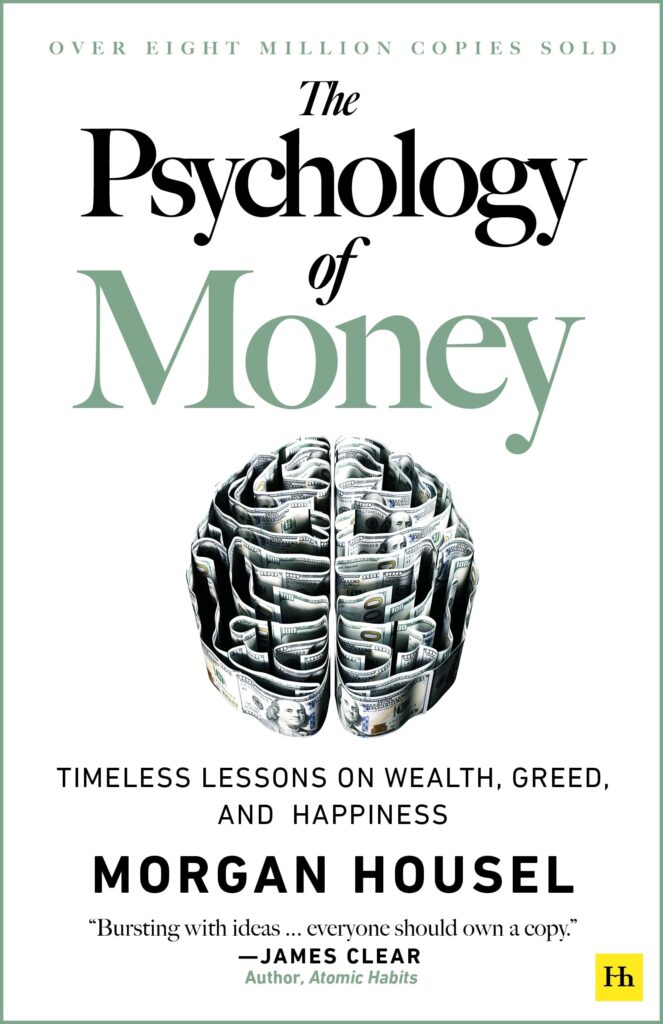
The Psychology of Money: Timeless lessons on wealth, greed, and happiness
Your relationship with money is broken, and it has nothing to do with your intelligence.
With over 8 million copies sold worldwide, The Psychology of Money has become one of the most influential personal finance books of our time. Award-winning author Morgan Housel, a partner at The Collaborative Fund and former columnist at The Wall Street Journal, reveals a powerful truth: financial success is less about what you know and more about how you behave.
Through 19 compelling short stories, Housel explores why we make irrational decisions with our hard-earned cash. He examines how emotions like fear, greed, and pride shape our financial choices far more than spreadsheets ever could. You will learn why getting wealthy and staying wealthy require completely different skills, and why the most valuable thing money can buy is control over your own time.
Housel challenges conventional wisdom at every turn. True wealth, he argues, is invisible. It is the money you do not spend, the options you keep open, and the freedom you preserve. The book shows why compounding is the most powerful force in finance and why leaving room for error matters more than chasing maximum returns.
Whether you are just starting your financial journey or looking to transform your relationship with money, this fast-paced, engaging read will change how you think about wealth, happiness, and the decisions that shape your financial future.
Interesting Facts
Over Eight Million Copies Sold: This book has become a global phenomenon. More than eight million copies have flown off shelves around the world. The book has been translated into more than 60 languages, reaching readers across continents.
Written By A Venture Capitalist: Morgan Housel is a partner at The Collaborative Fund, a venture capital firm. Before joining the VC world, he spent over a decade as a financial journalist. He wrote columns for The Motley Fool and The Wall Street Journal, earning multiple awards for his work.
Only Nineteen Short Stories: The book contains just 19 chapters, each a short story. Housel deliberately kept it brief because most single topics don't require 300 pages of explanation. He wanted readers to actually finish the book, so he made 20 short points instead of one long one people give up on.
Opens With A Janitor Millionaire: The introduction contrasts two men with opposite financial outcomes. Ronald Read was a gas station attendant and janitor who amassed $8 million through patient investing in blue chip stocks. Richard Fuscone was a Harvard-educated Merrill Lynch executive who went bankrupt in the 2008 crisis despite his prestigious education and high income.
Behavior Beats Intelligence: The central premise is that financial success is 20% knowledge and 80% behavior. A genius who loses control of their emotions can be a financial disaster, while ordinary folks with no financial education can become wealthy if they have the right behavioral skills.
Film Rights Were Optioned: Cavalry Media has optioned the film rights to The Psychology of Money. The book's storytelling approach and compelling narratives make it ripe for adaptation beyond the page.
Warren Buffett As Compounding Example: The book uses Warren Buffett to illustrate the power of time in investing. Of Buffett's $84.5 billion net worth, $81.5 billion came after his 65th birthday. His wealth isn't just from good returns but from getting good returns for an incredibly long time.
Wealth Is What You Don't See: One of the most powerful concepts is that true wealth is invisible. Someone driving a $100,000 car might be wealthy, but the only data point you have is that they have $100,000 less than before. Wealth is financial assets not yet converted into stuff you see.
Two-Time Award Winner: Morgan Housel won the Best in Business Award from the Society of American Business Editors and Writers twice. He also won the New York Times Sidney Award and was named by MarketWatch as one of the 50 most influential people in markets.
Reasonable Beats Rational: Housel argues that aiming for reasonable financial decisions beats trying to be perfectly rational. While finances can be analyzed rationally on paper, it's more realistic for most people to aim for reasonable approaches that let them sleep at night.
Ronald Read Owned 95 Stocks: The janitor millionaire held at least 95 different stocks at the time of his death. Many he had held for years, if not decades. He worked 25 years at a gas station, then 17 years as a part-time janitor at JC Penney, saving and investing consistently the entire time.
Inspired By A Blog Post: The Psychology of Money grew out of a blog post Morgan Housel wrote years earlier. His writing philosophy is to be a "selfish writer," writing first for himself to clarify his own thinking, which ironically makes the content more authentic and valuable to readers.
Sunday Times Number One Bestseller: The book topped the Sunday Times bestseller list in the UK. It has received endorsements from major figures including James Clear, author of Atomic Habits, who called it essential reading and said everyone should own a copy.
Quotes
"Use money to gain control over your time, because not having control of your time is such a powerful and universal drag on happiness." - Morgan Housel
"Nothing is as good or as bad as it seems." - Morgan Housel
"The world is filled with people who look modest but are actually wealthy and people who look rich who live at the razor’s edge of insolvency." - Morgan Housel
"Risk is what’s left over when you think you’ve thought of everything." - Morgan Housel
"You are one person in a game with seven billion other people and infinite moving parts. The accidental impact of actions outside of your control can be more consequential than the ones you consciously take." - Morgan Housel
"Getting money requires taking risks, being optimistic, and putting yourself out there. But keeping money requires the opposite of taking risk." - Morgan Housel
"There is no reason to risk what you have and need for what you don’t have and don’t need." - Morgan Housel
"Good investing is not necessarily about making good decisions. It’s about consistently not screwing up." - Morgan Housel
"Money’s greatest intrinsic value—and this can’t be overstated—is its ability to give you control over your time." - Morgan Housel
"Save. Just save. You don’t need a specific reason to save." - Morgan Housel
"one of the most powerful ways to increase your savings isn’t to raise your income. It’s to raise your humility." - Morgan Housel
"Spending money to show people how much money you have is the fastest way to have less money." - Morgan Housel
"Less ego, more wealth. Saving money is the gap between your ego and your income, and wealth is what you don’t see." - Morgan Housel
"The highest form of wealth is the ability to wake up every morning and say, “I can do whatever I want today.”" - Morgan Housel
Ratings & Reviews
What do you think?
There are no reviews yet. Be the first one to write one.