
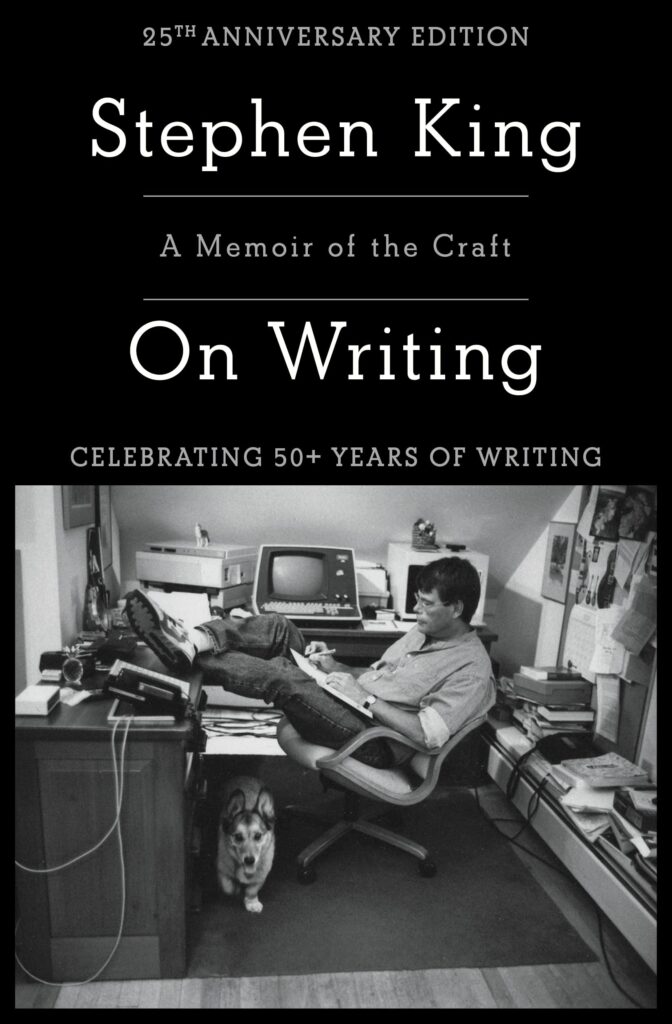
On Writing: A Memoir of the Craft
Part memoir, part master class from one of the bestselling authors of all time, On Writing: A Memoir of the Craft takes you inside the mind and methods of a literary legend. King shares the vivid memories that shaped him as a storyteller, from his childhood and early struggles to his battles with addiction and his triumphant rise to fame.
This isn't just another how-to guide. King opens his writer's toolbox and reveals the essential techniques every aspiring author needs to know. He covers vocabulary, grammar, dialogue, character development, and the art of revision with the same gripping style that has captivated millions of readers worldwide.
The book culminates with King's harrowing account of his near-fatal accident and his determined fight to return to the craft he loves. Writing, he shows us, isn't just about putting words on paper. It's about survival.
Originally published in 2000, On Writing has sold over a million copies and been named one of TIME Magazine's Top 100 Nonfiction Books of All Time. Roger Ebert praised it as having "more useful and observant things to say about the craft than any book since Strunk and White's The Elements of Style."
Whether you dream of writing your first novel or simply want to understand how a master storyteller works, this book belongs on your shelf.
Interesting Facts
Born from a near-death experience: King began writing On Writing in 1999, but a van struck him on June 19 that year while he was walking near his Maine home. He suffered a collapsed lung, multiple leg fractures, and a broken hip. The accident nearly killed him and deeply shaped the memoir's final sections.
Two books merged into one: The first half explores King's life story from childhood to fame. The second half delivers practical writing advice. Together they create something wholly unique.
Tabitha saved Carrie from the trash: King threw away the first three pages of Carrie, his breakthrough novel, because he felt uncomfortable writing about teenage girls. His wife Tabitha fished the crumpled, cigarette-ash-covered pages from the wastebasket, read them, and insisted he continue. She even helped him understand female characters better.
Writing compared to telepathy: In the book, King makes a fascinating comparison. He describes writing as a form of telepathy where he can plant images and ideas in your mind across time and space. You see what he sees simply by reading his words on a page.
The 2,000-word daily goal: King reveals his personal writing quota of 2,000 words per day, every single day, including holidays and birthdays. He believes writing less frequently causes characters to feel stale and the narrative edge to rust.
Stories as fossils to uncover: King uses a beautiful metaphor for his writing process. He sees stories as fossils already buried in the ground. His job is not to construct them but to carefully excavate them, revealing what was always there.
Roger Ebert called it essential: Film critic Roger Ebert praised On Writing, saying it had more useful things to say about the craft than any book since Strunk and White's The Elements of Style.
He wrote it longhand first: Despite being a prolific author, King drafted much of this book by hand. He found the slower pace suited memoir writing better than his usual typing.
Adverbs are the enemy: King famously declares that "the road to hell is paved with adverbs." This single piece of advice has influenced countless writers to trim their prose ruthlessly.
Serialized in The New Yorker: Before publication as a complete book, portions of On Writing were serialized in The New Yorker to vivid acclaim.
He reads constantly: King emphasizes reading as essential training. He claims to read 70 to 80 books per year. Bad books teach what not to do. Good books inspire.
Quotes
"If you want to be a writer, you must do two things above all others: read a lot and write a lot. There’s no way around these two things that I’m aware of, no shortcut." - Stephen King
"you can, you should, and if you’re brave enough to start, you will." - Stephen King
"The most interesting situations can usually be expressed as a What-if question." - Stephen King
"Description begins in the writer’s imagination, but should finish in the reader’s." - Stephen King
"The scariest moment is always just before you start." - Stephen King
"Sometimes you have to go on when you don’t feel like it, and sometimes you’re doing good work when it feels like all you’re managing is to shovel shit from a sitting position." - Stephen King
"Your job isn’t to find these ideas but to recognize them when they show up." - Stephen King
"The road to hell is paved with adverbs." - Stephen King
"I’m convinced that fear is at the root of most bad writing." - Stephen King
"Kill your darlings, kill your darlings, even when it breaks your egocentric little scribbler’s heart, kill your darlings." - Stephen King
"Writing is a lonely job. Having someone who believes in you makes a lot of difference. They don’t have to make speeches. Just believing is usually enough." - Stephen King
"Write with the door closed, rewrite with the door open." - Stephen King
"Books are a uniquely portable magic." - Stephen King
Ratings & Reviews
What do you think?
There are no reviews yet. Be the first one to write one.