
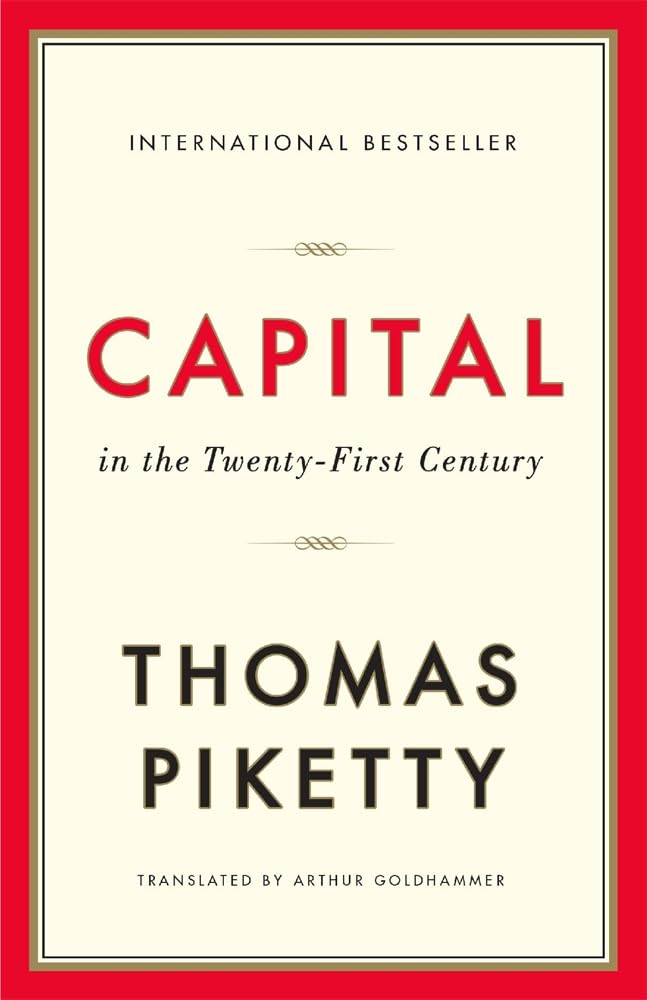
Capital in the Twenty-First Century
What happens when the rich keep getting richer while everyone else falls behind? French economist Thomas Piketty tackles this urgent question with three centuries of data from twenty countries, revealing patterns that will reshape how you understand wealth, power, and the future of capitalism.
This #1 New York Times and Wall Street Journal bestseller argues that when returns on capital outpace economic growth, wealth concentrates in fewer and fewer hands. Piketty shows that the broad middle-class prosperity following World War II was not the natural state of capitalism, but rather a brief exception. We are now returning to levels of inequality not seen since the Gilded Age.
Drawing on tax records, estate documents, and financial data spanning from the 18th century to today, Piketty constructs a sweeping narrative of how fortunes are made, inherited, and compounded. He examines how top executives have pulled away from ordinary workers and why inherited wealth increasingly dominates wealth earned through labor.
Winner of the Financial Times and McKinsey Business Book of the Year Award and finalist for the National Book Critics Circle Award, this book has sold over 1.5 million copies worldwide. Nobel laureate Paul Krugman called it "the most important economics book of the year, and maybe of the decade."
Piketty does not simply diagnose the problem. He proposes solutions, including a global wealth tax, and argues that political action has curbed dangerous inequalities before and can do so again.
Interesting Facts
Harvard's Biggest Bestseller Ever: The English edition became the greatest sales success in the 101-year history of Harvard University Press. The publisher and translator initially expected to sell maybe 20,000 copies. They were wildly wrong!
Heavier Than a Brick: The English edition runs 696 pages and weighs nearly two pounds. Yet it became a genuine bestseller, proving readers were hungry for serious economic analysis.
Three Little Characters Changed Everything: The book's central argument boils down to a deceptively simple formula: r > g. This means returns on capital typically exceed economic growth rates. When that happens, wealth concentrates at the top.
Bumped a Wall Street Thriller: When the English translation hit shelves in 2014, it knocked Michael Lewis's Flash Boys off the top of the bestseller list. An economics tome outselling a financial thriller? That's practically unheard of.
Over 2.5 Million Copies Sold: By the end of 2017, the book had sold over 2.5 million copies worldwide. It was translated into multiple languages including French, English, German, Chinese, and Spanish.
Fifteen Years of Research: Piketty based the book on fifteen years of research conducted between 1998 and 2013. He analyzed data from twenty countries spanning back to the eighteenth century.
Novels as Economic Evidence: Piketty uses Jane Austen and Honoré de Balzac novels to illustrate how inherited wealth dominated 19th-century society. He brings Elizabeth Bennet's marriage prospects and Balzac's ambitious characters into economic analysis.
The Translator's Regret: Arthur Goldhammer translated all 600 pages in just five months. He took a flat fee instead of royalties. Given the book's explosive success, he later admitted he would have made out better with royalties.
A Documentary Was Born: New Zealand filmmaker Justin Pemberton adapted the book into a feature documentary released in 2020. It earned a 93% rating on Rotten Tomatoes and features interviews with experts like Francis Fukuyama.
Called a "Political Bulldozer": When first published in French in 2013, Laurent Mauduit characterized it as "a political and theoretical bulldozer." Nobel laureate Paul Krugman called it the most important economics book of the decade.
Wars Temporarily Fixed Inequality: Piketty argues that inequality was reversed between 1930 and 1975 due to extraordinary circumstances. The two world wars, the Great Depression, and massive debt destroyed much wealth, especially among the elite.
Data Freely Available: All the charts and spreadsheets are posted online at the Paris School of Economics. Anyone can download and scrutinize his numbers.
Quotes
"When the rate of return on capital exceeds the rate of growth of output and income, as it did in the nineteenth century and seems quite likely to do again in the twenty-first, capitalism automatically generates arbitrary and unsustainable inequalities that radically undermine the meritocratic values on which democratic societies are based." - Thomas Piketty
"The dynamics of wealth distribution reveal powerful mechanisms pushing alternately toward convergence and divergence." - Thomas Piketty
"To a large extent, we have gone from a society of rentiers to a society of managers." - Thomas Piketty
"The world to come may well combine the worst of two past worlds: both very large inequality of inherited wealth and very high wage inequality justified in terms of merit and productivity." - Thomas Piketty
"When it comes to decreasing inequalities of wealth for good or reducing unusually high levels of public debt, a progressive tax on capital is generally a better tool than inflation." - Thomas Piketty
"For millions of people, “wealth” amounts to little more than a few weeks’ wages in a checking account or low-interest savings account, a car, and a few pieces of furniture." - Thomas Piketty
"Our modern democratic ideal is based on the hope that inequalities will be based on merit more than inheritance or luck." - Thomas Piketty
"The history of the distribution of wealth has always been deeply political." - Thomas Piketty
"The distribution of wealth is one of today's most widely discussed and controversial issues. But what do we really know about its evolution over the long term?" - Thomas Piketty
"At the heart of every major political upheaval lies a fiscal revolution." - Thomas Piketty
"Social distinctions can be based only on common utility." - Thomas Piketty
"Refusing to deal with numbers rarely serves the interests of the least well-off." - Thomas Piketty
"The right solution is a progressive annual tax on capital." - Thomas Piketty
"Capital is defined as the sum total of nonhuman assets that can be owned and exchanged on some market." - Thomas Piketty
Ratings & Reviews
What do you think?
There are no reviews yet. Be the first one to write one.