
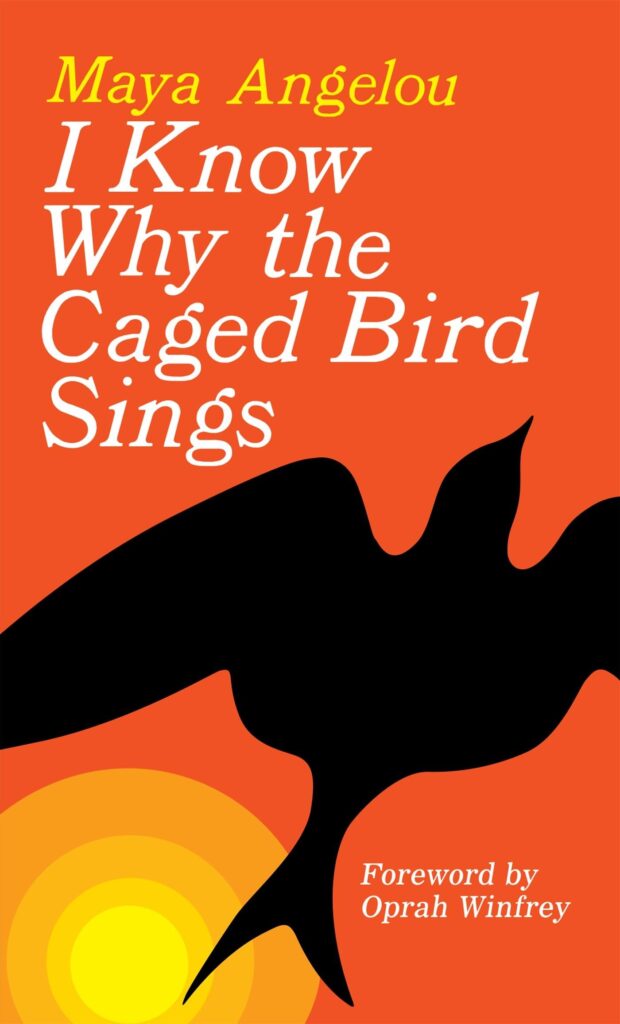
I Know Why the Caged Bird Sings
In the segregated American South of the 1930s, a young girl discovers her voice against impossible odds. Maya Angelou’s debut memoir chronicles her journey from trauma and silence to self-discovery and strength. This is the story of how a child who stopped speaking found the courage to sing.
Sent to live with her grandmother in rural Arkansas after her parents’ divorce, young Maya faces the brutal realities of racism, poverty, and devastating personal trauma. When an act of violence leaves her mute for nearly five years, she retreats into books and poetry, finding solace in language even as she refuses to speak. Through the love of her grandmother, her brother Bailey, and a teacher who recognizes her gift, Maya begins to reclaim her voice.
Angelou writes with searing honesty and lyrical beauty about the forces that tried to break her spirit and the resilience that saved her. From the dusty streets of Stamps, Arkansas to the vibrant neighborhoods of San Francisco, this coming-of-age story captures the pain and triumph of growing up Black and female in America.
A testament to the indomitable human spirit, I Know Why the Caged Bird Sings is an unforgettable portrait of courage, identity, and the transformative power of words.
Interesting Facts
Born from tragedy and friendship: Martin Luther King Jr. was assassinated on April 4, 1968, which was also Maya Angelou’s 40th birthday. Devastated by her friend’s death, Angelou was encouraged by James Baldwin to attend a dinner party at cartoonist Jules Feiffer’s home later that year, where her captivating childhood stories so impressed the guests that Random House editor Robert Loomis was contacted the very next day to convince her to write a book.
A literary dare sparked it: Angelou initially refused to write the book because she considered herself a poet and playwright, not a memoirist. Her editor Robert Loomis, advised by James Baldwin to use reverse psychology, told her it was “just as well, because to write an autobiography as literature is just about impossible.” Unable to resist a challenge, Angelou immediately began writing.
The title borrows from history: The title comes from Paul Laurence Dunbar’s 1899 poem “Sympathy,” which contains the line “I know why the caged bird sings.” Jazz musician and activist Abbey Lincoln suggested this title to Angelou. Dunbar himself wrote the poem while working at the Library of Congress, where the iron grating of the book stacks reminded him of a bird’s cage.
It launched a seven-book series: This debut memoir is the first in a seven-volume autobiographical series that Angelou wrote over 44 years, from 1969 to 2013 when she published her final autobiography at age 85. The series spans from her childhood in Arkansas to the assassination of Martin Luther King Jr.
A National Book Award nominee: The book was nominated for a National Book Award in 1970, the year after its publication, and remained on The New York Times paperback bestseller list for an impressive two years, cementing Angelou’s place in American literary history.
She was 40 when published: Angelou had already lived an extraordinarily varied life before writing her first book at age 40, having worked as a composer, singer, actor, dancer, civil rights worker, journalist, educator, and even the first Black female streetcar conductor in San Francisco at age 15.
Written in self-imposed isolation: After accepting the challenge to write the book, Angelou “closeted herself” in London for two years to complete the manuscript, sharing it with her friend, writer Jessica Mitford, before submitting it for publication in 1969.
It covers ages 3 to 16: The memoir begins when three-year-old Maya and her older brother Bailey are sent to Stamps, Arkansas to live with their grandmother after their parents’ divorce, and ends when Maya becomes a mother at age 16, documenting her transformation from a traumatized child into a self-possessed young woman.
A symbolic character for millions: Literary critics have called the young Maya “a symbolic character for every black girl growing up in America,” and the book became one of the most widely read and taught books written by an African American woman, though it has also faced frequent challenges and banning attempts in U.S. libraries.
Blurs autobiography and fiction: Reviewers often categorize the book as autobiographical fiction because Angelou uses thematic development, an episodic structure, and other techniques common to fiction. However, the prevailing critical view characterizes it as autobiography, a genre Angelou deliberately attempted to critique, change, and expand.
Literature as lifeline: The book powerfully demonstrates how literacy and the love of literature helped young Maya survive her trauma. After being raped at age eight and subsequently becoming selectively mute for nearly a year, she was introduced to books by Mrs. Bertha Flowers, and authors like Shakespeare and Dickens became her refuge and path to healing.
It made literary history: The memoir made Angelou the first African American woman to have a nonfiction bestseller, breaking barriers and forging a path for Black women’s writing that influenced generations of writers and readers worldwide.
Quotes
“There is no greater agony than bearing an untold story inside you.” – Maya Angelou
“Hoping for the best, prepared for the worst, and unsurprised by anything in between.” – Maya Angelou
“Words mean more than what is set down on paper. It takes the human voice to infuse them with shades of deeper meaning.” – Maya Angelou
“Instead, pursue the things you love doing, and then do them so well that people can’t take their eyes off you.” – Maya Angelou
“Life is going to give you just what you put in it. Put your whole heart in everything you do, and pray, then you can wait.” – Maya Angelou
“If you’re for the right thing, you do it without thinking.” – Maya Angelou
“I believe most plain girls are virtuous because of the scarcity of opportunity to be otherwise.” – Maya Angelou
“The quality of strength lined with tenderness is an unbeatable combination, as are intelligence and necessity when unblunted by formal education.” – Maya Angelou
“Ritie, don’t worry ’cause you ain’t pretty. Plenty pretty women I seen digging ditches or worse. You smart. I swear to God, I rather you have a good mind than a cute behind.” – Maya Angelou
“If growing up is painful for the Southern Black girl, being aware of her displacement is the rust on the razor that threatens the throat. It is an unnecessary insult.” – Maya Angelou
“She comprehended the perversity of life, that in the struggle lies the joy.” – Maya Angelou
“To be left alone on the tightrope of youthful unknowing is to experience the excruciating beauty of full freedom and the threat of eternal indecision.” – Maya Angelou
Ratings & Reviews
What do you think?
There are no reviews yet. Be the first one to write one.