
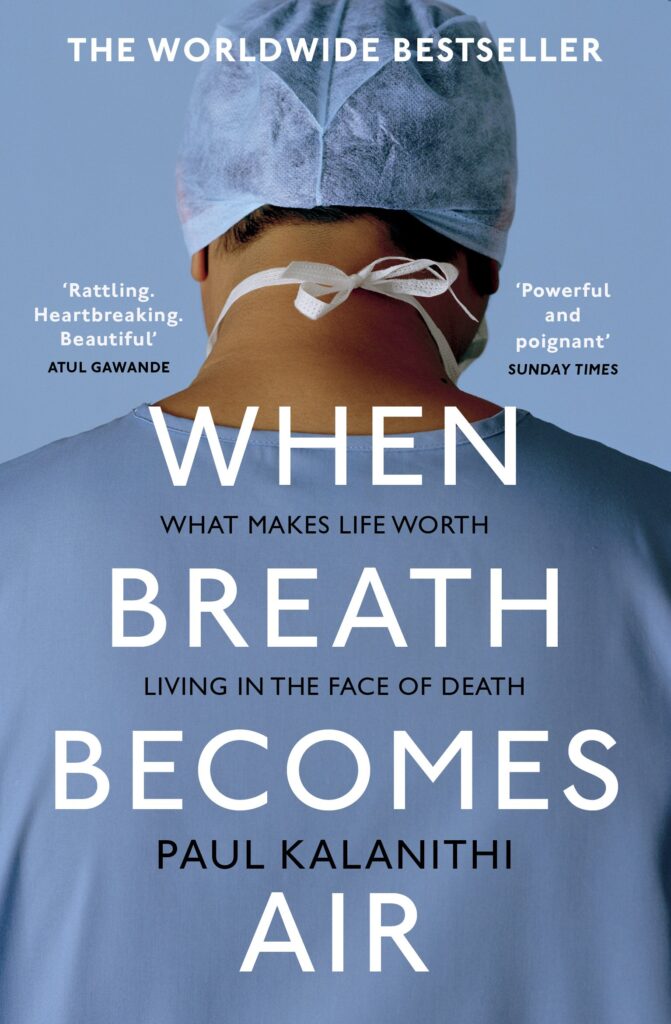
When Breath Becomes Air
At the age of thirty-six, on the verge of completing a decade of training as a neurosurgeon, Paul Kalanithi was diagnosed with stage IV lung cancer. One day he was a doctor saving lives in the operating room. The next, he was a patient fighting for his own.
When Breath Becomes Air is Kalanithi's breathtaking memoir about what happens when a brilliant mind trained to save lives must confront the end of his own. With degrees from Stanford, Cambridge, and Yale, Kalanithi had spent years grappling with the deepest questions of human existence through literature, philosophy, and medicine. Now those questions were no longer abstract.
What emerges is not a story about dying. It is a fierce, luminous exploration of what makes life worth living, written with the precision of a surgeon and the soul of a poet. Kalanithi's prose is so alive, so achingly beautiful, that you will forget you already know how this story ends.
Paul died in March 2015 while working on this manuscript, yet his words live on as a guide and gift to us all.
Interesting Facts
Written While Dying: Paul Kalanithi died in March 2015 while still working on this book, which was published posthumously just ten months later in January 2016. His wife Lucy completed the final preparations and wrote a heartbreaking epilogue to bring his unfinished manuscript to the world.
A Polymath’s Journey: Before becoming a neurosurgeon, Kalanithi earned both a bachelor’s and master’s degree in English literature from Stanford, then studied history and philosophy of science at Cambridge. He graduated cum laude from Yale Medical School, where he won the Lewis H. Nahum Prize for outstanding research.
Never Smoked, Still Got Lung Cancer: Kalanithi was diagnosed with stage IV non-small-cell EGFR-positive lung cancer at age 35 in May 2013, despite being a lifelong nonsmoker. He was in his final year of neurosurgical residency at Stanford when symptoms began.
Pulitzer Prize Finalist: The book became a Pulitzer Prize finalist and sold over two million copies. It spent 68 weeks on The New York Times bestseller list and was translated into more than 40 languages.
His Mother’s Reading List: When Paul was ten, his family moved from New York to Kingman, Arizona, which the U.S. census had declared the least educated district in America. His mother, worried about their education, obtained college prep reading lists and made him read books like 1984, which instilled in him a deep love of language.
A Daughter Named Cady: Paul and his wife Lucy had a daughter, Elizabeth Acadia (called Cady), in 2014 while Paul was battling cancer. In his final words written days before his death, he told her she had filled his dying days with a joy unknown to him in all his prior years.
Returned to Surgery: After his diagnosis, Kalanithi responded so well to the targeted therapy drug erlotinib that eight months later he had recovered enough strength to return to work as Chief Resident in Neurological Surgery at Stanford.
Samuel Beckett’s Mantra: Throughout his illness, seven words from Samuel Beckett repeated in Kalanithi’s head and became central to the book’s message: “I can’t go on. I’ll go on.” This phrase captured his determination to find meaning despite facing death.
Essays That Went Viral: Before the book’s publication, Kalanithi wrote essays for The New York Times, The Washington Post, and The Paris Review reflecting on mortality and medicine. His essay “Before I Go” received over 4 million views on The Washington Post’s website.
Quotes
"You can’t ever reach perfection, but you can believe in an asymptote toward which you are ceaselessly striving." - Paul Kalanithi
"Human knowledge is never contained in one person. It grows from the relationships we create between each other and the world, and still it is never complete." - Paul Kalanithi
"That message is simple: When you come to one of the many moments in life when you must give an account of yourself, provide a ledger of what you have been, and done, and meant to the world, do not, I pray, discount that you filled a dying man’s days with a sated joy, a joy unknown to me in all my prior years, a joy that does not hunger for more and more, but rests, satisfied. In this time, right now, that is an enormous thing." - Paul Kalanithi
"There is a moment, a cusp, when the sum of gathered experience is worn down by the details of living. We are never so wise as when we live in this moment." - Paul Kalanithi
"Will having a newborn distract from the time we have together? she asked. Don't you think saying goodbye to your child will make your death more painful? Wouldn't it be great if it did? I said. Lucy and I both felt that life wasn't about avoiding suffering." - Paul Kalanithi
"Science may provide the most useful way to organize empirical, reproducible data, but its power to do so is predicated on its inability to grasp the most central aspects of human life: hope, fear, love, hate, beauty, envy, honor, weakness, striving, suffering, virtue." - Paul Kalanithi
"I can’t go on. I’ll go on." - Paul Kalanithi
"even if I’m dying, until I actually die, I am still living." - Paul Kalanithi
"I began to realize that coming in such close contact with my own mortality had changed both nothing and everything. Before my cancer was diagnosed, I knew that someday I would die, but I didn’t know when. After the diagnosis, I knew that someday I would die, but I didn’t know when. But now I knew it acutely." - Paul Kalanithi
"The main message of Jesus, I believed, is that mercy trumps justice every time." - Paul Kalanithi
"Life wasn’t about avoiding suffering." - Paul Kalanithi
"Don’t think I ever spent a minute of any day wondering why I did this work, or whether it was worth it. The call to protect life—and not merely life but another’s identity; it is perhaps not too much to say another’s soul—was obvious in its sacredness. Before operating on a patient’s brain, I realized, I must first understand his mind: his identity, his values, what makes his life worth living, and what devastation makes it reasonable to let that life end." - Paul Kalanithi
"Years ago, it had occurred to me that Darwin and Nietzsche agreed on one thing: the defining characteristic of the organism is striving." - Paul Kalanithi
"The physician’s duty is not to stave off death or return patients to their old lives, but to take into our arms a patient and family whose lives have disintegrated and work until they can stand back up and face, and make sense of, their own existence." - Paul Kalanithi
"The tricky part of illness is that, as you go through it, your values are constantly changing. You try to figure out what matters to you, and then you keep figuring it out. It felt like someone had taken away my credit card and I was having to learn how to budget. You may decide you want to spend your time working as a neurosurgeon, but two months later, you may feel differently." - Paul Kalanithi
Ratings & Reviews
What do you think?
There are no reviews yet. Be the first one to write one.