
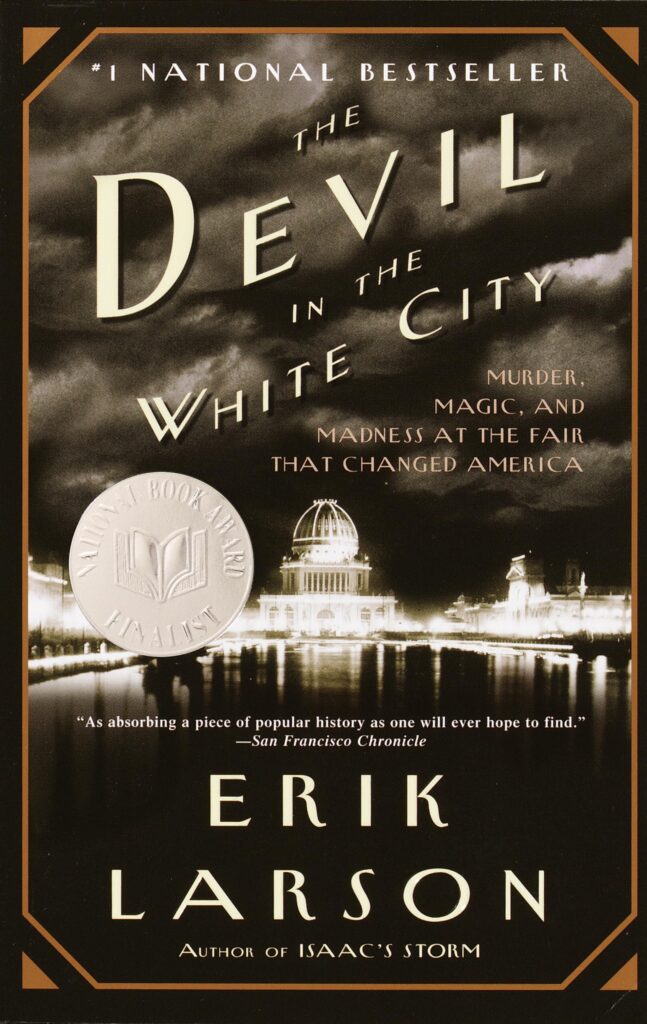
The Devil in the White City: Murder, Magic, and Madness at the Fair that Changed America
Two stories collide in 1890s Chicago, where ambition and evil walk the same streets. Architect Daniel Burnham races against impossible odds to build the 1893 World's Columbian Exposition, a gleaming White City that will prove America's greatness to the world. Just blocks away, a charming doctor named H.H. Holmes constructs his own creation: a hotel designed for murder.
As Burnham transforms swampy Jackson Park into a magnificent fairground with the help of Frederick Law Olmsted and other visionaries, Holmes lures young women to their deaths in his elaborately designed building, complete with secret passages, soundproof rooms, and a cremation furnace. The fair attracts millions of visitors and introduces the world to the Ferris wheel, but it also provides Holmes with an endless supply of victims who disappear without a trace.
Erik Larson masterfully weaves these parallel narratives together, bringing the Gilded Age to vivid life. This is the true story of the fair that changed America and the cunning serial killer who exploited its magic. With meticulous research and gripping storytelling, Larson reveals how beauty and horror existed side by side in a city rushing headlong into the twentieth century.
Interesting Facts
Two Parallel Stories Unfold: The book masterfully weaves together the tale of architect Daniel Burnham building the magnificent 1893 Chicago World's Fair and serial killer H.H. Holmes using the fair to lure victims to his death trap hotel just blocks away. These two men never met, yet their fates were forever linked by this transformative event that drew over 27 million visitors when America's total population was only 65 million!
A Massive Bestseller Success: This gripping narrative became a New York Times bestseller and was a finalist for the 2003 National Book Award for nonfiction. The book also won an Edgar Award for fact-crime writing and has collectively sold more than ten million copies alongside Larson's other works, proving that true crime mixed with architectural history creates an irresistible combination.
The White City Was Revolutionary: The fairgrounds earned the nickname "White City" because the neoclassical buildings were coated with stucco and painted white using a revolutionary compressed air spray painting technique. This magnificent display of Beaux-Arts architecture inspired the City Beautiful movement that transformed urban planning across America, from Washington D.C. to San Francisco, for decades to come.
Holmes Built a Murder Castle: H.H. Holmes constructed a three-story hotel specifically designed for killing, complete with gas jets, soundproof rooms, trap doors, acid vats, a dissection table, and a crematorium. He routinely fired construction workers before they could learn enough about his sinister purposes to report him, keeping his deadly design secret until after his capture.
The Fair Changed Everything: The 1893 World's Columbian Exposition introduced more than 27 million people to modern marvels including the first Ferris wheel (standing 264 feet tall to rival the Eiffel Tower), elevators, the zipper, Cracker Jacks, and the first voice recording. The fair ran for only six months but left an indelible mark on American culture and is even represented as a star on the Chicago flag!
A Tragic Partnership Ended: Daniel Burnham's business partner John Root, who was instrumental in designing the fair's layout, died suddenly of pneumonia in January 1891 at age 41, right in the middle of planning. Despite this devastating loss, Burnham pushed forward to complete construction of some 150 buildings on more than 600 acres, leading a workforce that reached 10,000 men.
Holmes's True Victim Count Remains Mystery: Before his execution by hanging on May 7, 1896, Holmes confessed to 27 murders, although some people he claimed to have killed were still alive. Larson estimates Holmes killed at least nine people, though some accounts suggest the number could be as high as 200. He was ultimately convicted of only one murder, that of his accomplice Benjamin Pitezel.
Only Two Buildings Survive Today: Of the more than 200 buildings created for the exposition, only two remain standing. The Palace of Fine Arts, built with brick and steel rather than plaster because nations wouldn't display art in non-fireproof buildings, now houses the Museum of Science and Industry. The Art Institute of Chicago building is the second survivor, originally used for international assemblies during the fair.
A Film in Development Hell: Leonardo DiCaprio purchased the film rights in 2010 with plans to star as Holmes, and Martin Scorsese came aboard to direct in 2015. The project has been stuck in development hell ever since, transforming from a feature film to a Hulu series with Keanu Reeves and Todd Field (which was scrapped in 2023), and back to a film again at 20th Century Studios as of January 2025.
Larson Worried It Would Ruin Him: Erik Larson feared the book would destroy his career because of its unusual style of pursuing two storylines simultaneously that never directly intersect. He also admitted in the book's notes that chapters describing Holmes's murders were merely conjecture built on a handful of facts, yet critics found the story of the fair too enchanting for even this grave misstep to doom the book.
Chicago Was Shockingly Dangerous: In the first half of 1892 alone, some 800 gruesome deaths were counted in Chicago, about four deaths every day, with murder rates among the highest in North America. A thousand trains a day brought single young women to the city seeking work as typewriters and stenographers, making them easy prey for Holmes in an era when they could disappear without anyone noticing.
Quotes
"Make no little plans; they have no magic to stir men's blood."
"It is so easy to disappear, so easy to deny knowledge, so easy in the city of Chicago to assume a new identity, to vanish through a saloon door, to pose as a newspaper reporter."
"His inherent mysteriousness invited speculation and myth."
"Chicago has become the black city…a monster, built by men, yet somehow out of the control of men."
"Beneath the smoke, the city lay spread out, with miles and miles of streets and houses, glass factories and huge stockyards, railroad tracks and lumberyards and lake steamers and coal barges."
"Holmes cast a spell on people. He was handsome, intelligent, and charming, a fast talker."
"The juxtaposition of pride and shame seemed almost as elemental as the place itself."
"Ladies and gentlemen, I will tell you this: If you want to astonish the whole world, build an extraordinary city in the middle of a swamp."
"Holmes's method was seduction, not intimidation or coercion."
"Everyday life in the city was lived at the level of crisis."
"The fairgrounds became an enchanted space, a place where the ordinary constraints were magically suspended."
"To Burnham, the fair was both a matter of honor and a labor of love."
"He loved to draw things; it was as if, with each new project, he had discovered the world anew."
"A sense of unreality pervaded everything; the city itself, gigantic and artificial, seemed like a thing from a dream."
"In Chicago, there was always a dark underbelly to the city’s glory."
Ratings & Reviews
What do you think?
There are no reviews yet. Be the first one to write one.