
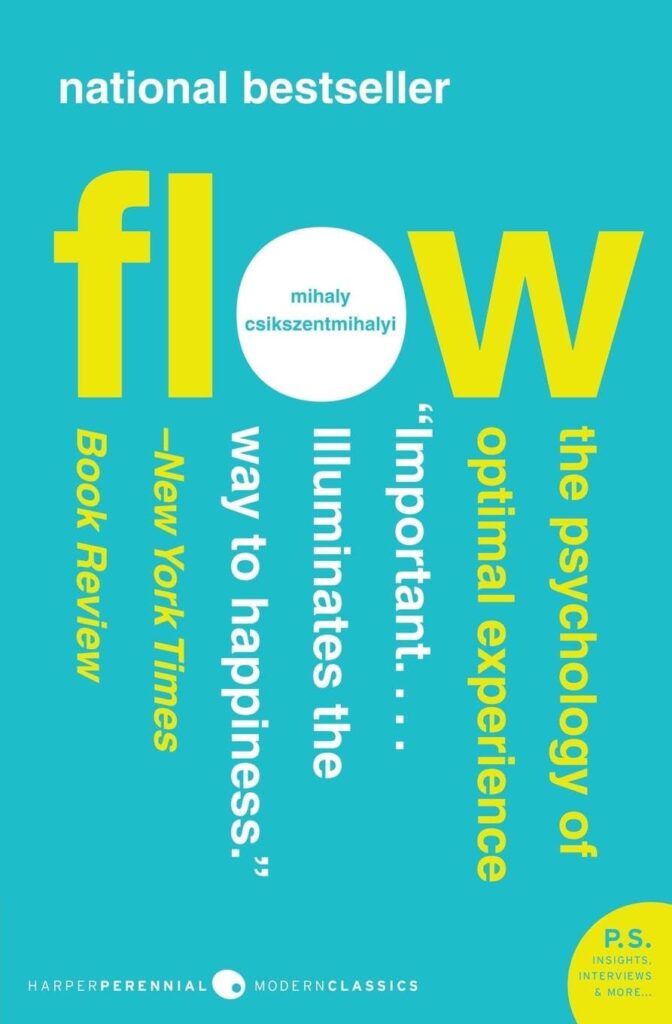
Flow: The Psychology of Optimal Experience
You've heard about how a musician loses herself in her music, how a painter becomes one with the process of painting. In work, sport, conversation, or hobby, you have experienced yourself the suspension of time, the freedom of complete absorption in activity.
This is flow. That magical state where you're so absorbed in an activity that nothing else matters.
Based on thousands of interviews, this book shows you how to achieve flow in your own life. During flow, people experience deep enjoyment, creativity, and total involvement with life. Time seems to disappear, self-consciousness fades, and you feel completely absorbed in what you're doing.
But flow isn't just left to chance. You'll learn the specific conditions that create this optimal experience. Csikszentmihalyi demonstrates how you can control this powerful state, turning everyday activities, from work to relationships to hobbies, into sources of endless creativity and fulfillment.
This isn’t about mindless pleasure or quick fixes. It’s about understanding what truly motivates people, and shaping your life to create more moments of optimal experience.
Discover how to unlock your potential, enhance creativity, reach peak performance, and greatly improve the quality of your life.
Interesting Facts
Born from War's Aftermath: Csikszentmihalyi became curious about happiness after witnessing the pain and suffering of Europeans during World War II. As a young man in post-war Europe, he watched people struggle to rebuild their lives and wondered what makes existence meaningful, a question that would define his entire career.
The Name Came from Artists: The term "flow" emerged directly from interviews in 1975 when people described their peak experiences using water metaphors. They said things like "It was like floating" and "I was carried on by the flow," leading Csikszentmihalyi to adopt this evocative name for the phenomenon.
Originally Published in 1990: The book first appeared through Harper & Row in 1990, though Csikszentmihalyi had been researching flow since the 1970s. His earlier academic work, "Beyond Boredom and Anxiety" from 1975, introduced the concept before he wrote this accessible version for general readers.
Thousands of Interviews Worldwide: The research behind Flow involved thousands of interviews across diverse national, cultural, and economic backgrounds. Csikszentmihalyi studied everyone from rock climbers and chess masters to surgeons and factory workers to understand when people felt most alive.
The Pager Revolution: Csikszentmihalyi pioneered the Experience Sampling Method, giving subjects pagers that beeped randomly throughout the day. When signaled, people recorded what they were doing and how they felt, creating an unprecedented real-time map of human happiness in everyday life.
Aristotle Opens the Book: The book begins by noting that 2,300 years ago, Aristotle concluded that more than anything else, humans seek happiness. Csikszentmihalyi uses this ancient wisdom as a launching point, arguing that despite all our technological progress, we understand happiness no better than the ancient Greeks did.
School Beats Leisure: Research revealed that adolescents experience high levels of challenge and skill more often in school than anywhere else in their lives. Paradoxically, while schools create the conditions for flow, students typically don't feel the deep concentration and enjoyment that should follow.
110 Bits Per Second: According to Csikszentmihalyi's research, the human mind can process about 110 bits of information per second. Just understanding someone speaking takes 40 to 60 bits, which explains why we can't multitask effectively during conversations.
The Autotelic Personality: The book introduces the concept of autotelic individuals (from Greek "autos" meaning self and "telos" meaning goal) who can transform any situation into a flow experience. These people find challenge and meaning even in mundane tasks, turning a repetitive factory job into an Olympic-style personal competition.
No Footnotes by Design: Csikszentmihalyi deliberately banished footnotes and dense scientific data from the book to avoid turning off general readers. He wanted the research accessible, though this aesthetic choice means the book meanders through dozens of pages of anecdotes rather than presenting compact axioms.
National Bestseller Status: Flow became a national bestseller and remains influential decades later. The book has been described by Newsweek as the work of "the leading researcher into 'flow states'" and continues to shape fields from education to business management.
Cross-Cultural Universality: While flow has been recognized as a universally valued state across every culture studied, research shows fascinating differences. Western individuals experience flow more frequently overall, but people in collectivistic societies report deeper flow during meaningful social activities connected to personal growth and future goals.
Quotes
"Control of consciousness determines the quality of life."
"The best moments in our lives are not the passive, receptive, relaxing times… The best moments usually occur if a person’s body or mind is stretched to its limits in a voluntary effort to accomplish something difficult and worthwhile."
"To overcome the anxieties and depressions of contemporary life, individuals must become independent of the social environment to the degree that they no longer respond exclusively in terms of its rewards and punishments."
"It is not the skills we actually have that determine how we feel but the way we use them."
"Happiness is not something that happens. It is not the result of good fortune or random chance. It is not something that money can buy or power command. It does not depend on outside events, but, rather, on how we interpret them."
"Flow is being completely involved in an activity for its own sake. The ego falls away. Time flies. Every action, movement, and thought follows inevitably from the previous one, like playing jazz."
"The enjoyment of life derives not from the presence of happiness, but from being involved in activities that require skill and concentration."
"How we feel about ourselves, the joy we get from living, ultimately depends directly on how the mind filters and interprets everyday experiences."
"Attention is what makes life meaningful. Attention shapes the self, and is the ultimate source of personal control."
"It is by being fully involved with every detail of our lives, whether good or bad, that we find happiness."
"One cannot enjoy doing the same thing at the same level for long. We grow either bored or frustrated; and then the desire to enjoy ourselves again pushes us to stretch our skills or to discover new opportunities for using them."
"Pleasure is an important component of the quality of life, but by itself does not bring happiness."
"A person can make himself happy, or miserable, regardless of what is actually happening 'outside,' just by changing the contents of consciousness."
"Unless a person knows how to give order to his thoughts, attention will be attracted to whatever is most problematic at the moment."
"The shape and content of life depend on how attention has been used. The mark of a person who is in control of consciousness is the ability to focus attention at will, to be oblivious to distractions, to concentrate for as long as it takes to achieve a goal, and not longer."
Ratings & Reviews
What do you think?
There are no reviews yet. Be the first one to write one.