
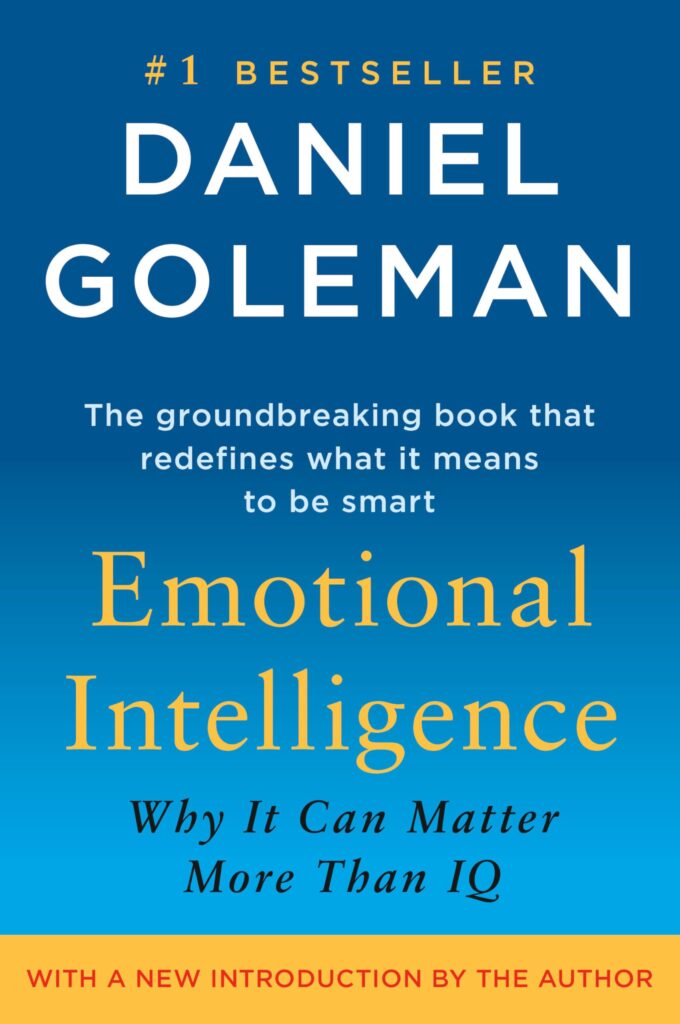
Emotional Intelligence: Why It Can Matter More Than IQ
Why does your IQ score predict so little about your real success in life? Everyone knows brilliant people who crash and burn while others with modest test scores thrive beyond all expectations. Daniel Goleman's bestseller reveals the answer: emotional intelligence matters more than you ever imagined.
Drawing on research in psychology and neuroscience, Goleman introduces us to our "two minds," the rational and the emotional, and shows how they work together to shape every aspect of our lives. He explains the fascinating mechanism of an "emotional hijacking," when our feelings overwhelm our reason and derail our best intentions. Through compelling real-world examples, he demonstrates why people with high IQs flounder while those with strong emotional skills soar.
The five crucial skills of emotional intelligence, including self-awareness, self-discipline, and empathy, determine our success in relationships, work, and even physical health. Unlike IQ, emotional intelligence isn't fixed at birth. These abilities can be taught, nurtured, and strengthened at any age, with immediate benefits to every area of your life.
This is an entirely new way to think about being smart. A vision of human possibility that every parent, teacher, and leader needs to embrace.
Interesting Facts
Bestseller for 18 Months Straight: This groundbreaking book spent a year and a half on The New York Times bestseller list, becoming a phenomenon that sparked a global movement around emotional intelligence. It's been translated into 40 languages and sold over 5 million copies worldwide, making it one of the most influential psychology books ever written.
TIME Magazine's Business Hall of Fame: TIME recognized Emotional Intelligence as one of the 25 most influential business management books of all time, proving that understanding emotions isn't just touchy-feely stuff but a revolutionary approach to workplace success.
Goleman Didn't Invent the Term: Here's a delightful twist! Daniel Goleman credits two psychology professors, John Mayer and Peter Salovey, with inventing the entire field of emotional intelligence during a casual conversation while painting a house together on a summer day. Goleman brilliantly popularized their academic work for the masses.
The Author Was a New York Times Science Reporter: Before becoming a bestselling author, Goleman spent 12 years reporting on brain and behavioral sciences for The New York Times, where he was nominated twice for the Pulitzer Prize. His journalism background gave him the perfect skill set to translate complex neuroscience into compelling stories.
IQ Only Predicts 20 Percent: The book argues that traditional IQ contributes only about 20 percent to life success, leaving a whopping 80 percent to other forces, particularly emotional intelligence. This paradigm-shattering claim challenged decades of assumptions about what makes people successful.
The Famous Marshmallow Test Connection: Goleman extensively discusses Walter Mischel's marshmallow experiments, showing how four-year-olds who could delay gratification grew up to be more emotionally intelligent adults with better life outcomes. The ability to wait for two marshmallows instead of eating one immediately predicted everything from SAT scores to healthier relationships.
He Coined "Amygdala Hijack": Goleman introduced the now-viral term "amygdala hijack" to describe those moments when our emotional brain overrides rational thinking in milliseconds, causing us to react impulsively before our logical mind can intervene. This concept has become everyday parlance in psychology and business circles.
Emotional Intelligence Can Be Taught: Unlike IQ, which remains relatively fixed, Goleman emphasizes that emotional intelligence can be nurtured and strengthened throughout our entire lives, with immediate benefits to health, relationships, and work. This hopeful message means we're not stuck with whatever emotional skills we developed in childhood.
The Book Has Five Parts: The structure takes readers on a journey from understanding the emotional brain's architecture, through the nature of emotional intelligence itself, into practical applications in marriage and workplace, then windows of opportunity in childhood, and finally emotional literacy programs that can transform society.
Published in 1995, Still Relevant Today: Though nearly 30 years old, the book's insights haven't aged because subsequent research has only strengthened Goleman's core arguments. A 25th anniversary edition was released with a new introduction, showing how emotional intelligence matters even more in our digital, automated age.
Harvard Business Review Called It Revolutionary: The prestigious Harvard Business Review described emotional intelligence as "a revolutionary, paradigm-shattering idea," validating Goleman's argument that self-awareness, empathy, and social skills matter more than technical expertise for professional success.
The Wall Street Journal Ranked Goleman Top 10: Following the book's success, The Wall Street Journal ranked Daniel Goleman as one of the 10 most influential business thinkers, transforming how the world educates children, relates to family and friends, and conducts business.
Quotes
"In a very real sense we have two minds, one that thinks and one that feels."
"If your emotional abilities aren't in hand, if you don't have self-awareness, if you are not able to manage your distressing emotions, if you can't have empathy and have effective relationships, then no matter how smart you are, you are not going to get very far."
"Being able to delay gratification is a master skill, a triumph of the reasoning brain over the impulsive one."
"The emotional brain responds to an event more quickly than the thinking brain."
"Much of emotional life is unconscious; it lies beyond self-control."
"People tend to become more angry when they feel put down, ignored, humiliated, or treated unfairly."
"The bedrock of emotional intelligence is self-awareness."
"Empathy represents the foundation skill for all the social competencies important for work."
"The ultimate act of integration for our two minds is to allow reason and feeling to work together, in harmony, for the best decisions and responses."
"Emotional self-control—delaying impulse, stifling hurtful anger—is the basis of will and character."
"The social and emotional abilities are skills that can be learned."
"Self-absorption in all its forms kills empathy, let alone compassion."
"The more a feeling is talked about, the more it tends to lose its force."
"An emotionally intelligent person is skilled in four areas: identifying emotions, using emotions, understanding emotions, and regulating emotions."
"The rules for work are changing. We're being judged by a new yardstick: not just by how smart we are, or by our training and expertise, but
Ratings & Reviews
What do you think?
There are no reviews yet. Be the first one to write one.