
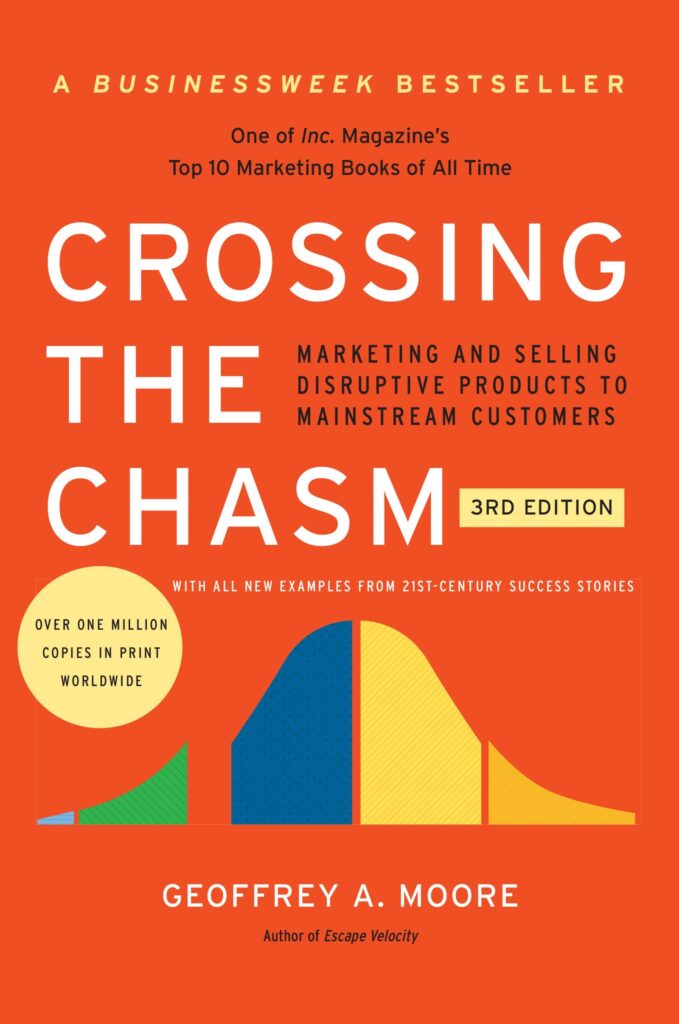
Crossing the Chasm Marketing and Selling Disruptive Products to Mainstream Customers
Why do most high-tech ventures fail?
They fall into the chasm, the vast gap between visionary early adopters and the lucrative mainstream market. If you can't cross this chasm, your technology is doomed.
With over a million copies sold, Geoffrey A. Moore's classic has become the definitive playbook for any company launching disruptive innovations. This essential guide reveals why the transition from early adopters to mainstream customers requires a completely different marketing strategy, one that most startups fatally misunderstand.
Moore introduces the Technology Adoption Life Cycle, showing how customer segments from innovators to laggards have dramatically different expectations. Early adopters will sacrifice for the advantage of being first. The early majority waits for proven productivity improvements. This fundamental disconnect creates the chasm where countless promising technologies die.
The solution? A repeatable framework for crossing this perilous gap. Learn to target a single beachhead market segment, small enough to dominate but big enough to matter. Discover how to position your whole product, build the right marketing strategy, and secure distribution channels with pragmatist buyers.
This third edition updates Moore's revolutionary insights with dozens of new examples, strategies for marketing in the digital world, and fresh guidance for today's technology landscape. Essential reading for entrepreneurs, marketers, and anyone bringing cutting-edge products to market.
Interesting Facts
From English Professor to Tech Guru: Geoffrey A. Moore earned a PhD in English literature from the University of Washington and taught English for four years at Olivet College before pivoting to a career in high tech, starting as a training specialist before transitioning into sales and marketing consulting.
Modest Expectations, Massive Success: Moore and his publisher originally thought the book would sell around 5,000 copies, but by 2002, ten years after first publication, more than 300,000 copies had been sold, and it has now sold over a million copies.
Word of Mouth Phenomenon: The book's success was entirely organic, spreading through word of mouth marketing, resonating first with high tech managers, then engineers, venture capitalists, and finally business schools, with Moore never making a single sales call to promote it.
Three Editions Over Two Decades: The book has been revised twice since its 1991 debut, with updated editions in 1999 and 2014, each bringing in dozens of new examples of successes and failures while keeping the core framework intact.
Based on Everett Rogers' Theory: The book adapts Everett Rogers' Diffusion of Innovations theory from 1962, which Moore refined to focus specifically on the unique challenges of high tech products and the dangerous gap between early adopters and the mainstream market.
Only for Discontinuous Innovations: Moore's theories specifically apply to novel or discontinuous innovations in B2B marketplaces that force significant changes in customer behavior, not to continuous innovations that customers can adopt smoothly.
The Bible of Entrepreneurial Marketing: In 2006, Tom Byers, director of the Stanford Technology Ventures Program, described it as "still the bible for entrepreneurial marketing 15 years later," cementing its status as essential reading for tech entrepreneurs.
Five Customer Segments: The book identifies five distinct customer segments in the Technology Adoption Life Cycle: innovators, early adopters, early majority, late majority, and laggards, each with dramatically different psychological profiles and purchasing behaviors.
D-Day Invasion Analogy: Moore uses the analogy of storming the beaches on D-Day from World War II to emphasize the life or death situation products face when crossing the chasm, requiring focused concentration of forces on a single beachhead.
Spawned Multiple Follow-Ups: The book's success led to several sequels including Inside the Tornado, Living on the Fault Line, and The Chasm Companion, plus the founding of three consulting firms: The Chasm Group, Chasm Institute, and TCG Advisors.
Real World Case Studies: The book provides real world examples of companies that have struggled in the chasm, making abstract concepts tangible and relatable across various industries and scenarios.
Quotes
"Chasm is a gap between the early adopters of the product and the early majority."
"Crossing the chasm requires moving from an early market dominated by a few visionary customers to a mainstream market dominated by a large group of pragmatic customers."
"The key to crossing the chasm is to focus on a specific niche market, the 'beachhead,' that can be conquered quickly."
"Visionaries are looking for a fundamental breakthrough, pragmatists are looking for an improvement."
"The goal is to secure a beachhead in a mainstream market segment and use it as a base for expansion into adjacent segments."
"The only way to win is to focus all your efforts on a single target market segment at a time."
"In the early market, the customer is buying a promise; in the mainstream market, the customer is buying a solution."
"Whole product thinking means delivering not just the core product, but everything required to achieve the compelling reason to buy."
"Entrepreneurs almost always err on the side of being too broad with their initial target market segmentation."
"The point of attack should be the market segment where you can become the market leader, not necessarily the largest segment."
"The early majority want to buy from market leaders; the difficulty is that there are none until the chasm is crossed."
"Word of mouth is the market’s way of learning how to buy new technology."
"Disruptive innovations require different marketing techniques compared to sustaining innovations."
"Building a market is different from building a product."
"Winning the battle for the initial target segment is the critical step in becoming the market leader."
Ratings & Reviews
What do you think?
There are no reviews yet. Be the first one to write one.