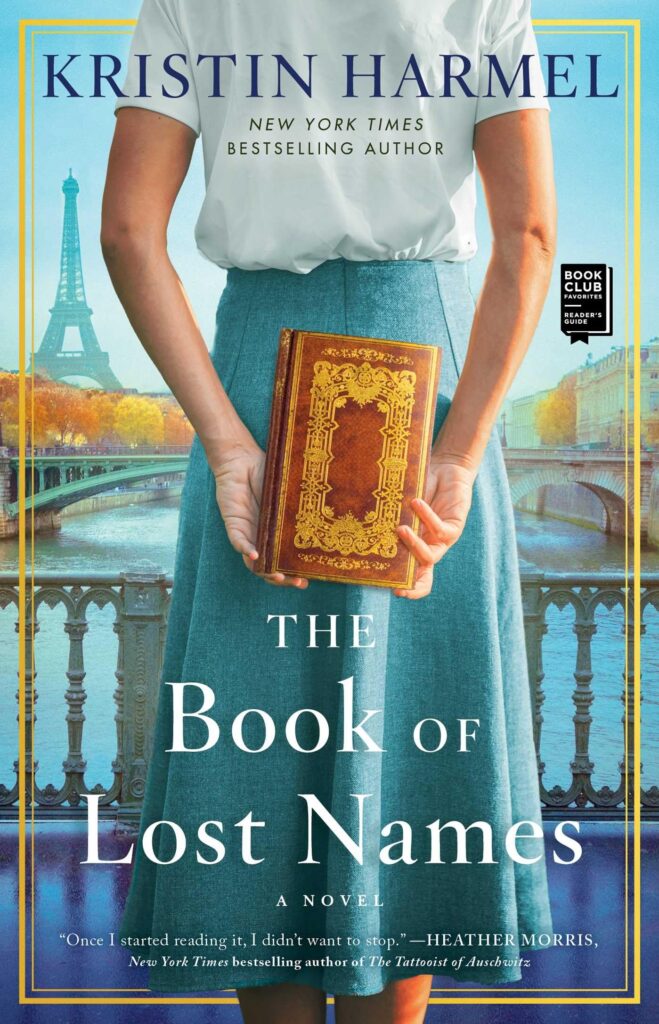
The Book of Lost Names
Eva is a young Jewish woman in occupied France with an extraordinary skill: she can forge documents that look completely authentic. When she joins the French Resistance, her talent becomes a lifeline. She creates new identities for Jewish children being smuggled to safety across the border.
But Eva does something remarkable. She keeps a secret record of every child's true name, hidden in code within the pages of an old religious text. Because names matter. Identity matters. And someday, these children will need to know who they really are.
The story moves between Eva's wartime heroics and her present-day life as a semi-retired librarian in Florida. When she spots a familiar book in a newspaper photograph, decades of buried memories come rushing back. What follows is a journey back through memory, courage, and sacrifice.
Inspired by the true stories of real WWII forgers who saved thousands of lives, this novel delivers everything I want in historical fiction. A courageous heroine. Heart-pounding danger. A tender romance that blooms in impossible circumstances. And questions about identity, sacrifice, and the stories we keep hidden.
Perfect for fans of The Nightingale, The Alice Network, and Lilac Girls.
Interesting Facts
Inspired by Real Forgers: The story draws from the true work of document forgers in the French Resistance during World War II. These brave individuals created false papers that helped thousands of Jewish children and adults escape Nazi-occupied France to safety in Switzerland.
Fibonacci Sequence Creates Secret Code: The characters use the Fibonacci sequence to encode children's real names in an 18th-century religious text. Author Kristin Harmel revealed she used to run the Fibonacci sequence in her head as a mental exercise before bed, and 30 years later it became the perfect code for her novel.
Published in Over 30 Languages: The Book of Lost Names became an international bestseller and has been translated into more than 30 languages worldwide. The novel reached number one on bestseller lists in multiple countries.
Two Timelines: The novel alternates between 1942 wartime France and 2005 Florida. Eva Traube is 23 when she forges documents during the war, then 86 when she sees her lost book in a newspaper photograph.
Harmel Started as a Sportswriter: Kristin Harmel began writing professionally at age 16, covering Major League Baseball and NHL hockey. She later became a reporter for People magazine before turning to historical fiction.
Real Forger Saved 14,000 Lives: Adolfo Kaminsky, one of the real-life forgers who inspired the novel, joined the French Resistance at 17. He and his fellow resistance members saved an estimated 14,000 Jewish lives using forged documents.
The Book Hides in Plain Sight: In the story, Eva and Rémy hide their coded records inside an old religious book in a church library. The Nazis would never suspect a dusty Catholic tome contained secret Jewish identities.
Chemistry Meets Art in Forgery: The novel details the fascinating technical aspects of document forgery, including using lactic acid to remove ink and understanding different paper types. Eva combines her artistic talent with Rémy's chemistry knowledge.
Harmel Researched Extensively: The author's note lists numerous books Harmel studied, including "Adolfo Kaminsky: A Forger's Life" and "A Good Place to Hide." She wanted to honor the real heroes whose stories inspired her fiction.
Argentina Protected Some Jews: The novel explores the historically accurate relationship between Nazi Germany and neutral Argentina. Jews with Argentine citizenship were exempt from concentration camps, a detail that features in a key plot thread.
Eva Works in Winter Park: The present-day scenes take place at the Winter Park Public Library in Florida, where Eva works as a semi-retired librarian. This is near Orlando, where author Kristin Harmel lives.
Compared to The Nightingale: Many reviewers and readers have drawn parallels between this novel and Kristin Hannah's "The Nightingale." Both feature strong female protagonists working with the French Resistance during World War II.
Quotes
"...we are only responsible for the things we do—or fail to do—ourselves." - Kristin Harmel
"The path of life is darkest when we choose to walk it alone." - Kristin Harmel
"every parent wants what is best for his or her child. But we are all guilty of seeing things through the lens of our own lives." - Kristin Harmel
"But if we shrink from them, if we lose our goodness, we let them erase us. We cannot do that, Eva. We cannot." - Kristin Harmel
"parents make all sorts of errors, because our ability to raise our children is always colored by the lives we’ve lived before they came along." - Kristin Harmel
"They are erasing us, and we are helping them." - Kristin Harmel
"You are betraying nothing if you follow your heart." - Kristin Harmel
"I would rather die knowing I tried to do the right thing than live knowing I had turned my back." - Kristin Harmel
"Once you've fallen in love with books, their presence can make you feel at home anywhere, even in places where you don't belong." - Kristin Harmel
"anyone who saw the magic in books had to be good." - Kristin Harmel
"Hope was a dangerous thief, stealing her today's for a tomorrow that would never come." - Kristin Harmel
"Because books bring us to another time and place, and you look as if you need that." - Kristin Harmel
"I’ve always thought that it’s those children—the ones who realize that books are magic—who will have the brightest lives." - Kristin Harmel
Ratings & Reviews
What do you think?
There are no reviews yet. Be the first one to write one.