
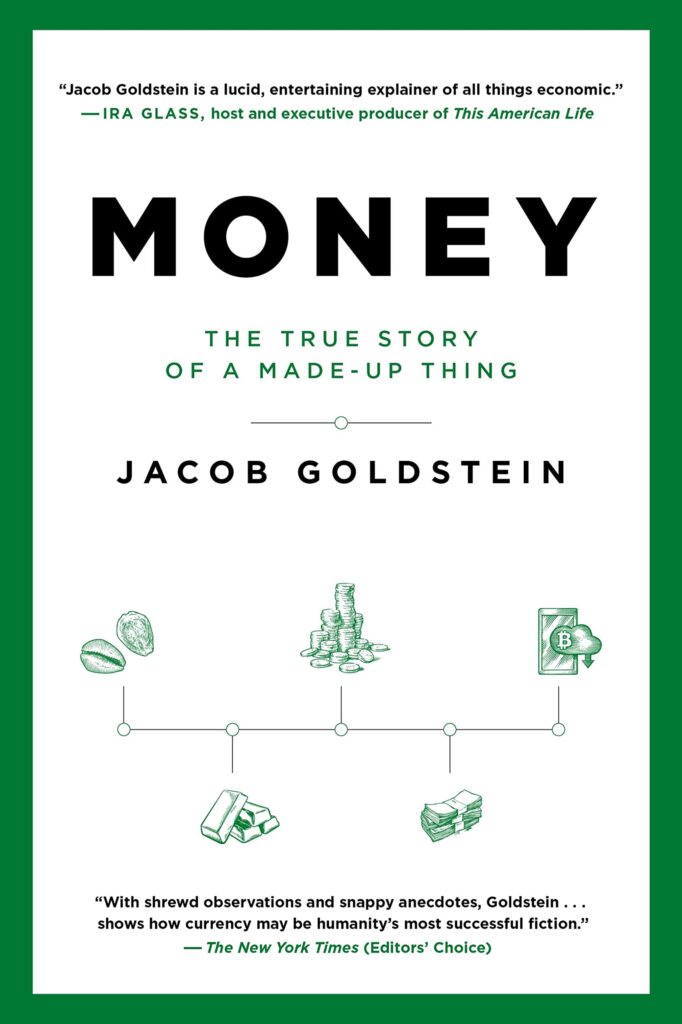
Money: The True Story of a Made-Up Thing
Everything you've ever believed about money is a collective hallucination.
Money only works because we all agree to believe in it. It's humanity's most successful fiction, and its history is wilder than you'd ever guess. Jacob Goldstein, host of NPR's Planet Money, takes you on a thrilling ride through the strange, scandalous history of money.
Travel from ancient Greece, where the first coins sparked an economic revolution, to medieval China, where Kublai Khan created paper money backed by nothing centuries before the West caught on. Meet John Law, the professional gambler and convicted murderer who brought modern money to France and promptly destroyed its economy. Follow the cypherpunks, radical libertarian programmers who paved the way for bitcoin.
Along the way, you'll encounter 43-pound copper coins that 17th-century Swedes strapped to their backs and learn why Santa Claus once appeared on American currency. Goldstein explains how FDR took America off the gold standard, why the 2008 financial crisis made trillions of dollars vanish into thin air, and what the future of money might look like.
Money is fast-paced, funny, and surprisingly human. Whether you're a finance junkie or have never read a word about economics, this book will change how you think about the bills in your wallet.
Interesting Facts
Money Is a Shared Fiction: Goldstein's entire thesis rests on a beautifully simple idea. Money only works because we all collectively agree to believe in it. The moment that trust evaporates, so does the money.
A Poet Sparked The Idea: The book was born from a 2008 conversation with Goldstein's aunt, a poet with an MBA. When he asked where trillions of dollars disappeared during the financial crisis, she said money is fiction and was never really there.
Sweden Had 43-Pound Coins: In 17th-century Sweden, people literally strapped massive copper coins to their backs to make purchases. This absurdity helped drive the invention of lighter paper alternatives.
Santa Claus Was on Money: During the free banking era of the 1840s and 1850s, any bank could print its own money. There were roughly 8,370 different varieties of paper currency circulating in America. Some of those bills even featured images of Santa Claus on them. Merchants subscribed to special magazines just to figure out which bills were real.
Accountants Invented Writing: Here's a delicious twist! The first writers weren't poets spinning epic tales. They were accountants tracking debts. For a long time, writing was nothing but IOUs and records of who owed what to whom.
Barter Is a Myth: Goldstein argues that money did not evolve from barter economies, despite what most economics textbooks claim. There is actually no solid evidence that widespread barter societies ever existed before money came along.
China Invented Paper Money First: Paper money first appeared in China around 1000 AD in Sichuan province. They used iron coins so heavy that buying a pound of salt required carrying a pound and a half of iron.
China Later Abandoned Paper Money: After leading the world in monetary innovation, China eventually gave up on paper money due to repeated inflation problems. An emperor decided to return to grain-based taxation.
A Convicted Murderer Shaped Finance: John Law, a Scottish gambler and convicted killer, brought modern banking to France in the early 1700s. He also crashed their entire economy. Goldstein calls him one of history's most influential monetary innovators.
Cypherpunks Paved Bitcoin's Path: A group of radical libertarian computer programmers called the cypherpunks laid the groundwork for bitcoin. Goldstein traces a direct line from their rebellious ideas to modern cryptocurrency.
Quotes
"Money feels cold and mathematical and outside the realm of fuzzy human relationships. It isn’t. Money is a made-up thing, a shared fiction." - Jacob Goldstein
"The thing that makes money money is trust - when we trust that we will be able to buy stuff with this piece of paper, or this lump of metal, tomorrow, and next month, and next year." - Jacob Goldstein
"The origin of money isn't what we thought it was; the story is more messy and bloody and interesting." - Jacob Goldstein
"Our dollar is now simply a fixed weight of gold - a unit of weight, masquerading as a unit of value. What good does it do us to be assured that our dollar weighs just as much as ever? Does this fact help us in the least to bear the high cost of living? What we really want to know is whether the dollar buys as much as ever." - Jacob Goldstein
"The essence of finance is time travel," the banker-turned-writer Matt Levine wrote. "Saving is about moving resources from the present into the future; financing is about moving resources from the future back into the present."
- Jacob Goldstein
"This theory - that money emerged from barter - is elegant and powerful and intuitive, but it suffers from one key weakness: there's no evidence that it's true." - Jacob Goldstein
"Money is fiction." - Jacob Goldstein
"Money isn't just some accounting device that makes exchange and saving more convenient. It's a deep part of the social fabric, bound up with blood and lust." - Jacob Goldstein
"Money is fundamentally, unalterably social." - Jacob Goldstein
"Saving is about moving resources from the present into the future; financing is about moving resources from the future back into the present." - Jacob Goldstein
"The barter story reduces money to something cold and simple and objective: a tool for impersonal exchange. In fact, money is something much deeper and more complex." - Jacob Goldstein
Ratings & Reviews
What do you think?
There are no reviews yet. Be the first one to write one.