
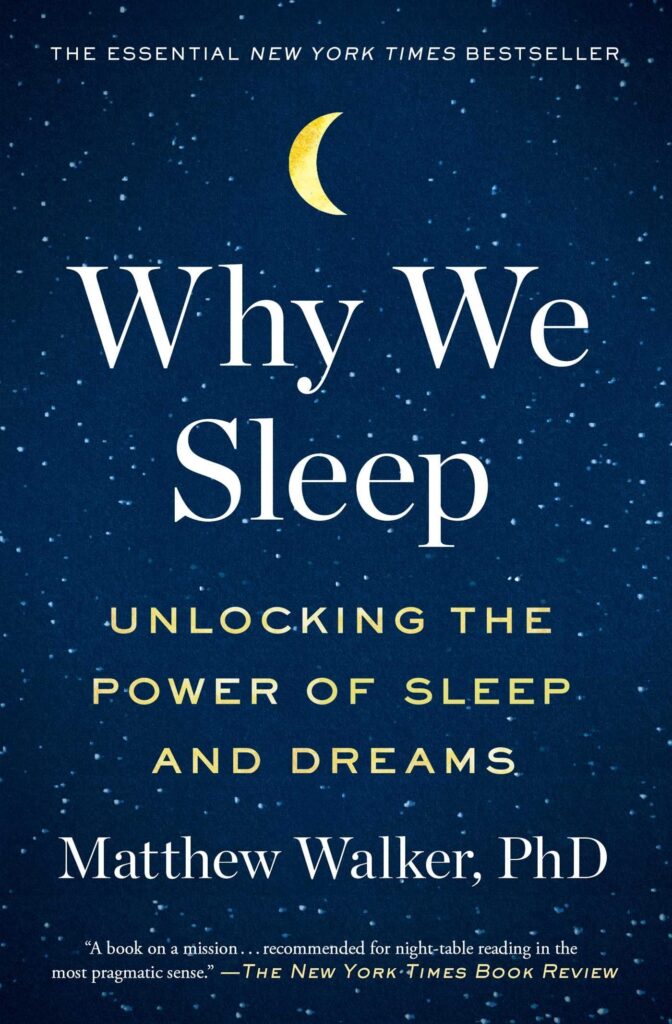
Why We Sleep: Unlocking the Power of Sleep and Dreams
You spend one-third of your life asleep, yet until recently, science couldn't explain why this mysterious state exists at all.
In this New York Times bestseller, neuroscientist Matthew Walker, founder and director of UC Berkeley's Center for Human Sleep Science, draws on decades of research to reveal how sleep transforms every aspect of our existence.
Within the brain, sleep enriches your ability to learn, memorize, and make logical decisions. It recalibrates emotions, restocks your immune system, fine-tunes metabolism, and regulates appetite. Dreaming creates a virtual reality space where the brain blends past and present knowledge to inspire creativity.
Walker answers the questions that matter: How do caffeine and alcohol affect sleep? What really happens during REM sleep? Why do sleep patterns change across a lifetime? Can common sleep aids cause long-term damage?
The consequences of sleep deprivation are severe. Reduced productivity, compromised happiness, and increased risk of diseases from cancer to Alzheimer's await those who shortchange their rest. Walker explains how we can harness sleep to improve learning, mood, and energy levels while slowing the effects of aging and increasing longevity.
Written by a former Harvard Medical School professor who has published over 100 scientific studies, this book provides both the science and the practical strategies to transform your nights and revolutionize your days.
Interesting Facts
Author's First Book Ever: Matthew Walker had never written a book before Why We Sleep. The project took him roughly four and a half years to complete. He was motivated to write it after a woman glanced at his sleep research and expressed excitement about when it would be published. Walker described this encounter as sincere validation that pushed him to share his decades of research with the world.
Bill Gates Loved It: Why We Sleep became a New York Times and Sunday Times bestseller. Bill Gates praised the book, saying Walker taught him a lot about this basic activity that every person on Earth needs. The book was named one of NPR's favorite books of 2017 and received widespread mainstream acclaim.
Dreams Are Overnight Therapy: Walker reveals that REM sleep acts like emotional first aid. During dreaming, your brain reprocesses painful experiences while stripping away the sharp emotional sting.
Read It Any Way You Want: The book is structured so you don't have to read it sequentially. Reviewers praised its flexible formatting, noting you can read it from cover to cover or cherry-pick chapters in whatever order you choose. Walker divided it into four parts covering how sleep works, its benefits, dreams, and societal sleep issues.
Sleep Cleans Your Brain: Your brain has its own waste removal system called the glymphatic system. It kicks into high gear during deep sleep, flushing out toxic proteins linked to Alzheimer's.
Caffeine Lingers Longer Than You Think: The book explains that caffeine has a half-life of five to seven hours. If you drink coffee at 2pm, roughly a quarter of that caffeine is still circulating in your system at midnight. This persistent presence can reduce the quality of your deep sleep even when you do manage to fall asleep.
Morning People And Night Owls Are Real: The book discusses chronotypes, explaining that people are genuinely either morning types or evening types. This preference is strongly determined by genetics. Walker writes about how this variation benefited human ancestors who slept in groups, as having different sleep schedules made them safer.
Sleep Debt Cannot Be Repaid: Walker emphasizes that lost sleep cannot be recovered later. When humans lose sleep, they can never sleep back what was previously lost. This is described as one of the most important takeaways from the book, with saddening consequences for health and cognitive function.
Humans Are The Only Species That Deliberately Skip Sleep: The book points out that human beings are the only species that will deliberately deprive themselves of sleep without legitimate gain. Walker emphasizes that there is no major organ or process in the brain that is not optimally enhanced by sleep.
Short Sleep Shortens Life: Adults sleeping less than six hours per night show significantly increased mortality risk. Walker found links to cancer, heart disease, diabetes, obesity, and mental illness.
Quotes
"The best bridge between despair and hope is a good night's sleep." - Matthew Walker
"When sleep is abundant, minds flourish. When it is deficient, they don't." - Matthew Walker
"REM-sleep dreaming takes the painful sting out of difficult, even traumatic, emotional episodes you have experienced during the day, offering emotional resolution when you awake the next morning." - Matthew Walker
"The leading causes of disease and death in developed nations - diseases that are crippling health-care systems, such as heart disease, obesity, dementia, diabetes, and cancer - all have recognized links to insufficient or disrupted sleep." - Matthew Walker
"Sleep is the single most effective thing we can do to reset our brain and body health each day - Mother Nature's best effort yet at contra-death." - Matthew Walker
"Humans are not sleeping the way nature intended. The number of sleep bouts, the duration of sleep, and when sleep occurs have all been comprehensively distorted by modernity." - Matthew Walker
"Sleep remained one of the last great biological mysteries." - Matthew Walker
"Sleep is the greatest legal performance-enhancing 'drug' that most people are probably neglecting." - Matthew Walker
"The number of people who can survive on five hours of sleep or less without any impairment, expressed as a percent of the population, and rounded to a whole number, is zero." - Matthew Walker
"Our lack of sleep is a slow form of self-euthanasia." - Matthew Walker
"Practice does not make perfect. It is practice, followed by a night of sleep, that leads to perfection." - Matthew Walker
"I believe it is time for us to reclaim our right to a full night of sleep, without embarrassment or the damaging stigma of laziness." - Matthew Walker
"Inadequate sleep - even moderate reductions for just one week - disrupts blood sugar levels so profoundly that you would be classified as pre-diabetic." - Matthew Walker
"If sleep does not serve an absolutely vital function, then it is the biggest mistake the evolutionary process has ever made." - Matthew Walker
Ratings & Reviews
What do you think?
There are no reviews yet. Be the first one to write one.