
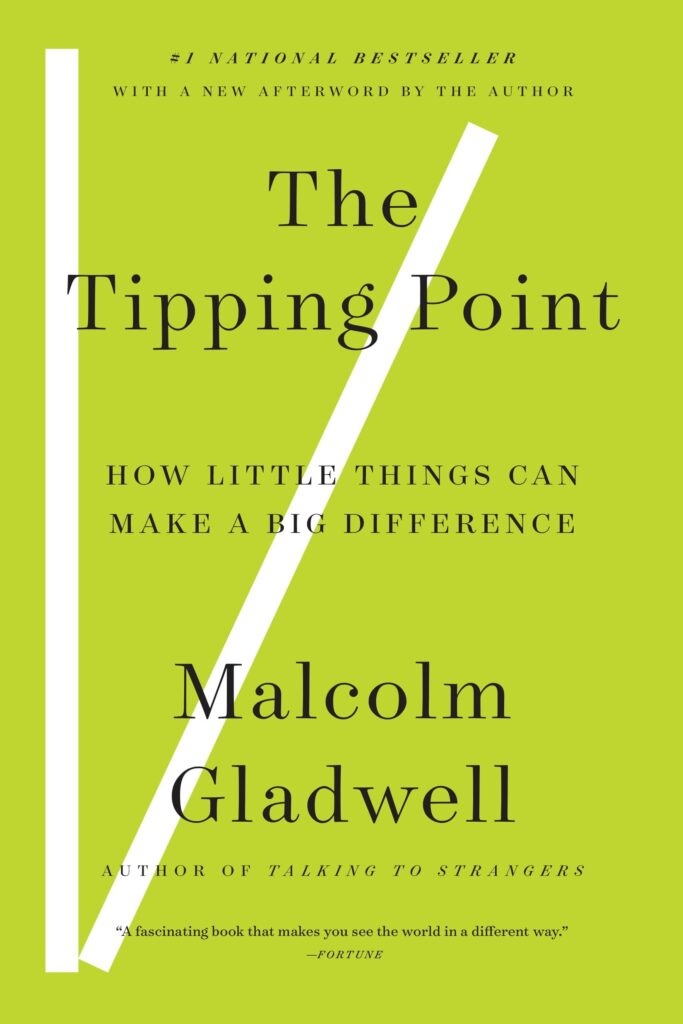
The Tipping Point: How Little Things Can Make a Big Difference
Why did Hush Puppies suddenly become the hottest shoe in America? How did a unknown novel become a bestselling phenomenon overnight? Malcolm Gladwell reveals the hidden patterns behind these explosive cultural shifts in this groundbreaking exploration of social epidemics.
The Tipping Point introduces three simple rules that explain how ideas, products, and behaviors spread like viruses through society. Gladwell shows how small changes can have massive effects, from the dramatic drop in New York City crime rates to the unexpected success of children's television shows. You'll discover why certain people (Connectors, Mavens, and Salesmen) hold disproportionate power in creating trends, and how the context of any situation can be more important than the message itself.
Drawing on fascinating case studies from business, education, and public health, Gladwell demonstrates that epidemics are not random. They follow identifiable patterns that anyone can learn to recognize and even create. Whether you're marketing a product, spreading an idea, or trying to understand why things go viral, this book will fundamentally change how you see the world around you.
Interesting Facts
Gladwell's Debut Became a Phenomenon: The Tipping Point was Malcolm Gladwell's first book, published in 2000, and it became a massive bestseller that sold 1.7 million copies by 2006. The book earned him an advance of up to $1.5 million and transformed him into a sought-after speaker who could command $40,000 per lecture. This debut work launched his career as one of the most influential popular nonfiction writers of our time.
Hush Puppies Exploded Without Marketing: One of the most delightful examples in the book is how Hush Puppies shoes went from selling just 30,000 pairs annually in the early 1990s to 430,000 pairs in 1995, then quadrupling to over 2 million by 1996. The company did absolutely nothing to cause this explosion! A handful of hipsters in Manhattan's East Village started wearing the unfashionable shoes precisely because nobody else would, and fashion designers noticed, creating an unstoppable trend.
Three Types of People Spread Ideas: Gladwell identifies three crucial personality types who make trends happen. Connectors are social butterflies with networks of over 100 people who link different social worlds together. Mavens are information specialists who accumulate knowledge and love sharing it to help others. Salesmen are charismatic persuaders with an irresistible energy that makes people want to agree with them. All three types working together create the perfect storm for an idea to go viral.
The Rule of 150 Limits Groups: Gladwell introduces Dunbar's number, calling it the "rule of 150," which suggests that humans can only maintain about 150 stable social relationships. He uses fascinating examples like how W.L. Gore and Associates discovered through trial and error that keeping buildings under 150 employees prevented social problems, and how Neolithic villages, Roman army units, and even modern Christmas card lists all hover around this magic number.
Paul Revere Succeeded Where Others Failed: The book brilliantly explains why Paul Revere's midnight ride became legendary while William Dawes, who rode the same night with the same message, is forgotten. Revere was a connector, maven, and salesman rolled into one superstar messenger. He knew everyone, understood the political situation deeply, and could persuade people to act. Dawes was just a regular guy delivering a message.
Stanley Milgram's Experiment Inspired the Theory: Gladwell built his "Law of the Few" concept on a 1967 experiment where psychologist Stanley Milgram had students in Nebraska send letters to a Boston stockbroker through chains of acquaintances. The letters took an average of six links to arrive, but here's the kicker: just three friends of the stockbroker provided the final connection for half of all successfully delivered letters. This proved certain people are disproportionately important for spreading information.
New York Crime Dropped Through Small Changes: The book explores how New York City's crime rate plummeted after 1990 not through massive reforms but by fixing small things like graffiti on subway cars and cracking down on fare evasion. This "broken windows" approach showed that context matters enormously. Cleaning up minor signs of disorder sent a powerful message that changed the entire environment and people's behavior within it.
Sesame Street Cracked the Stickiness Code: Gladwell reveals how children's shows like Sesame Street and Blue's Clues pioneered what he calls the "stickiness factor" through relentless testing of tiny details. They discovered that kids don't look away when bored but when confused, so they obsessively tweaked every element to maximize comprehension and retention. Small changes in presentation made these shows unforgettable and educational.
Yawning Proves Ideas Are Contagious: In a delightfully meta moment, Gladwell demonstrates contagion by writing about yawning, knowing that many readers will yawn just from reading the word repeatedly. He uses this to show that behaviors and ideas spread like viruses, not just through logic but through subtle, almost involuntary transmission. It's a perfect illustration of how epidemics work in ways we barely notice.
The Book Sparked Academic Debate: Economist Steven Levitt and Gladwell have had an ongoing friendly dispute about the New York crime drop, with Levitt arguing in Freakonomics that other factors like increased police numbers and demographic changes were more important than the broken windows theory. This intellectual sparring shows how The Tipping Point generated serious academic discussion about social change.
A Sequel Arrived 24 Years Later: In 2024, Gladwell released Revenge of the Tipping Point, revisiting his original ideas with a darker, more cautious perspective. At 61, he admits he's less optimistic than when he wrote the original, now exploring how tipping points can spread negative behaviors like the opioid epidemic.
Quotes
"The tipping point is that magic moment when an idea, trend, or social behavior crosses a threshold, tips, and spreads like wildfire."
"Small changes can make a big difference."
"Look at the world around you. It may seem like an immovable, implacable place. It is not. With the slightest push—in just the right place—it can be tipped."
"Emotion is contagious."
"The Law of the Few says that a tiny percentage of people do the majority of the work."
"Connectors are people with a special gift for bringing the world together."
"Mavens are information specialists, the people we rely upon to connect us with new information."
"Salesmen are the select group of people with the skills to persuade us when we are unconvinced of what we are hearing."
"People are more than just the sum of their life experiences."
"Once you reach a certain threshold, the idea, product, or message spreads exponentially."
"To appreciate the power of context is to appreciate how subtle the influences that govern our behavior are."
"Change isn’t about one dramatic moment, it’s about a series of small moments."
"We are actually influenced by our environment and the people around us far more than we realize."
"A tweak in the environment can create a tipping point for change."
"The world does not accord with our intuition."
Ratings & Reviews
What do you think?
There are no reviews yet. Be the first one to write one.