
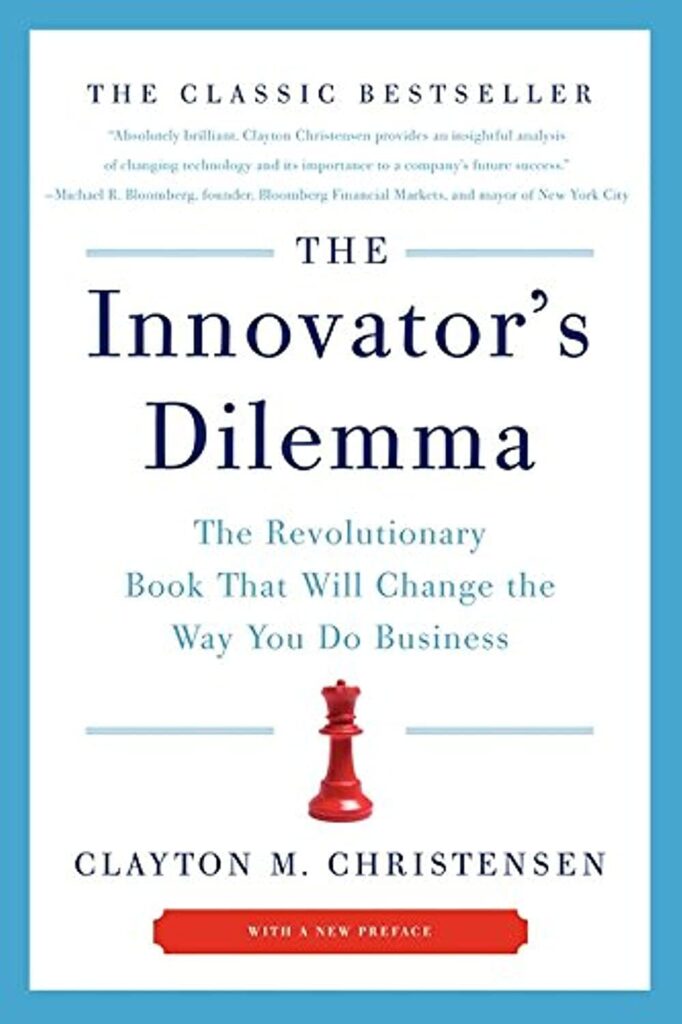
The Innovator's Dilemma The Revolutionary Book That Will Change the Way You Do Business
Why do great companies fail? Not because they make mistakes, but because they do everything right.
Harvard Business School professor Clayton M. Christensen reveals the shocking truth: the very practices that make companies successful can lead to their downfall.
In this bestseller, Christensen introduces the revolutionary concept of disruptive innovation. Through detailed case studies of the disk drive, steel, and mechanical excavator industries, he shows how industry leaders like IBM, Xerox, and Sears lost their market dominance to unexpected competitors. These giants listened to their customers, invested in better products, and pursued higher profits. Yet they still failed.
The problem? Disruptive technologies start small, serving overlooked markets with cheaper, simpler products. By the time these innovations improve enough to threaten mainstream markets, it's too late for established firms to respond. Christensen provides a framework for managers to recognize and capitalize on disruptive innovation before competitors do.
Steve Jobs called it deeply influential. Intel's Andy Grove named it the most important business book of the decade. Whether you're a CEO, entrepreneur, or manager, The Innovator's Dilemma will transform how you think about competition, innovation, and survival in today's fast-changing business world.
Interesting Facts
Harvard Professor Turned Business Oracle: Clayton Christensen was a Harvard Business School professor who taught this material to MBA students before writing the book, and his work has been cited by thought leaders from Steve Jobs to Malcolm Gladwell.
Published in 1997, Still Relevant: The book first appeared in 1997 and became an instant sensation, winning the Global Business Book Award as the best business book of the year and later being named by The Economist as one of the six most important books about business ever written.
Steve Jobs Called It Profound: Steve Jobs said the book deeply influenced his thinking, and it was the only business book on his list of favorite reads, shaping how he approached innovation at Apple.
Michael Bloomberg Bought 50 Copies: When the book came out, Michael Bloomberg was so impressed he sent fifty copies to his friends, demonstrating its immediate impact on business leaders.
Andy Grove's Book of the Decade: Intel CEO Andy Grove called it the most important book of the decade, showing how it resonated with leaders at the forefront of technology.
Coined "Disruptive Innovation": While Christensen first used the term "disruptive technologies" in a 1995 Harvard Business Review article, this book popularized the concept and later evolved the term to "disruptive innovation" in business language worldwide.
Hard Disk Drives as Laboratory: The book uses the hard disk drive industry as its primary case study because, as Christensen was told, it's to business what fruit flies are to genetics, with rapid generational changes that make patterns easy to observe.
Counterintuitive Core Premise: The book argues that doing everything "right" can actually lead to failure, showing how listening carefully to customers and investing in higher-performance products can blind companies to disruptive threats.
Multi-Industry Analysis: Beyond disk drives, Christensen examines patterns across multiple industries including mechanical excavators, steel manufacturing, and retailing to prove his theories apply broadly.
Spawned a Sequel and Series: The book proved so popular it was reprinted multiple times and led to a follow-up called The Innovator's Solution, plus additional books applying the framework to education and healthcare.
Five-Time McKinsey Award Winner: Christensen himself won the McKinsey Award for Harvard Business Review's best article five times, and was named the world's most influential business thinker by Thinkers50 in 2011 and 2013.
Data-Driven Academic Rigor: The book is based on extensive research of a database tracking every disk drive model and manufacturer between 1975 and 1994, giving it unusual scientific credibility for a business book.
Quotes
"Disruptive technologies bring to a market a very different value proposition than had been available previously."
"Customers groom a company’s profits, not its revenues. The only way to get growth out of a core business is to introduce new products and features that customers in the core market want and are willing to pay for."
"Good management was the most powerful reason for failure. Managers played the game the way it was supposed to be played."
"Managers must first be sure that the right product architecture matches the right market context before implementing organizational innovations."
"Many of the skills and values that corporate leaders have honed to help them succeed are the very things that will kill them when it comes time to confront disruptive innovation."
"Markets that do not exist cannot be analyzed."
"The reason why it is so difficult for existing firms to capitalize on disruptive innovations is that their processes and their business model that make them good at the existing business actually make them bad at competing for the disruption."
"Resource allocation decisions that make sense for one context can be disastrous in another."
"Successful companies want their resources to be focused where the profits are highest."
"The very decision-making and resource-allocation processes that are key to the success of established companies are the very processes that reject disruptive technologies."
"Because disruptive innovations usually promise lower profit margins, not greater profits, and because they generally can’t compete for capital with sustainable innovations in established companies, they are unlikely to get the resources they need when steering by the historic gross-margin performance of current products."
"Innovation is a slow process, requiring time, patience, and perseverance."
"Companies whose investment processes demand quantification of market size and financial returns before they can enter a market get paralyzed or walk away from disruptive technologies."
"In the beginning, disruptive technologies perform worse than established products in mainstream markets. But in a short time, they improve rapidly and can invade that market."
"Finding new markets for disruptive innovations requires experimentation and trial-and-error learning."
Ratings & Reviews
What do you think?
There are no reviews yet. Be the first one to write one.