
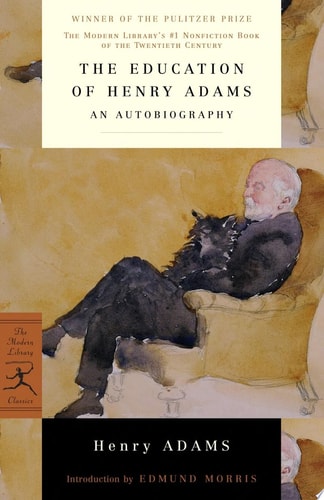
The Education of Henry Adams An Autobiography
The Education of Henry Adams is a unique autobiography written in the third person that chronicles Henry Adams's struggle to understand the rapidly changing world of the early twentieth century. Born in 1838 into one of America's most prominent political families as the great-grandson of John Adams and grandson of John Quincy Adams, Adams uses his privileged background to explore how traditional education failed to prepare him for modern life. The book blends autobiography, history, and philosophical reflection to examine the transformation of American society during the Gilded Age.
Adams privately printed the book in 1907 but forbade its commercial publication during his lifetime. After his death in 1918, it was published to widespread acclaim and won the Pulitzer Prize in 1919. The Modern Library later named it the best English-language nonfiction book of the twentieth century.
The narrative covers Adams's experiences from his Boston childhood through his work as his father's secretary during the Civil War, his career as a journalist and Harvard professor, and his travels across Europe and beyond. Notably, the book omits twenty years of his life, including his marriage and his wife's 1885 suicide. Adams critiques formal education while exploring themes of unity versus multiplicity, contrasting medieval faith with modern technological forces symbolized by the dynamo.
Written with wit, irony, and self-deprecating humor, this literary masterpiece offers profound insights into American intellectual and political life during a pivotal era in history.
Interesting Facts
Written in Third Person: Adams chose to write his autobiography in the third person, referring to himself as "Henry Adams" or simply "Adams" rather than "I." This unusual technique creates an ironic distance and allows him to treat himself almost as a fictional character, examining his life with detachment rather than intimacy.
Privately Printed First: The book was completed in 1906 and privately printed in 1907 in only one hundred copies at Adams's own expense. He sent these copies to friends mentioned in the text, asking them to strike out anything objectionable. It wasn't commercially published until after his death in 1918.
Posthumous Pulitzer Prize Winner: The book won the Pulitzer Prize for Biography in 1919, the year after Adams died. This made it one of the earliest winners of the award, which had only begun in 1917.
Modern Library's Top Pick: In 1998, the Modern Library ranked The Education of Henry Adams as the number one English-language nonfiction book of the 20th century. This extraordinary honor placed it above every other work of nonfiction published in that hundred-year span.
Twenty-Year Mysterious Gap: Adams deliberately omits twenty years of his life from 1872 to 1892, never directly mentioning his marriage to Marian "Clover" Hooper or her devastating suicide in 1885. He only refers to his wife indirectly, such as lamenting how the memorial he built for her became a tourist attraction.
The Dynamo Versus Virgin: The book's most famous chapter, "The Dynamo and the Virgin," contrasts the Virgin Mary as the unifying spiritual force of medieval Europe with the dynamo as the symbol of modern industrial and technological power. Adams encountered a forty-foot dynamo at the 1900 Paris Exposition and became almost obsessed with it, even writing a poem called "Prayer to the Dynamo."
Presidential Pedigree: Adams was the great-grandson of Founding Father and President John Adams, and grandson of President John Quincy Adams. His father, Charles Francis Adams, served as ambassador to Britain during the Civil War. Despite this illustrious lineage, Adams presents his formal education as a complete failure.
Companion to Another Book: Adams conceived The Education as a companion volume to his earlier work Mont-Saint-Michel and Chartres. While Chartres explored thirteenth-century unity and medieval philosophy, The Education examined twentieth-century multiplicity and modern fragmentation. He subtitled them "A Study of Thirteenth-Century Unity" and "A Study of Twentieth-Century Multiplicity."
The Manikin Metaphor: In his preface, Adams introduces the metaphor of a manikin, explaining that the figure called Henry Adams is merely a mannequin on which various garments of education are draped to see if they fit. He insisted the book was not about the individual but about testing whether different forms of education proved useful.
Riddled with Errors: The 1907 private printing contained hundreds of typographical errors and editorial inconsistencies. Adams never properly corrected these before his death, and the 1918 commercial edition made numerous changes that weren't entirely faithful to his intentions. A centennial edition finally attempted to restore Adams's original vision.
Influenced by Carlyle: The manikin metaphor and the theme of outdated beliefs needing replacement were influenced by Thomas Carlyle's Sartor Resartus, published in 1836. Adams even titled one chapter "Teufelsdröckh" after Carlyle's protagonist, offering readers a clue to this literary connection.
Predicted Technological Chaos: Adams was remarkably prescient about the accelerating pace of technological change. He mentioned X-rays, radioactivity, radio waves, automobiles, and correctly predicted that the twentieth century would bring even more explosive and disorienting changes, including what he feared would be weapons of "cosmic violence."
Quotes
A teacher affects eternity; he can never tell where his influence stops.
Practical politics consists in ignoring facts.
Chaos often breeds life, when order breeds habit.
A friend in power is a friend lost.
Politics, as a practice, whatever its professions, has always been the systematic organization of hatreds.
The proper study of mankind is woman.
Nothing in education is so astonishing as the amount of ignorance it accumulates in the form of inert facts.
Morality is a private and costly luxury.
The woman who is known only through a man is known wrong.
Chaos is the law of nature; order is the dream of man.
Power is poison. Its effect on Presidents has always been tragic.
The whole fabric of society, including its politics, rests upon a chemical formula.
Man is an impermanent arrangement of atoms, temporary and unstable.
The chief wonder of education is that it does not ruin everybody concerned in it, teachers and taught.
No man means all he says, and yet very few say all they mean, for words are slippery and thought is viscous.
Ratings & Reviews
What do you think?
There are no reviews yet. Be the first one to write one.