
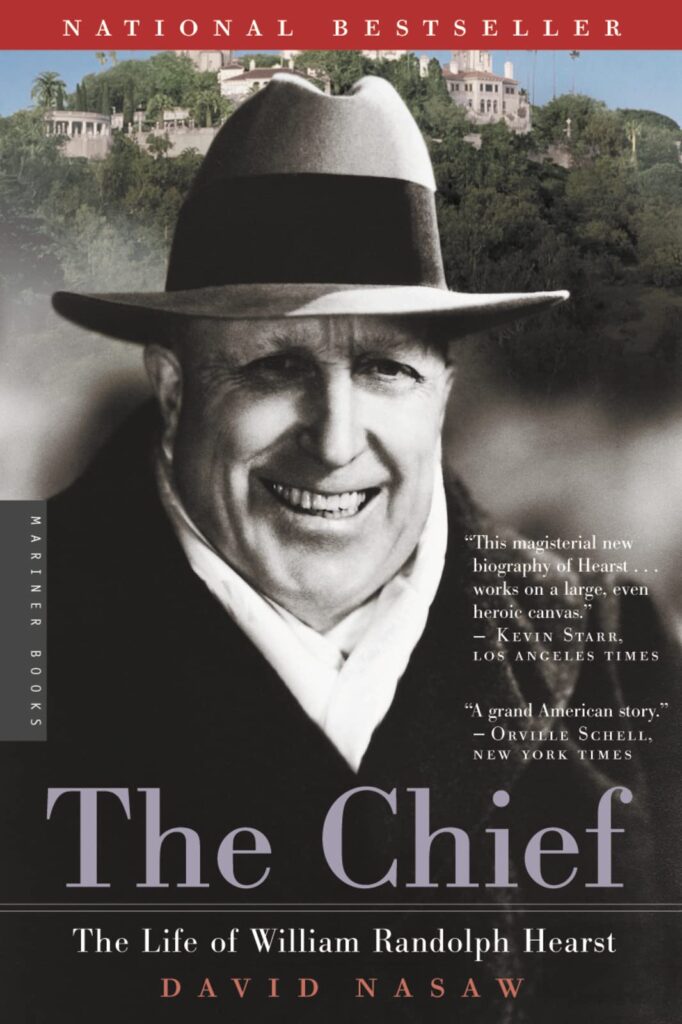
The Chief: The Life of William Randolph Hearst
He was the man who inspired Citizen Kane. The publishing titan who built an empire and a castle that rivaled anything in Hollywood's imagination. Now, discover the true story behind the legend.
William Randolph Hearst transformed a single newspaper into the largest media empire in American history. By the 1930s, he controlled twenty-eight newspapers, thirteen magazines, radio stations, and a movie studio. His influence shaped presidents, policies, and the very nature of American journalism.
From his privileged beginnings as a gold miner's son to his reign at the legendary San Simeon castle, Hearst lived a life of breathtaking ambition and contradiction. He moved from populist crusader to fierce opponent of the New Deal. He entertained Hollywood royalty while conducting a decades-long affair with actress Marion Davies.
Drawing on unprecedented access to Hearst's private papers, historian David Nasaw delivers the definitive biography of this American original. Winner of the Bancroft Prize and the J. Anthony Lukas Book Prize, The Chief reveals the man behind the myth.
Compelling, meticulously researched, and impossible to put down. This is the story of power, passion, and a media empire that changed America forever.
Interesting Facts
Massive Publishing Empire: By the 1930s, Hearst controlled the largest publishing empire in America. His holdings included twenty-eight newspapers, thirteen magazines, the Cosmopolitan Picture Studio, and radio stations. He was known to his staff as “the Chief.” At his peak, roughly 25 percent of Americans got their news from a Hearst-owned paper.
Unprecedented Archive Access: Nasaw became the first biographer to access the previously closed Hearst family archives. He gained cooperation from family members and the Hearst Corporation. This gave him materials no previous biographer had seen. The book draws on newly released private and business papers from archives on three continents.
Won the Bancroft Prize: The book won the prestigious Bancroft Prize for history. It was also a finalist for the National Book Critics Circle Award for biography in 2000. The J. Anthony Lukas Book Prize also went to this biography.
Never Submitted for Pulitzer: Despite its acclaim, The Chief was never submitted to the Pulitzer Prize committee. Nasaw himself called this “a bit of a scandal with Houghton Mifflin.” His two later biographies, on Andrew Carnegie and Joseph P. Kennedy, both became Pulitzer finalists.
Over 600 Pages Long: The biography spans 687 pages with over 600 pages of narrative. It includes extensive bibliographical references covering pages 609 through 656. The book took years of exhaustive research to complete.
Corrects Citizen Kane Myths: Nasaw dissects the factual inaccuracies in Orson Welles’s famous film Citizen Kane. The book reveals that Hearst’s defining attribute was his childish jovialness, not the dark brooding portrayed on screen. Wife Millicent and mistress Marion Davies emerge with more complexity than previous portrayals.
First Full Biography in Decades: When published in 2000, it was the first full-scale biography of Hearst in nearly forty years. The previous standard was W.A. Swanberg’s Citizen Hearst from 1961. Critics called Nasaw’s work unlikely to be surpassed as the definitive study.
Documents Controversial Political Connections: The book provides the first documentation of Hearst’s interactions with Hitler, Mussolini, and Churchill. It covers his relationships with every American president from Grover Cleveland to Franklin Roosevelt. Hearst corresponded with world leaders and even paid Mussolini and Hitler for newspaper columns.
Reveals Financial Collapse: Nasaw details how Hearst built his empire on borrowed money, first from his mother and later from banks. His father had left everything to his mother, not to William. Eventually Hearst’s spending habits forced him into virtual bankruptcy during the Depression.
Started with San Francisco Examiner: Hearst was handed the San Francisco Examiner at age twenty-four by his father George, a self-made mining millionaire. From this single paper he built a media empire that survives today. He learned hard work and perseverance from his father despite their distant relationship.
Quotes
“You furnish the pictures and I’ll furnish the war.” – William Randolph Hearst
“When free discussion is denied, hardening of the arteries of democracy has set in, free institutions are but a lifeless form, and the death of the republic is at hand.” – William Randolph Hearst
“Truth is not only stranger than fiction, it is more interesting.” – William Randolph Hearst
“Any man who has the brains to think and the nerve to act for the benefit of the people of the country is considered a radical by those who are content with stagnation and willing to endure disaster.” – William Randolph Hearst
“Putting out a newspaper without promotion is like winking at a girl in the dark — well-intentioned, but ineffective.” – William Randolph Hearst
“In suggesting gifts: Money is appropriate, and one size fits all.” – William Randolph Hearst
“We must be alarmingly enterprising, and we must be startlingly original, and do new and striking things which constitute a revolution.” – William Randolph Hearst
“All work and no play may make Jim a dull boy, but no work and all play makes Jim all kinds of a jackass.” – William Randolph Hearst
“A politician will do anything to keep his job – even become a patriot.” – William Randolph Hearst
“You must keep your mind on the objective, not on the obstacle.” – William Randolph Hearst
“It is a good thing that women are so easily manipulated. Otherwise, most of us wouldn’t be here.” – William Randolph Hearst
“I do not think that any man should be attacked because of his race or religion, or that he should be immune from attack because of race or religion.” – William Randolph Hearst
“We hold that the greatest right in the world is the right to be wrong, that in the exercise thereof people have an inviolable right to express their unbridled thoughts on all topics and personalities, being liable only for the abuse of that right.” – William Randolph Hearst
Ratings & Reviews
What do you think?
There are no reviews yet. Be the first one to write one.