
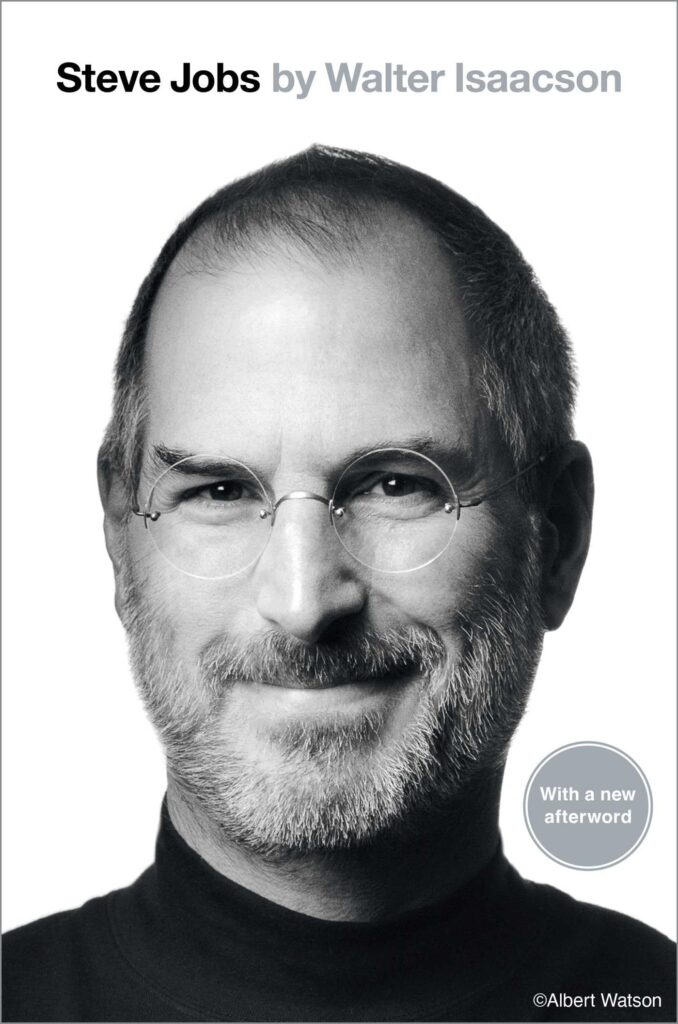
Steve Jobs
From the man who revolutionized six industries comes a story unlike any other. Based on more than forty interviews with Steve Jobs himself and over one hundred conversations with those who knew him best, Walter Isaacson delivers an unvarnished portrait of the most fascinating entrepreneur of our time. This is the authorized biography that Jobs requested but refused to control, allowing Isaacson unprecedented access to his life, his triumphs, and his demons.
Jobs was a creative genius whose passion for perfection transformed personal computers, animated movies, music, phones, tablet computing, and digital publishing. He could inspire his teams to achieve the impossible, yet his intensity and brutal honesty often drove those around him to fury and despair. His friends, foes, and colleagues reveal the passions, perfectionism, obsessions, and compulsion for control that shaped both the man and his revolutionary products.
This is more than a biography. It's a masterclass in innovation, leadership, and the price of greatness. Jobs's tale is instructive and cautionary, filled with lessons about creativity, character, and values that resonate far beyond Silicon Valley. Discover how one man's relentless vision changed the way we live, work, and connect with the world.
Interesting Facts
Jobs Requested the Biography: Steve Jobs personally approached Walter Isaacson to write his authorized biography, reaching out to the acclaimed biographer who had previously chronicled the lives of Benjamin Franklin and Albert Einstein. What makes this even more remarkable is that Jobs initially resisted the idea when Isaacson first suggested it years earlier, but eventually came around when he realized he wanted his children to know him better.
Zero Editorial Control: Although Jobs cooperated fully with the book, he demanded no control over its content except for one thing: the book's cover design. He even waived his right to read the manuscript before publication, telling Isaacson to make it honest and unvarnished. This is absolutely extraordinary for someone known for his obsessive control over every Apple product detail!
Over 140 Interviews Total: Isaacson conducted more than 40 interviews with Jobs himself over two years, plus interviews with over 100 family members, friends, adversaries, competitors, and colleagues. Jobs encouraged everyone to speak honestly, even if it meant revealing unflattering truths about him. Can you imagine giving your biographer permission to interview your enemies?
The Title Was Almost "iSteve": The original working title was "iSteve: The Book of Jobs," chosen by Simon & Schuster's publicity department. Isaacson's wife and daughter liked it initially, but then thought it was "too cutesy." Isaacson convinced the publisher to change it to simply "Steve Jobs" to reflect Jobs's minimalist aesthetic and make it feel more authentic.
Record-Breaking First Week Sales: The biography sold 379,000 copies in its first week in the United States alone, making it the biggest week of sales for any book in nearly a year. After just six days on sale, it was already the 18th bestselling book of 2011, and it ultimately became Amazon's number one seller for the entire year despite its late October release.
Three Million Copies Sold: By 2015, the book had sold more than three million copies in the United States alone, cementing its status as a commercial blockbuster and one of the bestselling business biographies of all time.
Published Just Weeks After His Death: Simon & Schuster moved the publication date up by a month after Jobs died on October 5, 2011, releasing it on October 24, 2011. The timing created an enormous wave of publicity and public interest, with Isaacson appearing on "60 Minutes" and other major media outlets.
His Inner Circle Hated It: Several of Jobs's closest colleagues and family members expressed strong disapproval of the biography. Tim Cook said it did Jobs "a tremendous disservice" and that the person described wasn't someone he would have wanted to work with. Jony Ive was even more blunt, saying his "regard couldn't be lower." Laurene Powell Jobs also disapproved, feeling the book didn't capture the real Steve.
42 Chapters With 150+ Subheadings: While the book contains only 42 chapters, it has so many sub-headings that some audiobook versions list 150+ chapters. There's even a mistake in the audiobook where Chapter 41 is incorrectly titled "Round Three, A Never-ending Struggle" instead of "Round Three, Twilight Struggle."
Inspired a Major Hollywood Film: The book became the basis for a 2015 drama film starring Michael Fassbender as Jobs, directed by Danny Boyle with a screenplay by Aaron Sorkin. The screenplay was adapted from both Isaacson's biography and additional interviews Sorkin conducted himself.
Balanced Portrait Despite Criticism: Isaacson strived to present a balanced view that didn't sugarcoat Jobs's flaws, documenting his cruelty, reality distortion field, and difficult personality alongside his genius. The New York Times praised it as "an encyclopedic survey" with appropriate passion, while reviewers noted Isaacson successfully contradicted Jobs's own versions of events with facts and other perspectives.
Six Industries Revolutionized: The biography chronicles how Jobs's passion for perfection revolutionized six distinct industries: personal computers, animated movies, music, phones, tablet computing, and digital publishing. This comprehensive scope shows how one person's vision fundamentally reshaped multiple aspects of modern life, connecting creativity with technology in unprecedented ways.
Quotes
"One way to remember who you are is to remember who your heroes are." - Steve Jobs
"If you want to live your life in a creative way, as an artist, you have to not look back too much. You have to be willing to take whatever you’ve done and whoever you were and throw them away. The more the outside world tries to reinforce an image of you, the harder it is to continue to be an artist." - Steve Jobs
"If you act like you can do something, then it will work." - Steve Jobs
"If you just sit and observe, you will see how restless your mind is. If you try to calm it, it only makes it worse, but over time it does calm, and when it does, there's room to hear more subtle things - that's when your intuition starts to blossom and you start to see things more clearly and be in the present more." - Steve Jobs
"People who know what they’re talking about don’t need PowerPoint." - Steve Jobs
"The best way to predict the future is to invent it." - Steve Jobs
"Picasso had a saying - 'good artists copy, great artists steal' - and we have always been shameless about stealing great ideas." - Steve Jobs
"I think different religions are different doors to the same house. Sometimes I think the house exists, and sometimes I don’t. It’s the great mystery." - Steve Jobs
"Remembering that you are going to die is the best way I know to avoid the trap of thinking you have something to lose. You are already naked. There is no reason not to follow your heart." - Steve Jobs
"Some people say, 'Give the customers what they want.' But that's not my approach. Our job is to figure out what they're going to want before they do. I think Henry Ford once said, 'If I’d asked customers what they wanted, they would have told me, "A faster horse!"'" - Steve Jobs
"You should never start a company with the goal of getting rich. Your goal should be making something you believe in and making a company that will last." - Steve Jobs
"Did Alexander Graham Bell do any market research before he invented the telephone?" - Steve Jobs
"In the first 30 years of your life, you make your habits. For the last 30 years of your life, your habits make you." - Steve Jobs
Ratings & Reviews
What do you think?
There are no reviews yet. Be the first one to write one.