
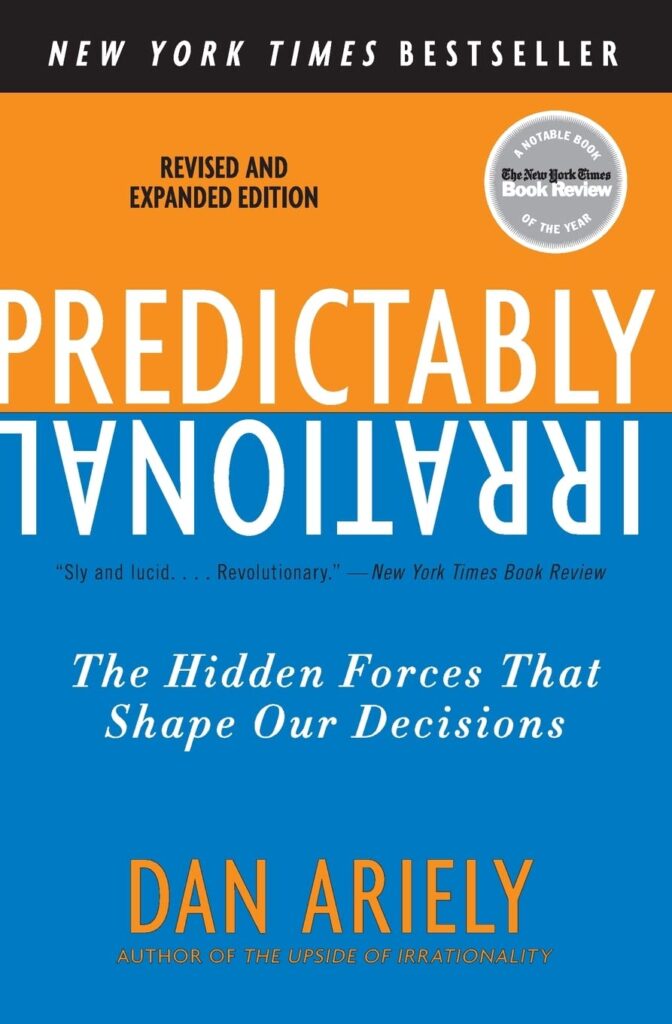
Predictably Irrational: The Hidden Forces That Shape Our Decisions
Why do our headaches vanish with a fifty-cent aspirin but persist with a one-cent version? Why do we splurge on lavish meals yet clip coupons to save twenty-five cents? You think you're making rational decisions, but behavioral economist Dan Ariely is about to prove you wrong.
In this revised and expanded edition of his New York Times bestseller, Ariely shatters the myth that we behave rationally. Through ingenious experiments and real-world examples, he reveals the invisible forces that hijack our decision-making. From choosing romantic partners to buying cars, from losing weight to managing money, we consistently overpay, underestimate, and procrastinate.
But here's the revelation: our mistakes aren't random. They're systematic and predictable, making us predictably irrational. We overvalue what we own, get irrationally excited by anything free, and let emotions override logic in high-stakes moments. We anchor to arbitrary prices and let expectations shape our experiences more than reality does.
Blending psychology, economics, and entertaining storytelling, Ariely exposes how expectations, emotions, and social norms skew our reasoning in ways we never notice. This eye-opening book will transform how you understand yourself and the world around you, one decision at a time.
Interesting Facts
Born from Burns: Dan Ariely's fascination with irrational behavior began after a magnesium flare explosion left him with third-degree burns over 70 percent of his body when he was 18. During his three-year hospital stay, he observed nurses making systematic errors in pain treatment, which sparked his journey into behavioral economics research.
The Chocolate Kiss Reversal: When Ariely sold Lindt truffles for 15 cents and Hershey Kisses for 1 cent, 73% chose the superior truffles. But when he dropped each price by just one penny, making the Kisses free, suddenly 69% chose the inferior free chocolate, demonstrating the irrational power of zero.
Amazon's French Failure: When Amazon launched free shipping with a second book purchase, every country saw huge sales jumps except France. The culprit? France charged one franc (about 20 cents) instead of zero. Once changed to truly free, French sales soared, proving free isn't just cheap, it's magical.
Duke Basketball Madness: Students who won the lottery for coveted Duke basketball tickets valued them at $2,400, while students who lost the lottery said they'd pay only $170 for the same tickets. This tenfold gap reveals how ownership instantly warps our perception of value.
The Economist's Decoy: When MIT students chose between a $59 web subscription and $125 print subscription, 68% picked the cheaper option. But add a useless $125 print-only option (which nobody chose), and suddenly 84% picked the expensive combo, showing how decoys manipulate decisions.
Lawyers Work for Free: When AARP asked lawyers to help needy retirees for $30 per hour, they refused. When asked to do it for free, they overwhelmingly agreed. Small payments destroy social norms and trigger market thinking, making us less generous.
Coke Vanishes, Cash Stays: Ariely secretly placed six-packs of Coke in MIT dorm fridges, and within 72 hours every can disappeared. Then he placed plates with six one-dollar bills in the same fridges. After 72 hours, not a single dollar was taken, revealing we cheat more easily when cash isn't directly involved.
Arousal Changes Everything: Berkeley students in a sexually aroused state were far more likely to engage in risky behaviors they'd never consider in a calm state. Ariely argues we systematically underestimate how different we become under emotional arousal, whether from lust, anger, or hunger.
Self-Imposed Deadlines Work: Students who set their own intermediate deadlines for papers performed better than those with no deadlines but worse than those with imposed deadlines. This proves we know we'll procrastinate but aren't great at forcing ourselves to behave.
Price Makes Placebos Stronger: Ariely discovered that expensive fake medicine works better than cheap fake medicine. A $2.50 pill relieves more pain than the identical 10-cent pill, earning him an Ig Nobel Prize in 2008 for this delightfully absurd finding.
TV Show Inspiration: NBC's series "The Irrational," which premiered in September 2023 starring Jesse L. Martin, was directly inspired by Ariely's life, research, and this book. The protagonist runs an Institute for Advanced Hindsight, mirroring Ariely's real research center at Duke.
Quotes
"Most people don’t know what they want unless they see it in context."
"We usually think of ourselves as sitting in the driver’s seat, with ultimate control over the decisions we make and the direction our life takes; but, alas, this perception has more to do with our desires—with how we want to view ourselves—than with reality."
"Free is not just an indicator of price; it is also an emotional hot button—a source of irrational excitement."
"We are pawns in a game whose forces we largely fail to comprehend."
"Our first decisions resonate over a long sequence of decisions. First impressions are important, and so is the first price we see on a product. This is called ‘arbitrary coherence.’"
"Expectations can exert a forceful influence on our perceptions, and there is a strong connection between what we expect and what we experience."
"We fall in love with what we already have. We focus on what we may lose, rather than what we may gain."
"The opportunity to cheat increases as we distance ourselves from money."
"What we really want is not the thing itself but a relative advantage over others."
"When given two options, we don’t always choose the better one—we choose the one with a more attractive decoy."
"It is not that we don’t know there are better options; it’s that the options in front of us crowd out the alternatives."
"We tend to overvalue what we own, especially if we have a hand in creating it."
"When we believe beforehand that something will be good, it generally will be good—and when we think it will be bad, it will be bad."
"Once we have accepted an idea or a value, we are very unlikely to question it, even if the context changes."
"We consistently overestimate our ability to resist temptation and make rational decisions."
Ratings & Reviews
What do you think?
There are no reviews yet. Be the first one to write one.