
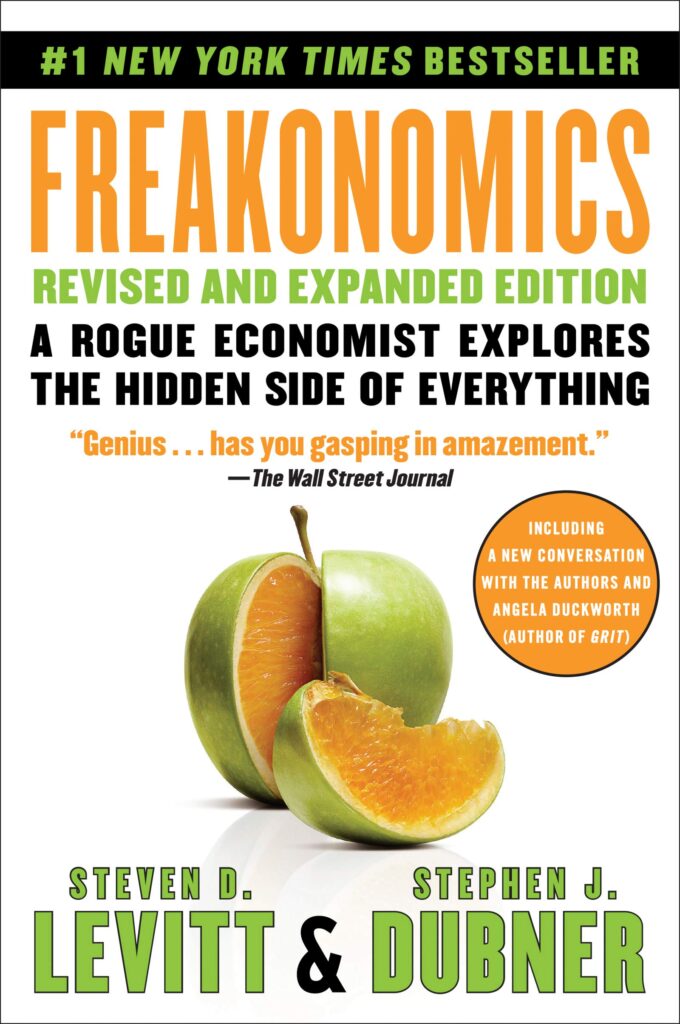
Freakonomics: A Rogue Economist Explores the Hidden Side of Everything
What do schoolteachers and sumo wrestlers have in common? Why do drug dealers still live with their moms? Which is more dangerous, a gun or a swimming pool? These are the kinds of provocative questions that rogue economist Steven D. Levitt tackles in this groundbreaking bestseller.
Freakonomics reveals the hidden side of everything by applying economic theory to the riddles of everyday life. Levitt and co-author Stephen J. Dubner demonstrate that economics is fundamentally the study of incentives, showing how people get what they want, especially when others want the same thing. Through compelling storytelling and data analysis, they expose surprising truths that turn conventional wisdom on its head.
Discover how Chicago schoolteachers and Japanese sumo wrestlers both cheat when the stakes are high enough. Explore the inner workings of crack gangs and why most drug dealers earn minimum wage. Learn what the Ku Klux Klan and real estate agents have in common, and how information asymmetry gives experts power over the rest of us. Investigate the controversial connection between legalized abortion and the dramatic crime drop of the 1990s.
With over 5 million copies sold worldwide and more than two years on the New York Times bestseller list, Freakonomics will arm you with enough riddles and stories to last a thousand cocktail parties. More importantly, it will teach you to see the world through a new lens, where nothing is quite as it seems and the most interesting questions lead to the most unexpected answers.
Interesting Facts
Born from a Magazine Profile: The entire Freakonomics phenomenon started when journalist Stephen Dubner profiled economist Steven Levitt for The New York Times Magazine in 2003, and publishers immediately saw book potential in their chemistry. Levitt initially resisted writing a book, saying he didn’t consider himself much of a writer, but proposed collaborating with Dubner instead.
Massive Global Success: By late 2009, Freakonomics had sold over 4 million copies worldwide and been translated into 35 languages. The book spent more than two years on The New York Times bestseller list, peaking at number two in nonfiction, and was named the 2006 Book Sense Book of the Year.
Sumo Wrestling Corruption Exposed: Levitt’s statistical analysis of 32,000 sumo matches revealed that wrestlers with 7-7 records won about 80% of the time against 8-6 opponents, when they should have won only 48.7% of the time. Even more damning, in rematches between the same wrestlers, the previously 7-7 wrestler won only 40% of the time, suggesting collusion and match-fixing.
Dubner’s Rock Star Past: Before becoming a bestselling author, Stephen Dubner played in a rock band called The Right Profile that was signed to Arista Records. He quit music to pursue writing, earning an MFA from Columbia University where he also taught English.
Prestigious Economics Medal: Steven Levitt won the 2003 John Bates Clark Medal, awarded every two years to the most influential American economist under 40, for his work on crime. He’s currently the William B. Ogden Distinguished Service Professor of Economics at the University of Chicago.
Defamation Lawsuit Settlement: Political activist John Lott sued Levitt for defamation over claims in the book. Levitt eventually settled by admitting in a letter that he had mischaracterized Lott’s research practices, with The Chronicle of Higher Education calling it “a doozy of a concession.”
Multimedia Empire: The book’s success spawned an entire franchise, including SuperFreakonomics, a documentary film with a nearly $3 million budget, and a popular blog. The film featured prominent directors such as Morgan Spurlock and Alex Gibney. It also led to the Freakonomics Radio podcast, which launched in 2010 and now reaches about 15 million global downloads each month.
Blogosphere-Fueled Phenomenon: The book’s commercial success was partly attributed to the blogosphere, representing an early example of how online communities could drive traditional book sales. This grassroots digital buzz helped transform an economics book into a cultural touchstone.
Teacher Cheating Algorithm: Levitt developed an algorithm to detect teacher cheating on standardized tests in Chicago by looking for suspicious patterns of identical correct answers among students. After the study was publicized, cheating fell by 30% the following year, and enough evidence was gathered to fire many teachers.
Quotes
“Morality, it could be argued, represents the way that people would like the world to work, whereas economics represents how it actually does work.” – Steven D. Levitt
“The conventional wisdom is often wrong.” – Steven D. Levitt
“Information is a beacon, a cudgel, an olive branch, a deterrent–all depending on who wields it and how.” – Steven D. Levitt
“As W.C. Fields once said: a thing worth having is a thing worth cheating for.” – Steven D. Levitt
“An incentive is a bullet, a lever, a key: an often tiny object with astonishing power to change a situation.” – Steven D. Levitt
“If you both own a gun and a swimming pool in your backyard, the swimming pool is about 100 times more likely to kill a child than the gun is.” – Steven D. Levitt
“Social scientists sometimes talk about the concept of ‘identity’. It is the idea that you have a particular vision of the kind of person you are, and you feel awful when you do things that are out of line with that vision.” – Steven D. Levitt
“There are three basic flavors of incentive: economic, social, and moral.” – Steven D. Levitt
“A rogue economist explores the hidden side of everything.” – Steven D. Levitt
“For emotion is the enemy of rational argument.” – Steven D. Levitt
“Knowing what to measure and how to measure it makes a complicated world much less so.” – Steven D. Levitt
“An expert must be BOLD if he hopes to alchemize his homespun theory into conventional wisdom.” – Steven D. Levitt
Ratings & Reviews
What do you think?
There are no reviews yet. Be the first one to write one.