
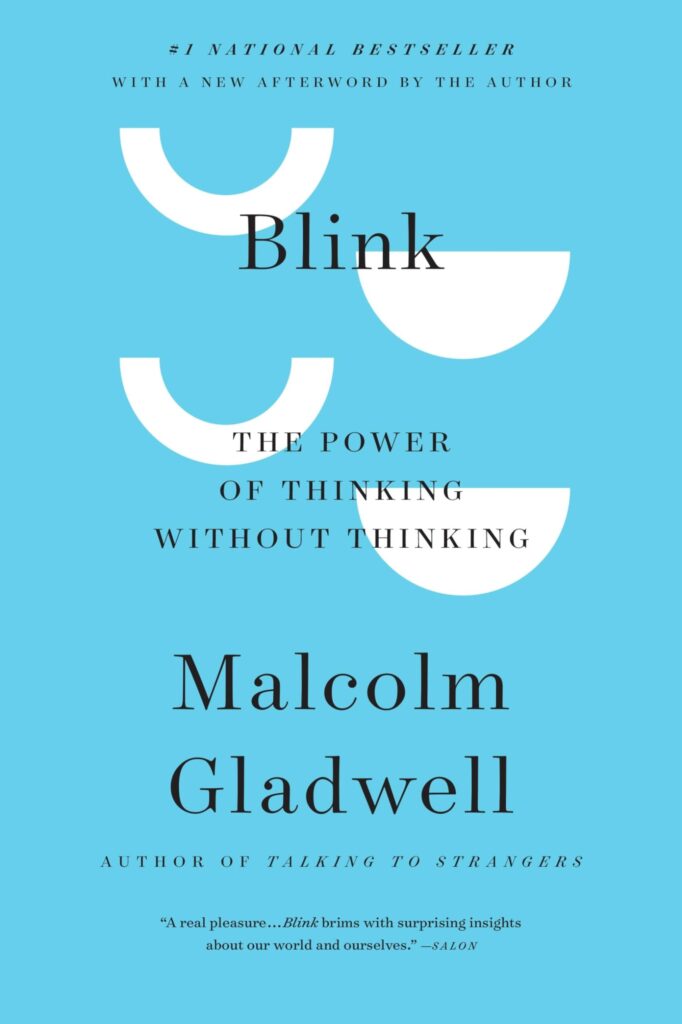
Blink: The Power of Thinking Without Thinking
What if you could make brilliant decisions in the blink of an eye? In this exploration of rapid cognition, Malcolm Gladwell reveals the hidden power of snap judgments and split-second choices.
Drawing on art experts who can spot a forgery in minutes, psychologist John Gottman who can predict divorce with 95% accuracy, and emergency room doctors who diagnose heart attacks more accurately with less information, Gladwell shows how the unconscious mind works at lightning speed.
But this remarkable ability comes with a dark side. Our snap judgments can also be corrupted by unconscious biases, stereotypes, and prejudices that lead us dangerously astray. Through riveting stories from military war games, police shootings, speed dating, and orchestra auditions, Gladwell demonstrates when to trust your instincts and when to be wary of them.
Blending neuroscience with unforgettable real-world examples, Blink challenges everything you thought you knew about thinking. Discover how to harness the power of thinking without thinking to make smarter, faster decisions in every area of your life.
Interesting Facts
Gladwell's Second Book: Published in 2005, Blink became Malcolm Gladwell's second bestseller following The Tipping Point, exploring how we make decisions in the blink of an eye with examples ranging from art experts to marriage counselors to police shootings.
Thin-Slicing Defined: The book introduces "thin-slicing," our ability to find patterns and make accurate judgments based on incredibly narrow slices of experience, sometimes in just two seconds, using our adaptive unconscious rather than deliberate analysis.
The Getty Kouros Mystery: The book opens with the fascinating story of a Greek statue purchased by the Getty Museum for nearly $10 million after 14 months of scientific testing, which art experts immediately identified as fake within seconds based purely on intuition.
Marriage Prediction Mastery: Psychologist John Gottman can predict with 95% accuracy whether a couple will still be married in 15 years after observing them for just one hour, and maintains 90% accuracy after only 15 minutes of conversation.
Warren Harding's Halo Effect: The book explores how Warren G. Harding became president largely because he looked presidential, demonstrating the "halo effect" where one positive quality makes us assume superiority in unrelated areas.
The Amadou Diallo Tragedy: Gladwell examines the 1999 shooting where four NYPD officers fired 41 shots at innocent immigrant Amadou Diallo, who was reaching for his wallet, illustrating how stress creates "temporary autism" where we lose our ability to read facial expressions.
Orchestra Blind Auditions Revolution: The book discusses how orchestras implementing blind auditions behind screens increased female musicians from 5% to 50%, showing how removing visual information can eliminate unconscious bias.
Pentagon War Games Upset: A retired Marine commander named Paul Van Riper defeated a technologically superior force in Pentagon war games using intuitive, improvisational leadership, proving that more information isn't always better for decision-making.
New Coke's Taste Test Failure: The book explores why New Coke failed despite winning taste tests, demonstrating how asking people to explain their preferences can actually confuse them and lead to wrong conclusions.
Bedroom Personality Reading: Research shows strangers can accurately assess someone's personality traits by examining their bedroom for just a few minutes, often more accurately than the person's own friends can.
Abbie Conant's Inspiration: The book ends with trombonist Abbie Conant's story of sexism at the Munich Philharmonic from 1980 to 1993, which Gladwell called "my inspiration" for writing Blink, showing how blind auditions can overcome prejudice.
Quotes
“The key to good decision making is not knowledge. It is understanding.”
“We have, as human beings, a storytelling problem. We're a bit too quick to come up with explanations for things we don't really have an explanation for.”
“We don’t know where our first impressions come from or precisely what they mean, so we don’t always appreciate their fragility.”
“Truly successful decision making relies on a balance between deliberate and instinctive thinking.”
“Our unconscious is a powerful force. But it’s fallible. It’s often hard to know where the line is between what we can and cannot trust.”
“Being able to act intelligently and instinctively in the moment is possible only after a long and rigorous period of education and experience.”
“Insight is not a lightbulb that goes off inside our heads. It is a flickering candle that can easily be snuffed out.”
“We live in a world that assumes that the quality of a decision is directly related to the time and effort that went into making it. But ‘Blink’ and thin-slicing suggest that this is not always the case.”
“There can be as much value in the blink of an eye as in months of rational analysis.”
“Delay is the enemy of progress.”
“A person watching a silent videotape of a doctor and his patient will, on average, do a much better job predicting whether or not that doctor will be sued than someone who knows the doctor’s record in detail.”
“Too much information, I realized in those moments, is sometimes just too much information.”
“How good people’s decisions are under the fast-moving, high-stress conditions of rapid cognition is a function of training and rules and rehearsal.”
“The first task of Blink is to convince you of a simple fact: decisions made very quickly can be every bit as good as decisions made cautiously and deliberately.”
“Our first impressions are generated by our experiences and our environment, which means that we can change our first impressions—we can alter the way we think-slice—by changing the experiences that comprise those impressions.”
Ratings & Reviews
What do you think?
There are no reviews yet. Be the first one to write one.