
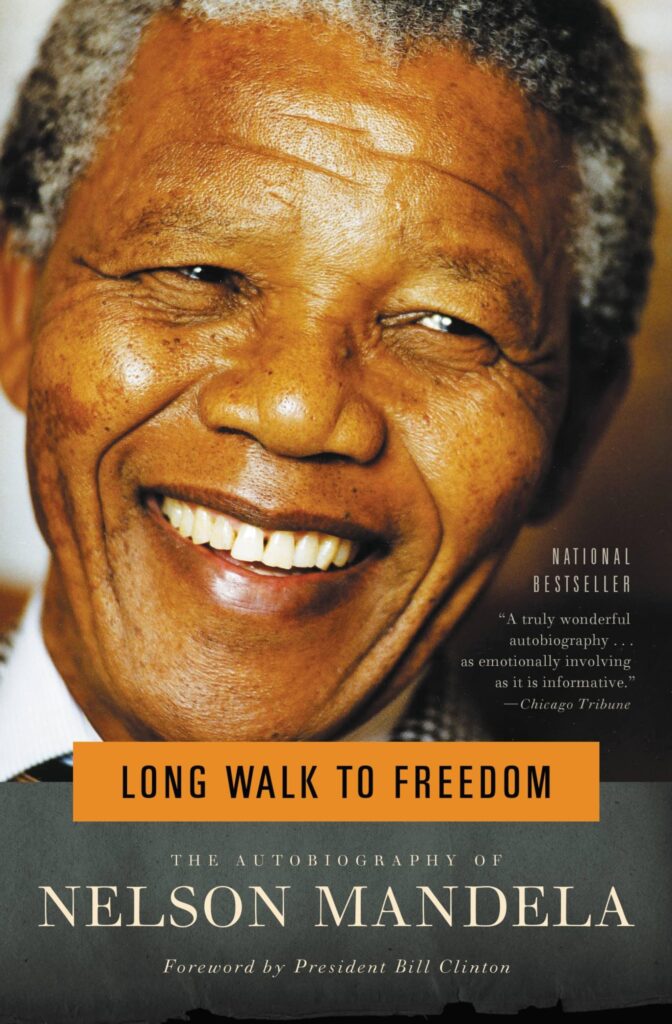
Long Walk to Freedom: The Autobiography of Nelson Mandela
From a small village in South Africa's Eastern Cape to the presidency of a reborn nation, this is the story of one man's extraordinary journey through history. Nelson Mandela's autobiography takes you inside the mind of a freedom fighter who spent 27 years in prison yet emerged without bitterness to lead his country. Written partly in secret on Robben Island, where he endured hard labor and isolation, this memoir reveals the personal cost of his struggle, including two failed marriages and years away from his family.
Long Walk to Freedom chronicles Mandela's evolution from a young lawyer to a militant revolutionary to a global icon of reconciliation. You'll witness his childhood among Thembu royalty, his political awakening in Johannesburg, and his leadership of the African National Congress's campaign against apartheid. The narrative builds through his arrest, the famous Rivonia Trial, and the brutal decades on Robben Island, where he transformed a prison into a university of resistance.
But this isn't just a political memoir. Mandela writes with unflinching honesty about his doubts, his mistakes, and his ambivalence about sacrificing family for the cause. The final chapters capture the tense negotiations that ended apartheid and his historic election as South Africa's first democratically elected president in 1994.
This is essential reading for anyone who wants to understand how one person's courage and moral vision can change the world. Winner of the Nobel Peace Prize, Mandela tells his own story with the same dignity and humanity that defined his life.
Interesting Facts
Written Secretly in Prison: Mandela began writing the manuscript for Long Walk to Freedom clandestinely on Robben Island in 1976, composing it by hand on scraps of paper under conditions that strictly prohibited personal writing by political prisoners. Fellow prisoners Walter Sisulu and Ahmed Kathrada reviewed each section and provided critical feedback, creating what Mandela called an “assembly line” for processing the manuscript.
Smuggled in Cocoa Containers: The 600-page handwritten manuscript was transcribed into microscopic shorthand by prisoner Laloo Chiba, reducing it to just 60 pages. Fellow prisoner Mac Maharaj then smuggled these pages off Robben Island in 1976 by hiding them in the bound cover of a study file when he was released, after portions had been buried in cocoa containers in the prison garden.
Ghostwritten by Richard Stengel: American journalist Richard Stengel collaborated with Mandela as his ghostwriter in the early 1990s, conducting over 75 hours of recorded interviews. Stengel was chosen partly because he had written a book about South Africa called January Sun, and he met with Mandela at his house starting as early as 4:30 in the morning to accommodate Mandela’s prison-honed early rising habits.
Published the Presidential Year: The book was published in 1994 by Little Brown & Co., the same year Mandela became South Africa’s first democratically elected president. Stengel later noted that during the writing process, the book was about “the 150th most important thing” Mandela had to do each day as he was simultaneously negotiating the constitution and democratic elections.
Six Million Copies Sold: Long Walk to Freedom has sold over six million copies worldwide and has been translated into numerous languages, making it one of the bestselling political autobiographies of all time. The book won the prestigious Alan Paton Award in 1995.
Seventy Hours of Lost Tapes: The recorded interviews between Stengel and Mandela were nearly forgotten for decades until Stengel revisited them and created a podcast called “Mandela: The Lost Tapes” in 2022. During the recording process, three hours of tapes were actually stolen from Stengel’s Johannesburg home in a robbery, though he was able to continue the project.
Idris Elba Played Mandela: The book was adapted into a major motion picture titled “Mandela: Long Walk to Freedom” in 2013, directed by Justin Chadwick and starring British actor Idris Elba. Mandela personally awarded the film rights to producer Anant Singh’s company years before 2009, and tragically, Mandela’s death was announced during the film’s London premiere for Prince William and his wife.
Started Writing at Night: While imprisoned, Mandela adopted an unorthodox work schedule for writing portions of the book, working most of the night and sleeping during the day. He wrote secretly despite harsh conditions that included daily quarry work that damaged his eyesight from lime dust exposure.
Assembly Line Collaboration: The writing process on Robben Island involved remarkable teamwork. After Mandela wrote each section, Kathrada reviewed it and read it aloud to Walter Sisulu, then both men wrote comments in the margins. Mandela took their suggestions seriously and often incorporated their changes, demonstrating that even this personal memoir was a collaborative effort among the imprisoned leaders.
Inspired a Sequel: A follow-up memoir titled “Dare Not Linger: The Presidential Years” was published in 2017, compiled from Mandela’s handwritten notes and unfinished drafts. The title comes from the powerful closing sentence of Long Walk to Freedom where Mandela wrote, “But I can only rest for a moment, for with freedom comes responsibilities, and I dare not linger, for my long walk is not ended.”
Stengel Married on Mandela’s Advice: During their time working together, Mandela urged Richard Stengel to marry Mary Pfaff, a South African photographer Stengel had met while working on the book. Stengel took his advice, and both of their sons carry Mandela’s names as middle names: Rolihlahla (Mandela’s birth name) and Madiba (his clan name).
Quotes
"I have walked that long road to freedom. I have tried not to falter; I have made missteps along the way. But I have discovered the secret that after climbing a great hill, one only finds that there are many more hills to climb." - Nelson Mandela
"No one is born hating another person because of the color of his skin, or his background, or his religion. People must learn to hate, and if they can learn to hate, they can be taught to love, for love comes more naturally to the human heart than its opposite." - Nelson Mandela
"I am fundamentally an optimist. Whether that comes from nature or nurture, I cannot say. Part of being optimistic is keeping one's head pointed toward the sun, one's feet moving forward. There were many dark moments when my faith in humanity was sorely tested, but I would not and could not give myself up to despair." - Nelson Mandela
"For to be free is not merely to cast off one's chains, but to live in a way that respects and enhances the freedom of others." - Nelson Mandela
"I learned that courage was not the absence of fear, but the triumph over it. The brave man is not he who does not feel afraid, but he who conquers that fear." - Nelson Mandela
"A leader...is like a shepherd. He stays behind the flock, letting the most nimble go out ahead, whereupon the others follow, not realizing that all along they are being directed from behind." - Nelson Mandela
"Education is the great engine of personal development. It is through education that the daughter of a peasant can become a doctor, that the son of a mineworker can become the head of the mine, that a child of farmworkers can become the president of a great nation." - Nelson Mandela
"Freedom is indivisible; the chains on any one of my people were the chains on all of them, the chains on all of my people were the chains on me." - Nelson Mandela
"I knew as well as I knew anything that the oppressor must be liberated just as surely as the oppressed. A man who takes away another man’s freedom is a prisoner of hatred, he is locked behind the bars of prejudice and narrow-mindedness. I am not truly free if I am taking away someone else’s freedom, just as surely as I am not free when my freedom is taken from me." - Nelson Mandela
"A freedom fighter learns the hard way that it is the oppressor who defines the nature of the struggle, and the oppressed is often left no recourse but to use methods that mirror those of the oppressor." - Nelson Mandela
"I had no epiphany, no singular revelation, no moment of truth, but a steady accumulation of a thousand slights, a thousand indignities and a thousand unremembered moments produced in me an anger, a rebelliousness, a desire to fight the system that imprisoned my people." - Nelson Mandela
"In South Africa, to be poor and black was normal, to be poor and white was a tragedy." - Nelson Mandela
"There is a streak of goodness in men that can be buried or hidden and then emerge unexpectedly." - Nelson Mandela
Ratings & Reviews
What do you think?
There are no reviews yet. Be the first one to write one.