
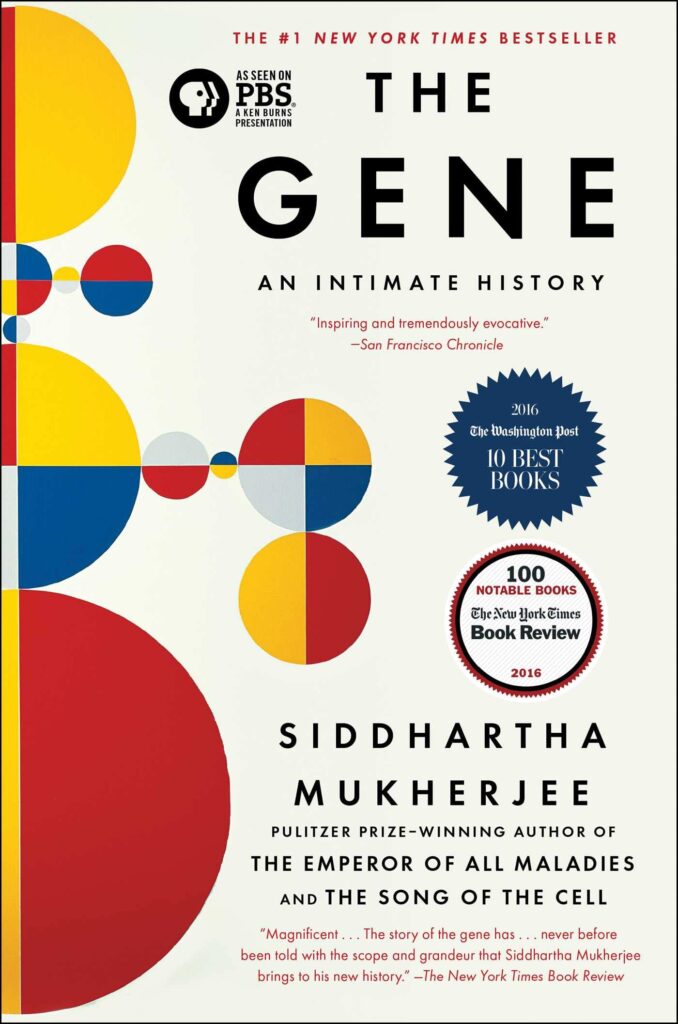
The Gene: An Intimate History
What makes you human? The answer lies in a master code that has shaped life for millennia, a code that scientists have only recently learned to read and are now beginning to write. From the Pulitzer Prize-winning author of The Emperor of All Maladies comes an epic journey through the history of the gene. It traces the story from Aristotle’s early theories to Gregor Mendel’s pea plant experiments and the revolutionary mapping of the human genome.
This is science as thrilling detective story. Mukherjee weaves together the brilliant minds who unlocked heredity’s secrets, from Darwin and Mendel to Watson, Crick, and Franklin, revealing how their discoveries transformed medicine and our understanding of what it means to be human. But this isn’t just a tale of scientific triumph.
Threading through the narrative is Mukherjee’s own family history, marked by recurring mental illness, reminding us that genetics isn’t abstract science. It’s deeply personal, shaping our identities, our health, and the futures of our children. As we gain unprecedented power to edit DNA with precision, we face profound questions about the boundaries of human intervention.
Accessible, compassionate, and utterly compelling, The Gene prepares readers for the moral complexities of our genetic age. This is the story of humanity’s past, present, and future, written with the narrative power that made Mukherjee’s cancer biography a sensation.
Interesting Facts
Spans Centuries of Discovery: The book chronicles genetic research from ancient thinkers like Aristotle and Pythagoras through Gregor Mendel’s pea experiments all the way to 21st-century scientists who mapped the entire human genome.
Deeply Personal Family Story: Mukherjee weaves his own family’s tragic history of mental illness throughout the narrative, including his cousin Moni’s schizophrenia and two of his father’s brothers who suffered from mental breakdowns, creating what he calls a “bright, red line” through the scientific history.
Scientists Feared Creating Frankensteins: When recombinant DNA technology emerged in the 1970s, some interviewees genuinely worried the experiments could produce dangerous organisms. The fear was real enough to trigger the research moratorium.
Only 100 Genes Known by the 1980s: Despite decades of genetic research, scientists had identified only about 100 actual genes by the 1980s. The complexity of the genome was far greater than anyone initially imagined.
Traces Humanity to One Woman: All humans alive today can trace their ancestry to a single woman who lived in Africa about 200,000 years ago. Scientists call her Mitochondrial Eve. This means we're far more genetically similar than different.
Ken Burns Made a Documentary: The book inspired a PBS documentary by legendary filmmaker Ken Burns in 2020, with Mukherjee serving as a key commentator, bringing the gene’s story to an even wider audience.
Named a Top Book of 2016: The Gene appeared on both The Washington Post’s and The New York Times’ lists of the best books of 2016, and was shortlisted for the Royal Society Prizes for Science Books.
Addresses Eugenics Horrors: The book doesn’t shy away from the dark history of genetics, examining how genetic ideas led to Nazi eugenics programs and forced sterilizations, serving as a cautionary tale about the dangers of genetic determinism.
Explores CRISPR Technology: Mukherjee discusses cutting-edge gene-editing technology like CRISPR, which he describes as giving scientists unprecedented ability to modify the human genome with remarkable precision, raising profound ethical questions.
Mother and Aunt Are Twins: The author uses his mother and her identical twin sister, who have distinctly different personalities despite sharing the same DNA, to explore the complex relationship between genes, environment, and identity.
Discusses Sexual Identity Genetics: The book includes a particularly powerful section on the genetic basis of sexual identity, examining how genes influence gender and sexuality in ways that challenge simplistic biological definitions.
Over 600 Pages Long: The hardcover edition spans more than 600 pages, combining rigorous science with compelling storytelling, character sketches of famous scientists, and philosophical reflections on what it means to be human in the age of genetic manipulation.
Quotes
"Freaks become norms, and norms become extinct. Monster by monster, evolution advanced." - Siddhartha Mukherjee
"Normalcy is the antithesis of evolution." - Siddhartha Mukherjee
"Memories sharpen the past; it is reality that decays." - Siddhartha Mukherjee
"If we define 'beauty' as having blue eyes (and only blue eyes), then we will, indeed, find a 'gene for beauty.' If we define 'intelligence' as the performance on only one kind of test, then we will, indeed, find a 'gene for intelligence.' The genome is only a mirror for the breadth or narrowness of human imagination." - Siddhartha Mukherjee
"Like musicians, like mathematicians—like elite athletes—scientists peak early and dwindle fast. It isn’t creativity that fades, but stamina: science is an endurance sport. To produce that single illuminating experiment, a thousand nonilluminating experiments have to be sent into the trash; it is battle between nature and nerve." - Siddhartha Mukherjee
"The point is this: if you cannot separate the phenotype of mental illness from creative impulses, then you cannot separate the genotype of mental illness and creative impulse." - Siddhartha Mukherjee
"Three profoundly destabilizing scientific ideas ricochet through the twentieth century, trisecting it into three unequal parts: the atom, the byte, the gene." - Siddhartha Mukherjee
"History repeats itself, in part because the genome repeats itself. And the genome repeats itself, in part because history does. The impulses, ambitions, fantasies, and desires that drive human history are, at least in part, encoded in the human genome." - Siddhartha Mukherjee
"The universe seeks equilibriums; it prefers to disperse energy, disrupt organization, and maximize chaos. Life is designed to combat these forces. We slow down reactions, concentrate matter, and organize chemicals into compartments; we sort laundry on Wednesdays." - Siddhartha Mukherjee
"It is tempting to write the history of technology through products: the wheel; the microscope; the airplane; the Internet. But it is more illuminating to write the history of technology through transitions: linear motion to circular motion; visual space to subvisual space; motion on land to motion on air; physical connectivity to virtual connectivity." - Siddhartha Mukherjee
"Our genome has negotiated a fragile balance between counterpoised forces, pairing strand with opposing strand, mixing past and future, pitting memory against desire. It is the most human of all things that we possess. Its stewardship may be the ultimate test of knowledge and discernment for our species." - Siddhartha Mukherjee
"Grief might be diminished, but so might tenderness. Traumas might be erased but so might history. Infirmities might disappear, but so might vulnerability. Chance would become mitigated, but so, inevitably, would choice." - Siddhartha Mukherjee
"Scientists divide. We discriminate. It is the inevitable occupational hazard of our profession that we must break the world into its constituent parts - genes, atoms, bytes - before making it whole again." - Siddhartha Mukherjee
Ratings & Reviews
What do you think?
There are no reviews yet. Be the first one to write one.