
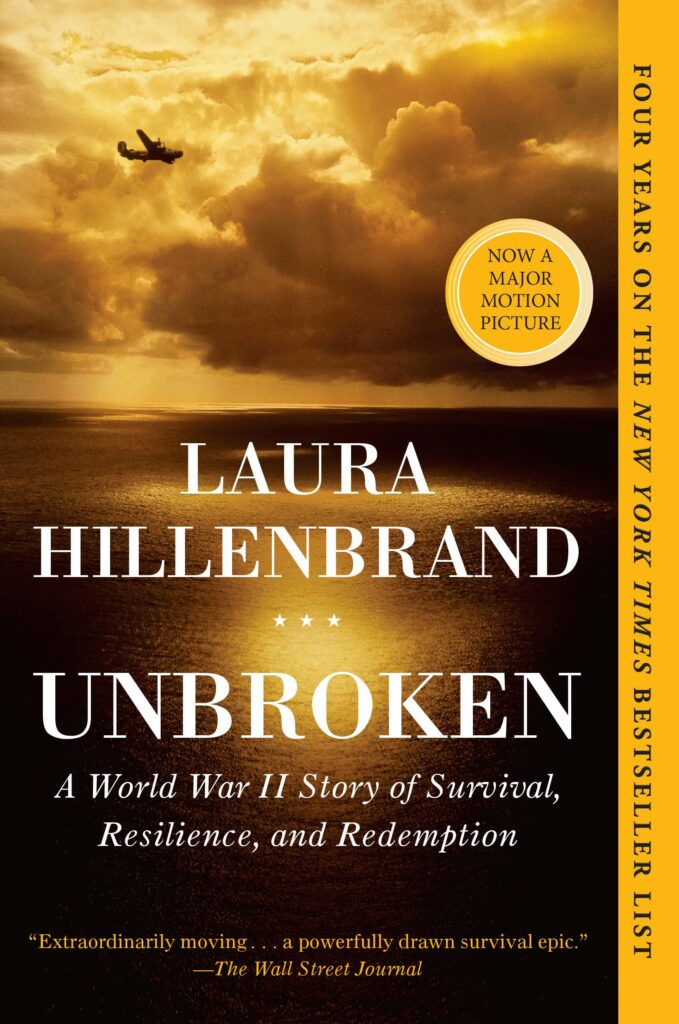
Unbroken: A World War II Story of Survival, Resilience, and Redemption
On a May afternoon in 1943, an Army Air Forces bomber crashed into the Pacific Ocean and disappeared, leaving only a spray of debris and a slick of oil, gasoline, and blood. Then, on the ocean surface, a face appeared. So began one of the most extraordinary odysseys of the Second World War.
The lieutenant's name was Louis Zamperini. In boyhood, he'd been a cunning and incorrigible delinquent, breaking into houses, brawling, and fleeing his home to ride the rails. As a teenager, he channeled his defiance into running, discovering a prodigious talent that carried him to the Berlin Olympics. But when war came, the athlete became an airman, embarking on a journey that led to his doomed flight, a tiny raft, and a drift into the unknown.
Ahead of Zamperini lay thousands of miles of open ocean, leaping sharks, thirst and starvation, enemy aircraft, and beyond, a trial even greater. Driven to the limits of endurance, Zamperini would answer desperation with ingenuity, suffering with hope, brutality with rebellion. His fate, whether triumph or tragedy, would be suspended on the fraying wire of his will.
After surviving 47 days adrift at sea, Zamperini was captured by the Japanese and spent more than two years as a prisoner of war, enduring relentless torture and dehumanization. Upon his return home, he struggled with alcoholism and haunting nightmares until a spiritual awakening transformed his life. His journey from Olympic athlete to war hero to man of forgiveness is a testament to the resilience of the human mind, body, and spirit.
Interesting Facts
Record-Breaking Bestseller Run: Unbroken spent more than four years on the New York Times bestseller list, including fifteen consecutive weeks at number one, making it the fifth longest-running nonfiction bestseller of all time. The book has sold over four million copies and was hailed by Time magazine as the top nonfiction book of 2010. This incredible success came despite the author never leaving her home during much of the writing process.
Seven Years in the Making: Laura Hillenbrand spent seven years researching and writing Unbroken, conducting over 75 interviews with Louis Zamperini entirely by phone. She never met Zamperini in person due to her debilitating chronic fatigue syndrome, yet their connection was so profound that Zamperini sent her one of his Purple Hearts after learning about her illness. He felt she understood his suffering in ways others couldn't.
Written from a Sickbed: Hillenbrand wrote much of Unbroken while lying in bed, battling myalgic encephalomyelitis (chronic fatigue syndrome) that left her housebound for years. During a two-year stretch while writing, she was unable to leave her house even once because she wasn't strong enough to walk to her car. She worked on the book every single day without missing one, despite her severe illness.
Hitler's Memorable Compliment: At the 1936 Berlin Olympics, Louis Zamperini finished eighth in the 5,000-meter race but ran his final lap in an astonishing 56 seconds. This caught Adolf Hitler's attention, who called Zamperini to his box and shook his hand, saying "Ah, you're the boy with the fast finish." This moment isn't shown in the film adaptation but appears in Hillenbrand's book.
47 Days Adrift at Sea: After their B-24 bomber crashed into the Pacific Ocean, Zamperini and two crewmates survived 47 days on a life raft with minimal food and no water. They caught albatrosses and fish, fended off constant shark attacks, and were even strafed by a Japanese bomber. One crewmate, Mac McNamara, died on day 33, leaving only Zamperini and pilot Russell Allen Phillips to be captured by the Japanese.
The Coen Brothers Wrote the Screenplay: Angelina Jolie directed the 2014 film adaptation, but the screenplay was written by the legendary Coen Brothers along with Richard LaGravenese and William Nicholson. Universal Pictures purchased the film rights before the book was even published, showing extraordinary confidence in Hillenbrand's storytelling prowess.
Translated into 30 Languages: The global impact of Unbroken is staggering, with the book translated into over 30 languages. Combined with Hillenbrand's first book Seabiscuit, her two works have sold over 13 million copies worldwide, making her one of the most successful nonfiction authors of the 21st century.
From Juvenile Delinquent to Olympian: Young Louis Zamperini was an incorrigible troublemaker who started smoking at age five and drinking at age eight. He stole, fought, and was known to local police. His older brother Pete channeled Louis's defiance into running, and by age 19, he became the youngest American to compete in the Olympic 5,000-meter race, nearly breaking the four-minute mile.
The Bird's Sadistic Reign: The book features one of World War II's most notorious war criminals, Mutsuhiro Watanabe, nicknamed "the Bird" by POWs. The name was deliberately chosen because it carried no negative connotation that could get prisoners beaten. Watanabe singled out Zamperini for particularly brutal torture because of his Olympic fame, and he remained one of Japan's most wanted war criminals after the war.
A Story of Forgiveness: The redemption portion of the book's subtitle refers to Zamperini's remarkable journey after the war. Suffering from severe PTSD and alcoholism, he found salvation through Billy Graham's ministry and devoted the rest of his life to helping at-risk youth. In 1998, at age 80, he carried the Olympic torch in Nagano, Japan, near the POW camps where he'd been held, embodying his message of forgiveness.
Shared Suffering Created Understanding: Hillenbrand's own experience with chronic illness gave her unique insight into Zamperini's suffering as a POW. She felt she could "climb into their bodies and minds" in ways she couldn't have if she'd been healthy. Zamperini told her this enabled him to delve more deeply into his experiences with her than with others, and after reading the book, he had to keep putting it down and looking out the window to remind himself he was safe.
Quotes
"A lifetime of glory is worth a moment of pain."
"Dignity is as essential to human life as water, food, and oxygen."
"The paradox of vengefulness is that it makes men dependent upon those who have harmed them, believing that their release from pain will come only when they make their tormentors suffer."
"When the body is strong and healthy, the mind is always given a chance to be free."
"Without dignity, identity is erased."
"In the grip of his greatest trial, Louie had discovered a human grace: that life is not worth living if it is not lived for others."
"Endurance, you see, is not just the ability to bear a hard thing, but to turn it into glory."
"All he could do was keep going."
"If you’re going through hell, keep going."
"Such beauty, he thought, was too perfect to have come by chance. That day, he believed, he had seen profound wonder in a broken world."
"One moment of pain is worth a lifetime of glory."
"In resilience and imagination, he found his way."
"Adversity introduces a man to himself."
"His boyhood self would have scorned the idea, but in fact, redemption is possible, even when it seems elusive."
"For he who has conquered himself, the victory is great indeed."
Ratings & Reviews
What do you think?
There are no reviews yet. Be the first one to write one.