
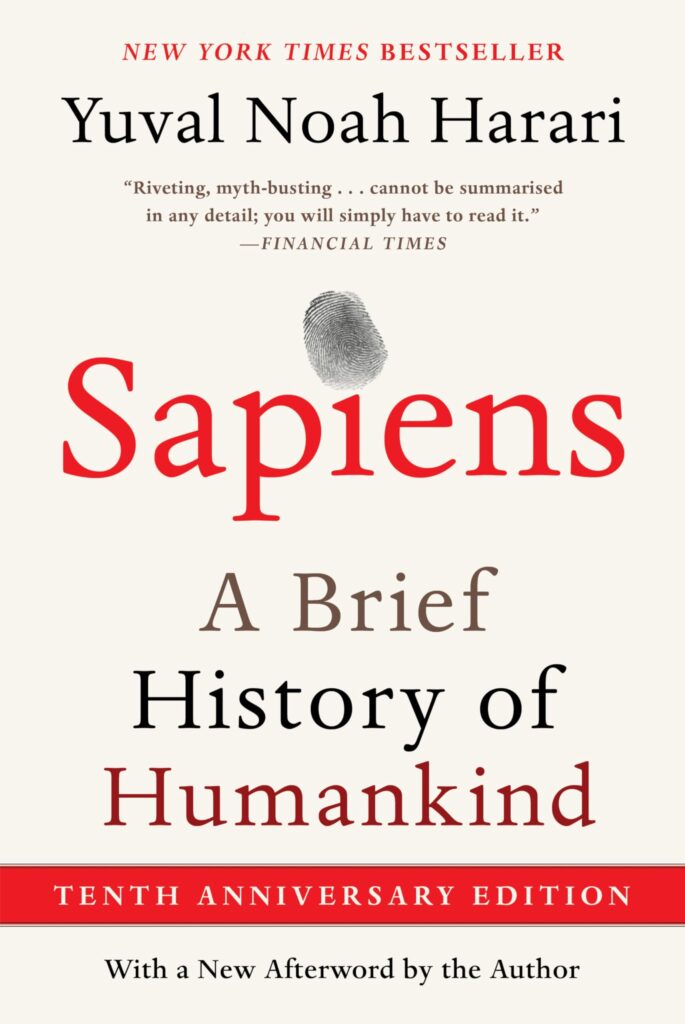
Sapiens: A Brief History of Humankind
One hundred thousand years ago, at least six different species of humans inhabited Earth. Today there is only one. What happened to the others, and what may happen to us?
In this international bestseller, historian Yuval Noah Harari takes readers on an epic journey through the entire history of our species. Starting 70,000 years ago with the Cognitive Revolution, Harari explores how Homo sapiens rose from insignificant apes to rulers of the world. He reveals how our unique ability to believe in shared myths, from gods and nations to money and human rights, enabled us to cooperate in massive numbers and build civilizations.
Harari challenges everything you thought you knew about being human. He argues that the Agricultural Revolution may have been history's biggest fraud, making most people's lives worse, not better. He traces how empires rose and fell, how capitalism conquered the globe, and how the Scientific Revolution gave us unprecedented power over nature and ourselves.
Blending history, biology, philosophy, and economics, Sapiens asks the big questions about where we came from and where we're going. As humans gain the ability to redesign themselves through biotechnology and artificial intelligence, understanding our past has never been more crucial to shaping our future.
Interesting Facts
Born from Classroom Lectures: Sapiens started as a series of 20 undergraduate world history lectures that Harari taught at Hebrew University of Jerusalem, transforming academic material into one of the most successful popular history books of the 21st century. The book captures the energy and accessibility of those original classroom discussions, making complex ideas digestible for millions.
Hebrew First, Global Later: The book was originally published in Hebrew in 2011 and didn't reach English-speaking audiences until 2014. This three-year gap turned out to be a blessing, as the book became a massive bestseller in Israel first, building momentum that would eventually propel it to international phenomenon status across 65 languages.
Staggering Sales Numbers: Harari's books have collectively sold over 45 million copies worldwide, with Sapiens alone accounting for a huge portion of that success. By 2017, the English edition had hit 1 million copies sold, and the numbers just kept climbing. The book spent 96 consecutive weeks in the top positions of the UK Sunday Times bestseller list and appeared on the New York Times bestseller list for 182 weeks.
Celebrity Book Club Favorite: Barack Obama, Bill Gates, and Mark Zuckerberg all publicly recommended Sapiens, with Gates calling it one of the ten books he'd bring to a desert island. The book also got an unexpected boost when contestants on the British reality show "Love Island" bonded over it in 2017, causing a 23% sales spike in the UK that week.
Three Revolutions Framework: Harari organizes all of human history around three pivotal revolutions: the Cognitive Revolution (70,000 years ago, when humans developed advanced language and imagination), the Agricultural Revolution (12,000 years ago), and the Scientific Revolution (500 years ago). This framework gives readers a memorable way to understand the massive sweep of human development.
Agriculture as History's Biggest Fraud: One of the book's most provocative arguments is that the Agricultural Revolution actually made life worse for most humans. Harari argues that farming led to harder work, worse diets, more disease, and less leisure time compared to hunter-gatherer lifestyles. The real winners were wheat and other crops, which essentially domesticated humans rather than the other way around.
Fiction as Superpower: Harari's central thesis is that humans dominate Earth because we're the only species that can believe in and cooperate around shared fictions like gods, nations, corporations, money, and human rights. This ability to create "imagined orders" allows millions of strangers to work together toward common goals, something no other animal can do at scale.
Academic Controversy: While Sapiens became a publishing phenomenon, many professional historians and scientists have been highly critical. Anthropologist Christopher Robert Hallpike called it entertainment rather than serious scholarship, and neuroscientist Darshana Narayanan found numerous substantial errors. The book's extremely broad scope makes it nearly impossible for any single expert to critique comprehensively, which may have actually protected it from early academic pushback.
Six Human Species: The book opens with the striking fact that 100,000 years ago, at least six different human species inhabited Earth, including Neanderthals, Homo erectus, and Homo floresiensis (tiny humans who reached only 3.5 feet tall). Today only Homo sapiens remains, and Harari argues we likely played a role in the extinction of our evolutionary cousins.
Inspired by Jared Diamond: Harari openly acknowledges that Jared Diamond's "Guns, Germs, and Steel" was one of his greatest inspirations. Both books take a sweeping, interdisciplinary approach to human history, though Harari's work is more focused on cognitive and cultural evolution while Diamond emphasized geography and biology.
Multimedia Empire: Sapiens has expanded far beyond the original book into a graphic novel series (launched in 2020 with artists David Vandermeulen and Daniel Casanave), an audiobook, and even inspired Harari's children's book series "Unstoppable Us." Harari and his husband Itzik Yahav also founded Sapienship, a social impact company focused on education and storytelling.
New York Times Top 100: Sapiens was selected as one of the New York Times Readers' Pick for Top 100 Books of the 21st Century, cementing its status as a defining work of contemporary nonfiction. The tenth anniversary edition published in 2024 includes a new afterword from Harari, reflecting on how the book's themes have evolved in an age of AI and global challenges.
Quotes
"You could never convince a monkey to give you a banana by promising him limitless bananas after death in monkey heaven."
"History began when humans invented gods, and will end when humans become gods."
"This is the essence of the Agricultural Revolution: the ability to keep more people alive under worse conditions."
"One of history’s few iron laws is that luxuries tend to become necessities and to spawn new obligations."
"Culture tends to argue that it forbids only that which is unnatural. But from a biological perspective, nothing is unnatural."
"Most people do not wish to accept that the order governing their lives is a make-believe order."
"Money is the most universal and most efficient system of mutual trust ever devised."
"In order to change an existing imagined order, we must first believe in an alternative imagined order."
"The romantic contrast between modern industry that destroys nature, and our ancestors who lived in harmony with nature, is exaggerated."
"Each year the US population spends more money on diets than the amount needed to feed all the hungry people in the rest of the world."
"Ever since the Cognitive Revolution, Sapiens have thus been living in a dual reality."
"Knowledge that does not change behaviour is useless."
"Biology enables, culture forbids."
"Happiness does not really depend on objective conditions of either wealth, health or even community. Rather, it depends on the correlation between objective conditions and subjective expectations."
"As far as we can tell, from a purely scientific viewpoint, human life has absolutely no meaning."
Ratings & Reviews
What do you think?
There are no reviews yet. Be the first one to write one.