
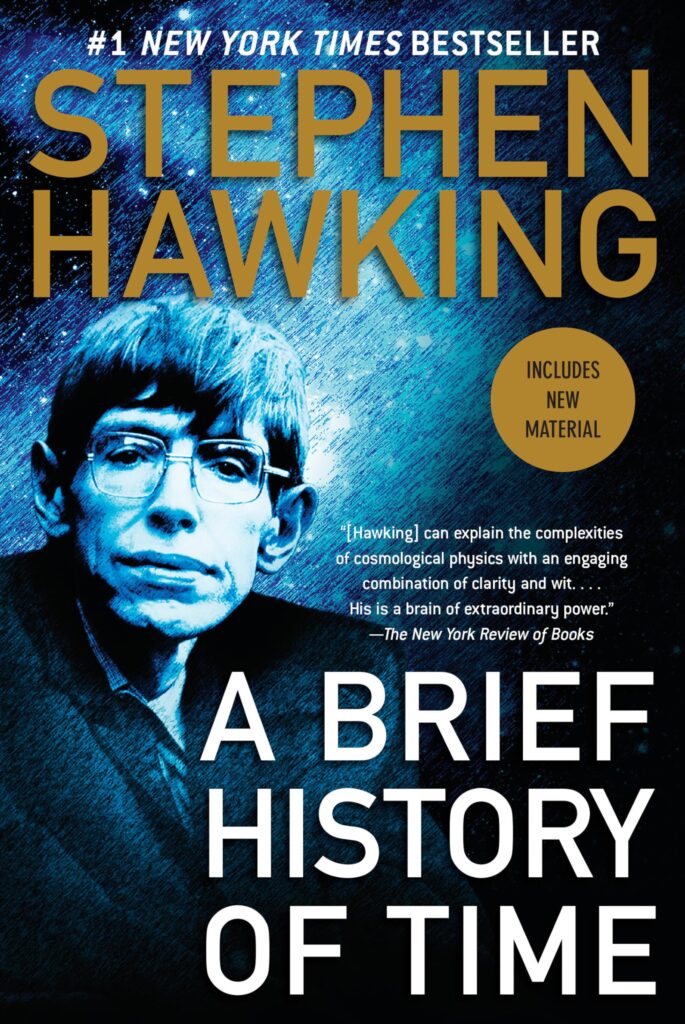
A Brief History of Time
What if the universe had a beginning? What if time itself could bend, or even end? These are the questions that have haunted humanity since we first looked up at the stars, and Stephen Hawking dares to answer them all.
From one of the greatest scientific minds of our time comes a journey into the deepest mysteries of existence. In this landmark bestseller, Hawking takes you from the Big Bang to black holes, from quarks to quantum mechanics, explaining the fundamental forces that shape our reality. He explores whether time always flows forward, if the universe has boundaries, and what will happen when it all ends.
Written in clear, accessible language that anyone can understand, this book transforms mind-bending physics into an adventure of discovery. Hawking held the same prestigious position at Cambridge University once occupied by Isaac Newton, and he brings that legacy of brilliance to every page. With over 25 million copies sold worldwide in 40 languages, this #1 New York Times bestseller has captivated readers across the globe.
Whether you're a science enthusiast or simply curious about your place in the cosmos, A Brief History of Time will change the way you see the universe forever. This is your chance to grasp the ultimate secrets at the very heart of creation.
Interesting Facts
Record-Breaking Bestseller Run: A Brief History of Time appeared on the Sunday Times bestseller list for an astonishing 237 weeks, making it one of the longest-running bestsellers in publishing history. This record-breaking achievement transformed Hawking from respected academic into global celebrity and demonstrated how scientific expertise could be translated into popular education.
Published on April Fools' Day: The first edition was published on April 1, 1988, a delightful coincidence for a book that would go on to challenge our understanding of reality itself. What started as an ambitious attempt to explain cosmology to general readers became a landmark volume in science writing.
The One-Equation Rule: Hawking was warned by his publisher that every equation in the book would halve the readership. Taking this advice to heart, he stripped out all mathematical formulas except one: Einstein's famous E=mc². This bold decision to rely on diagrams and clear explanations instead of equations helped make complex physics accessible to millions.
Astronomical Sales Numbers: The book has sold more than 25 million copies worldwide and has been translated into 40 languages. Hawking himself noted that roughly one copy had been sold for every 750 people on Earth.
Carl Sagan's Memorable Introduction: The first edition featured an introduction by astronomer Carl Sagan, who recounted witnessing Hawking sign his name in a book at the Royal Society that bore Isaac Newton's signature on its earliest pages. Sagan called Hawking the worthy successor to Newton and Paul Dirac, both former holders of the same prestigious Cambridge professorship.
Written for Financial Reasons: Hawking decided to write this popular science book in 1982 partly to finance his children's education and home expenses. Despite his numerous academic honors, these awards hadn't significantly changed his financial status, motivating him to reach beyond academic publishing to a mass-market audience.
Multiple Updated Editions: The book's success led to numerous revised versions, including a 1996 illustrated edition with over 240 photographs and diagrams, a 1998 tenth-anniversary edition, and a 2005 collaboration with Leonard Mlodinow called A Briefer History of Time that further simplified the concepts for readers.
Inspired a Documentary and TV Series: Director Errol Morris created a 1991 documentary about Hawking, produced by Steven Spielberg, that combined material from the book with biographical interviews. The book also inspired a six-part television series, a CD-ROM interactive adventure, and even a commissioned opera by the Metropolitan Opera that was ultimately canceled.
Time Magazine's Elite List: A Brief History of Time was included on Time magazine's prestigious list of the 100 best nonfiction books since the magazine's founding. This recognition cemented its status not just as a bestseller but as an enduring contribution to literature and public understanding of science.
Discusses Wormholes and Time Travel: Later editions included an entirely new chapter on wormholes and time travel, exploring whether Einstein's General Theory of Relativity might allow us to create passages through space-time for rapid galactic travel or journeying backward in time. Hawking playfully notes we haven't seen tourists from the future yet, but discusses possible explanations.
Quotes
"Even if there is only one possible unified theory, it is just a set of rules and equations. What is it that breathes fire into the equations and makes a universe for them to describe?"
"The universe doesn't allow perfection."
"If time travel is possible, where are the tourists from the future?"
"Ever since the dawn of civilization, people have not been content to see events as unconnected and inexplicable."
"Most sets of values would give rise to universes that, although they might be very beautiful, would contain no one able to wonder at that beauty."
"An expanding universe does not preclude a creator."
"Why is the universe the way we see it? The answer is then simple: If it had been any different, we would not be here!"
"I am just a child who has never grown up. I still keep asking these 'how' and 'why' questions. Occasionally, I find an answer."
"Our goal is nothing less than a complete description of the universe we live in."
"We are just an advanced breed of monkeys on a minor planet of a very average star. But we can understand the Universe. That makes us something very special."
Ratings & Reviews
What do you think?
There are no reviews yet. Be the first one to write one.