
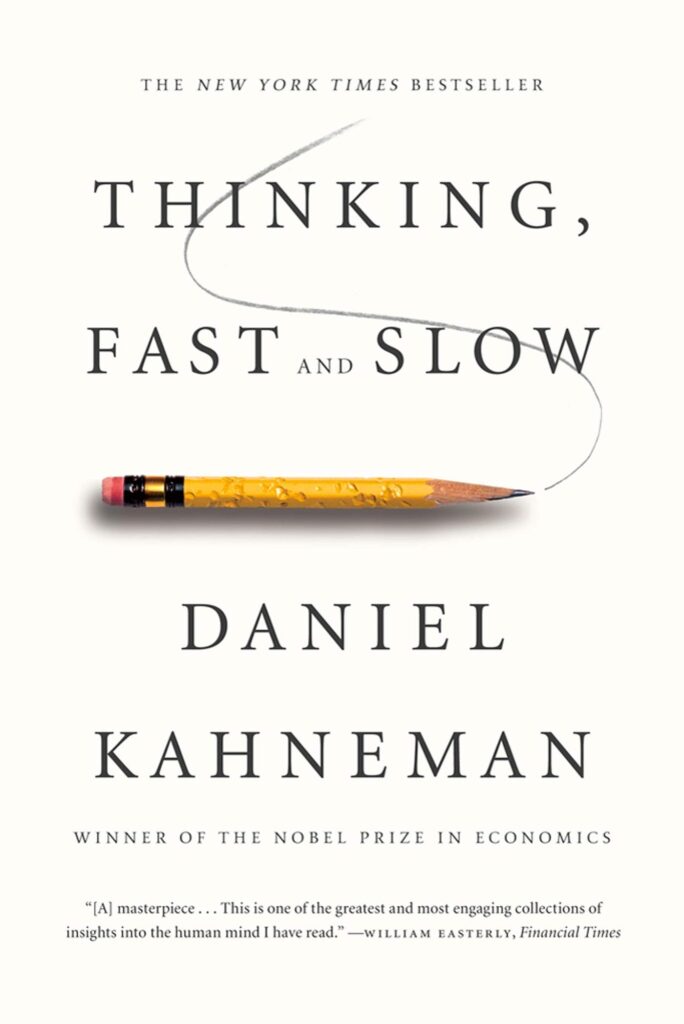
Thinking, Fast and Slow
Why do smart people make terrible decisions?
Your mind is playing tricks on you right now, and you don't even know it. Nobel Prize winner Daniel Kahneman reveals the hidden forces that shape every choice you make, from what you buy to who you trust.
Meet the two systems that run your brain. System 1 is fast, instinctive, and emotional. System 2 is slower, more deliberate, and logical. Together, they determine how you think, but System 1 is secretly in control far more than you realize, leading you into predictable errors and biases.
Drawing on decades of research with Amos Tversky, Kahneman exposes the mental shortcuts that cloud your judgment. You'll discover why you're overconfident in your predictions, why you fear losses more than you value gains, and why the way choices are framed completely changes your decisions. From investing in the stock market to planning your next vacation, these cognitive biases affect everything.
This isn't just theory. Kahneman offers practical insights to help you recognize when to trust your intuition and when to slow down and think carefully. You'll learn techniques to guard against the mental glitches that get you into trouble in business and personal life.
A contemporary classic that has transformed millions of readers, Thinking, Fast and Slow will change the way you think about thinking.
Interesting Facts
Nobel Winner Wrote This: Daniel Kahneman won the 2002 Nobel Prize in Economic Sciences, remarkably becoming the first psychologist to receive this honor despite never having taken a single economics course. Everything he knew about economics, he learned from collaborators like Richard Thaler and Jack Knetsch while revolutionizing how we understand human decision-making.
A Psychologist Changed Economics Forever: This isn't a traditional economics book at all! Kahneman trained as a psychologist and his work fundamentally challenged the assumption that humans are rational economic actors. His research with Amos Tversky created an entirely new field called behavioral economics, which economist Richard Thaler called one of the most important accomplishments of 20th century science.
The Book Topped Lists for Nearly a Decade: Published in 2011, Thinking, Fast and Slow remained on bestseller lists for almost ten years and has sold over 2.6 million copies. It won the National Academy of Sciences Best Book Award in 2012 and was named one of The New York Times Book Review's ten best books of 2011.
Two Systems Run Your Mind: The book's central framework introduces System 1 (fast, intuitive, emotional thinking) and System 2 (slower, deliberative, logical thinking) as metaphorical characters in your mind. Kahneman deliberately personifies these systems to make complex psychological concepts accessible, even though they're not literal brain structures but rather descriptions of how our mental processes work.
Written for Office Gossip: Kahneman explicitly states he wrote this book for conversations around the office water cooler. He believes it's much easier to spot thinking errors in others than in ourselves, so he aims to give readers a richer vocabulary for discussing the judgments and choices of colleagues, friends, and family.
Built on Decades of Groundbreaking Research: The book synthesizes over 30 years of Kahneman's research, covering different phases of his career from early work on cognitive biases to prospect theory and happiness studies. The research he did with Amos Tversky produced papers cited over 50,000 times, with their 1979 prospect theory paper becoming the most cited in economics.
Compared to History's Greatest Works: Nassim Taleb, author of The Black Swan, called Thinking, Fast and Slow a landmark book in social thought, placing it in the same league as Adam Smith's The Wealth of Nations and Sigmund Freud's The Interpretation of Dreams. Steven Pinker described Kahneman as among the most influential psychologists in history.
The Book Has Five Distinct Parts: The structure guides readers through judgment and choice, exploring why statistical thinking is difficult for humans, examining overconfidence, analyzing how we make choices, and introducing the distinction between the "experiencing self" and "remembering self," two different ways we evaluate our own happiness.
Baseball Scouts Love It: The book achieved an unexpected following among baseball scouts and executives who recognize that the thinking patterns Kahneman describes help them avoid falling into prescriptive yet inaccurate patterns of analysis when making major judgments based on limited information.
A Friendship Changed Science: The research behind this book emerged from one of the most remarkable collaborations in scientific history between Kahneman and Amos Tversky. Their partnership, which began in 1969 after a contentious seminar discussion, was so influential that Michael Lewis wrote an entire bestselling book about it called The Undoing Project: A Friendship That Changed Our Minds.
The Author Acknowledged Flaws: In a remarkable display of intellectual humility, Kahneman later acknowledged that some research in the book, particularly in chapter 4, relied on studies with replicability problems. He admitted in blog comments that he placed too much faith in underpowered studies, demonstrating the very kind of judgment error his book explores.
It Introduces Practical Mental Tools: Beyond theory, the book offers readers techniques to recognize when they can and cannot trust their intuitions, how to tap into slower thinking when needed, and how to guard against mental glitches in both business and personal decisions. Kahneman wanted to provide tools that would genuinely improve how people think about thinking.
Quotes
"Nothing in life is as important as you think it is, while you are thinking about it."
"A reliable way to make people believe in falsehoods is frequent repetition, because familiarity is not easily distinguished from truth."
"Our comforting conviction that the world makes sense rests on a secure foundation: our almost unlimited ability to ignore our ignorance."
"We are prone to overestimate how much we understand about the world and to underestimate the role of chance in events."
"The idea that the future is unpredictable is undermined every day by the ease with which the past is explained."
"Hindsight bias helps us explain the past, but it makes the past feel more predictable than it was."
"We can be blind to the obvious, and we are also blind to our blindness."
"What you see is all there is."
"Losses loom larger than gains."
"Nothing in life is as important as you think it is when you are thinking about it."
"The essence of intuitive heuristics: when faced with a difficult question, we often answer an easier one instead, usually without noticing the substitution."
"Confidence is a feeling, which reflects the coherence of the information and the cognitive ease of processing it."
"The engine of capitalism is optimism."
"People are much more sensitive to losses than to gains."
"Risk policies that are made in advance of decisions, therefore, shield us from the vagaries of emotion and from the temptation to overturn sound decisions because of temporary moods or preferences."
Ratings & Reviews
What do you think?
There are no reviews yet. Be the first one to write one.