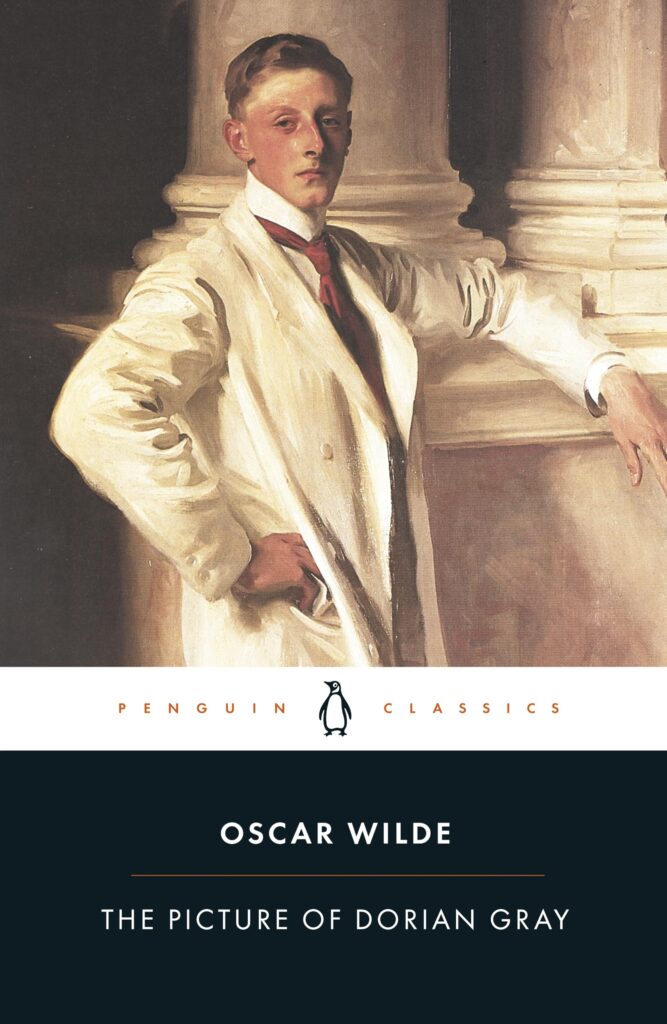
The Picture of Dorian Gray
Oscar Wilde published his only novel in 1890, and it still feels dangerous.
A young man named Dorian Gray sits for a portrait painted by the artist Basil Hallward. The painting is stunning. Dorian, realizing his beauty will fade, makes a terrible wish. He wants the portrait to age instead of him.
The wish comes true.
What follows is a story about a man who stays forever young and beautiful while his portrait absorbs every sin, every cruelty, every ugly choice he makes. The painting becomes a mirror of his soul. And Dorian cannot stop looking at it.
Lord Henry Wotton is the devil on Dorian's shoulder. He speaks in brilliant, quotable poison. You will underline half of what he says. Then you will feel uneasy about how much you agree with him.
Wilde wrote about vanity, influence, and the cost of living without consequence. The novel caused a scandal when it was first published. Critics called it immoral. Wilde essentially said that was the point.
This book is short, sharp, and impossible to shake. It asks one question you will think about long after you finish. What would you do if no one could see what your choices did to you?
Read it. Then hide your mirrors.
Interesting Facts
Oscar Wilde's Only Novel: The Picture of Dorian Gray stands as the sole novel Oscar Wilde ever wrote. He focused primarily on poetry, plays, and essays throughout his career. This makes the book even more remarkable as his singular venture into long-form fiction.
Inspired By A Portrait Sitting: Wilde got the idea for the story in December 1887 when a Canadian artist named Frances Richards painted his portrait. After seeing it, he jokingly remarked what a tragedy it was that the portrait would never age while he would. The moment he said it, he realized what a perfect plot it would make.
Published For Twenty-Five Cents: The first version appeared in the July 1890 issue of Lippincott's Monthly Magazine and sold for just twenty-five cents to American readers. It was a cheaply printed novella before becoming a proper book.
Censored Before Publication: Editor J.M. Stoddart deleted around 500 words from Wilde's original manuscript without his permission before the magazine publication. These cuts removed homoerotic content and references to Dorian's lovers as "mistresses." Wilde didn't see these changes until the story appeared in print.
Received 216 Negative Reviews: During just the first month after publication, the novella received 216 negative reviews. Critics called it "unclean," "poisonous," "nauseous," and said it had "mephitic odours of moral and spiritual putrefaction."
Expanded From Thirteen To Twenty Chapters: After the backlash, Wilde revised and expanded the story significantly. He added six new chapters when the book version was published in April 1891. The additions helped dilute the perceived immorality and homoerotic themes.
Used As Evidence Against Wilde: The book was used as evidence during Wilde's 1895 trial for "gross indecency." Prosecutors read passages aloud in court to portray him as immoral. The novel became a weapon to turn the public and jury against him.
Wilde Identified With All Three Characters: Wilde famously said the novel "contains much of me." He explained that Basil Hallward is "what I think I am," Lord Henry is "what the world thinks me," and Dorian is "what I would like to be in other ages, perhaps."
Famous Preface Added Later: The preface, now famous as a manifesto for art for art's sake, was written after the initial criticism. Wilde published it first in The Fortnightly Review, then included it in the 1891 book edition. It contains his celebrated line "All art is quite useless."
Mostly Ignored Until The 1980s: The novel was considered "unworthy" of critical attention for decades. Even renowned critic Richard Ellmann wrote that "parts of the novel are wooden, padded, self-indulgent." Only from the 1980s onward did scholars begin reassessing it as a masterpiece.
Dinner That Changed Literature: On August 30, 1889, editor J.M. Stoddart dined with Oscar Wilde and Sir Arthur Conan Doyle at the Langham Hotel. He commissioned novellas from both writers. Doyle submitted The Sign of the Four, while Wilde delivered Dorian Gray seven months later.
Self-Censorship In The Manuscript: Even before the editor's cuts, Wilde censored himself while writing. In the original manuscript, he changed words like "beauty" to "good looks" and "passion" to "feeling" when describing Basil's admiration for Dorian. He crossed out Basil's confession about holding Dorian's hand.
Original Typescript At UCLA: The earliest surviving manuscript, with Wilde's handwritten additions, is housed at UCLA's William Andrews Clark Memorial Library. It remained largely forgotten except by scholars until Harvard's Belknap Press published an annotated, uncensored edition in 2011.
Quotes
"Life has everything in store for you, Dorian. There is nothing that you, with your extraordinary good looks, will not be able to do." - Oscar Wilde
"Never marry at all, Dorian. Men marry because they are tired, women, because they are curious: both are disappointed." - Oscar Wilde
"Those who find ugly meanings in beautiful things are corrupt without being charming. This is a fault. Those who find beautiful meanings in beautiful things are the cultivated. For these there is hope." - Oscar Wilde
"Live! Live the wonderful life that is in you! Let nothing be lost upon you. Be always searching for new sensations. Be afraid of nothing." - Oscar Wilde
"I am jealous of everything whose beauty does not die. I am jealous of the portrait you have painted of me. Why should it keep what I must lose? Every moment that passes takes something from me and gives something to it. Oh, if it were only the other way! If the picture could change, and I could be always what I am now!" - Oscar Wilde
"How sad it is! I shall grow old, and horrible, and dreadful. But this picture will remain always young. It will never be older than this particular day of June. If it were only the other way! If it were I who was to be always young, and the picture that was to grow old! For that—I would give everything!" - Oscar Wilde
"Some things are more precious because they don't last long." - Oscar Wilde
"I make a great difference between people. I choose my friends for their good looks, my acquaintances for their good characters, and my enemies for their good intellects. A man cannot be too careful in the choice of his enemies." - Oscar Wilde
"Humanity takes itself too seriously. It is the world's original sin. If the cave-man had known how to laugh, History would have been different." - Oscar Wilde
"The basis of optimism is sheer terror." - Oscar Wilde
"The books that the world calls immoral are books that show the world its own shame." - Oscar Wilde
"It is only shallow people who do not judge by appearances. The true mystery of the world is the visible, not the invisible." - Oscar Wilde
"You will always be fond of me. I represent to you all the sins you never had the courage to commit." - Oscar Wilde
"Experience is merely the name men gave to their mistakes." - Oscar Wilde
"Whenever a man does a thoroughly stupid thing, it is always from the noblest motives." - Oscar Wilde
Ratings & Reviews
What do you think?
There are no reviews yet. Be the first one to write one.