
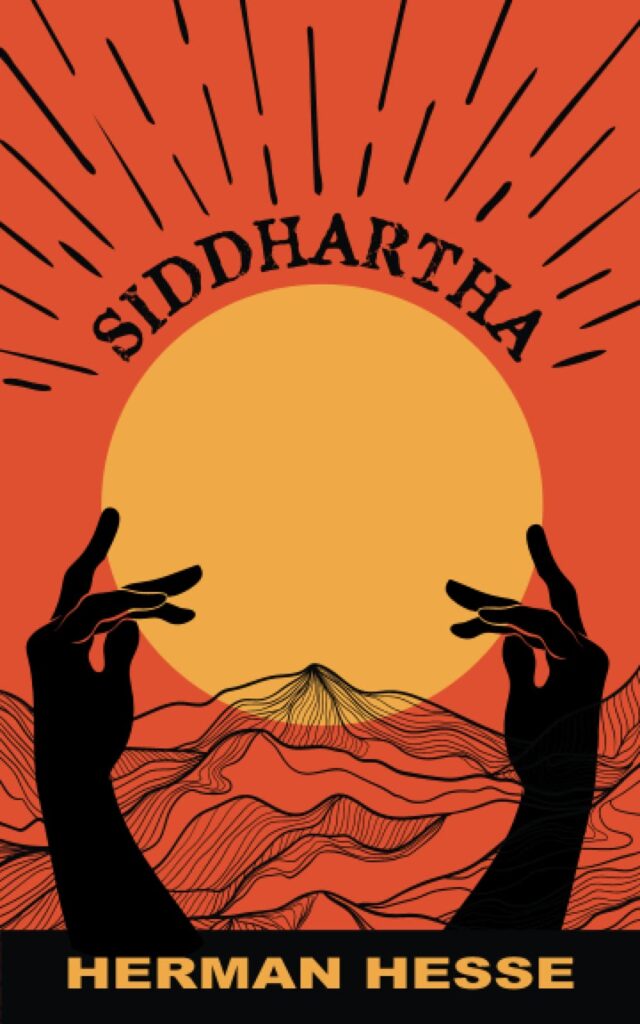
Siddhartha
A young man abandons wealth, privilege, and everything he knows to answer a question that burns inside him: What is the meaning of life?
Hermann Hesse's timeless 1922 masterpiece follows Siddhartha, the brilliant son of a Brahmin in ancient India, as he rejects the comfortable path laid before him. Driven by an insatiable thirst for truth, he joins wandering ascetics, meets the Buddha himself, and plunges into a world of sensual pleasure and material success. Yet none of these paths bring him peace.
Written in lyrical, flowing prose, this philosophical novel weaves together Eastern and Western thought into a profound meditation on the human search for meaning. Siddhartha's journey takes him through fasting and feasting, love and loss, wealth and poverty. Only beside a river, guided by a humble ferryman, does he begin to understand the unity that connects all living things.
A defining text of the 1960s counterculture, Siddhartha continues to captivate readers today. It speaks to anyone who has ever questioned whether there is more to life than what society offers.
Interesting Facts
Written In A Spiritual Crisis: Hesse began writing Siddhartha in 1919 during one of the darkest periods of his life. His father had died, his wife was suffering from schizophrenia, his son was seriously ill, and his marriage was falling apart. He turned to psychoanalysis with Carl Jung and immersed himself in Eastern philosophy to find his way through.
Two Years Of Writer's Block: The book took nearly three years to complete because Hesse got stuck halfway through. He published Part One in July 1921 without an ending. He couldn't finish because he hadn't yet experienced the transcendental unity his character was seeking. He lived as a semi-recluse, studying Hindu and Buddhist scriptures intensely, trying to reach that state himself.
Never Set Foot In India: Despite writing the most famous Western novel set in India, Hesse never visited India proper. He traveled to Sri Lanka, Indonesia, Borneo, and Burma in 1911 but illness prevented him from reaching India. He found the heat, squalor, and noise physically oppressive and cut his trip short. The India in Siddhartha came entirely from his imagination and study of sacred texts.
Four Million American Copies: By its 2022 centenary, the novel had sold over four million copies in the United States alone. It became one of the most popular Western novels ever written about India, despite Hesse never setting foot there.
Flopped At First In Germany: When Siddhartha was published in German in 1922, it made little impression. German readers weren't particularly interested. The book only became a sensation decades later when it was translated into English in 1951 and discovered by American counterculture.
The 1960s Made It A Phenomenon: By the time Hesse died in 1962, his works were barely read in America despite his Nobel Prize. Then suddenly in the mid-1960s, Siddhartha became a massive bestseller with the hippie movement. Its themes of rejecting authority, seeking enlightenment, and finding your own path resonated perfectly with that generation.
Structured On Hindu Life Stages: The novel's twelve chapters are deliberately structured on three traditional stages of life for Hindu males: student, householder, and renunciate. They also correspond to the Buddha's Four Noble Truths in Part One and the Eightfold Path in Part Two.
Became A Film In 1972: A film version starring Shashi Kapoor and directed by Conrad Rooks was released in 1972. The novel was also loosely adapted into a musical Western called Zachariah in 1971.
At Least Seven English Translations: Since the first English translation in 1951, at least seven different English versions have been published. Translators have debated how to preserve Hesse's deliberate, meditative rhythms and musical quality in the original German.
Quotes
"Knowledge can be communicated, but not wisdom. One can find it, live it, do wonders through it, but one cannot communicate and teach it." - Siddhartha
"The world, Govinda, is not imperfect or slowly evolving along a long path to perfection. No, it is perfect at every moment; every sin already carries grace within it, all small children are potential old men, all sucklings have death within them, all dying people - eternal life." - Hermann Hesse
". . . gentleness is stronger than severity, water is stronger than rock, love is stronger than force." - Siddhartha
"Have you also learned that secret from the river; that there is no such thing as time? That the river is everywhere at the same time, at the source and at the mouth, at the waterfall, at the ferry, at the current, in the ocean and in the mountains, everywhere and that the present only exists for it, not the shadow of the past nor the shadow of the future." - Siddhartha
"Beautiful was the world, colourful was the world, strange and mysterious was the world!" - Hermann Hesse
"Your soul is the whole world." - Siddhartha
"When someone seeks, then it easily happens that his eyes see only the thing that he seeks, and he is able to find nothing, to take in nothing because he always thinks only about the thing he is seeking, because he has one goal, because he is obsessed with his goal. Seeking means: having a goal. But finding means: being free, being open, having no goal." - Siddhartha
"It is not for me to judge another man's life. I must judge, I must choose, I must spurn, purely for myself. For myself, alone." - Siddhartha
"I felt knowledge and the unity of the world circulate in me like my own blood." - Hermann Hesse, Siddhartha
"I can think. I can wait. I can fast." - Siddhartha
"I have always believed, and I still believe, that whatever good or bad fortune may come our way we can always give it meaning and transform it into something of value." - Siddhartha
"My real self wanders elsewhere, far away, wanders on and on invisibly and has nothing to do with my life." - Siddhartha
"I will no longer mutilate and destroy myself in order to find a secret behind the ruins." - Siddhartha
Ratings & Reviews
What do you think?
There are no reviews yet. Be the first one to write one.