
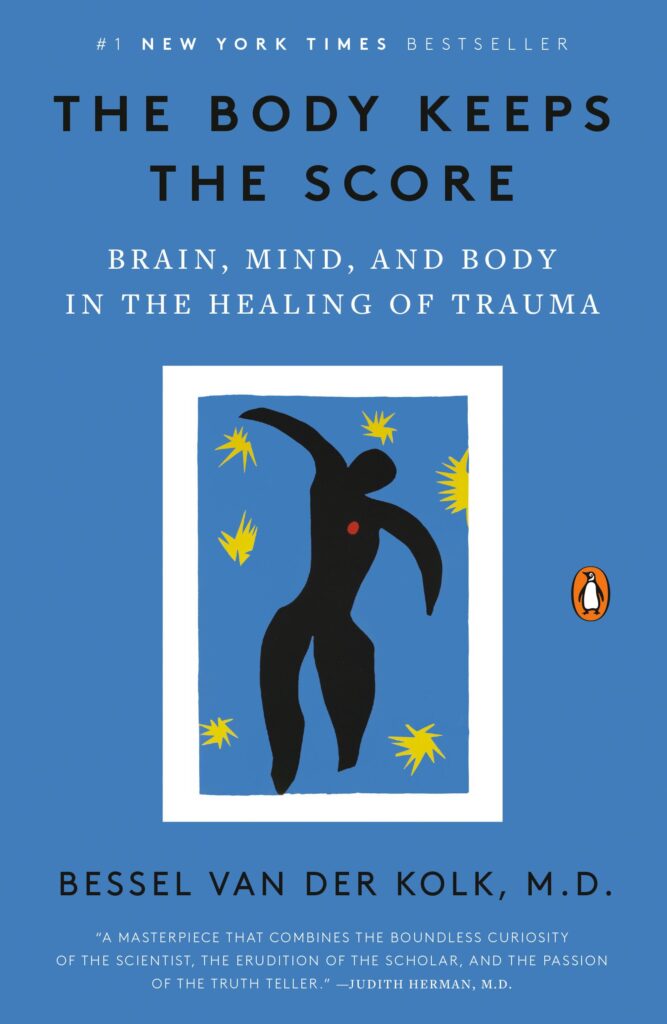
The Body Keeps the Score: Brain, Mind, and Body in the Healing of Trauma
Your mind may forget, but your body remembers everything.
Trauma isn't just a psychological wound. It reshapes your brain, rewires your nervous system, and lives in your cells. In this #1 New York Times bestseller, van der Kolk reveals how overwhelming stress compromises our capacities for pleasure, engagement, self-control, and trust. Veterans, abuse survivors, and anyone who has experienced trauma will find their experiences illuminated with clarity and compassion.
In this #1 New York Times bestseller, psychiatrist Bessel van der Kolk draws on over thirty years of research to reveal how traumatic stress fundamentally changes the way we think, feel, and live.
Drawing on cutting-edge neuroscience and attachment research, Dr. van der Kolk explains why traditional talk therapy often falls short. The mind may try to bury trauma to protect us, but the body remembers. This disconnect between mind and body lies at the heart of traumatic stress.
But there is hope. Dr. van der Kolk explores innovative treatments, from neurofeedback and EMDR to yoga and theater, that offer new paths to recovery by activating the brain's natural neuroplasticity. These approaches help survivors reclaim ownership of their bodies and their lives.
A professor of psychiatry at Boston University School of Medicine and founder of the Trauma Center in Brookline, Massachusetts, Dr. van der Kolk combines rigorous science with deeply moving patient stories. Whether you are a trauma survivor, a loved one seeking understanding, or a professional looking for new approaches, this book offers powerful insights and practical pathways toward healing.
Interesting Facts
Sold Over Six Million Copies: This book spent more than eight years on the New York Times bestseller list after its 2014 publication. It became a cultural phenomenon during the pandemic when interest in mental health surged.
Born From a 1994 Article: The book's title comes from van der Kolk's 1994 Harvard Review of Psychiatry article. He spent two decades expanding those ideas into the full book published in 2014.
Author Studied Trauma Since the 1970s: Van der Kolk began his trauma research career in 1978 working with Vietnam veterans. Back then, PTSD wasn't even an official diagnosis yet.
Fought for Complex PTSD Recognition: Van der Kolk led efforts to add Complex PTSD to the DSM-IV. His work group voted 19 to 2 in favor, but the recommendation was rejected by the larger committee.
Explores Unconventional Treatments: The book examines yoga, EMDR, neurofeedback, theater, and other body-based therapies. Van der Kolk received National Institutes of Health grants to study EMDR and yoga for trauma.
Yoga Outperformed Medication In His Study: Van der Kolk's research found that yoga reduced PTSD symptoms more effectively than any drug studied to date. The body-based approach worked because trauma lives in physical sensations, not just memories.
Conducted First SSRI Studies for PTSD: He led the first research studies examining how SSRI medications affect people with PTSD. This work opened new treatment pathways.
He Founded The Trauma Center In 1982: Van der Kolk established one of the first clinics dedicated specifically to traumatic stress in Brookline, Massachusetts. It became a leading research and treatment facility for over three decades.
Emphasizes Body Over Talk Therapy: Van der Kolk argues that trauma lives in the body, not just the mind. Traditional talk therapy alone often fails because trauma affects the survival parts of the brain.
Became Pandemic Reading Phenomenon: The book surged in popularity during COVID-19. Library wait times stretched to months, and it dominated bestseller lists throughout 2020 and 2021.
Brain Scans Revealed Surprising Patterns: Van der Kolk used neuroimaging to show that traumatized brains look different. The speech center actually shuts down during trauma flashbacks, explaining why victims struggle to put experiences into words.
Writing Took Years Of Personal Struggle: Van der Kolk worked on the manuscript for over a decade before publication. He wanted to translate complex neuroscience into language that ordinary people could understand and use.
Quotes
"Trauma is not what happens to you, but what happens inside you as a result of what happens to you." - Bessel van der Kolk
"Imagination is absolutely critical to the quality of our lives." - Bessel van der Kolk
"Physical self-awareness is the first step in releasing the tyranny of the past." - Bessel van der Kolk
"It takes enormous trust and courage to allow yourself to remember." - Bessel van der Kolk
"The essence of trauma is that it is overwhelming, unbelievable, and unbearable." - Bessel van der Kolk
"The greatest sources of our suffering are the lies we tell ourselves." - Bessel van der Kolk
"The body keeps the score: If the memory of trauma is encoded in our senses, in muscle tension, and in anxiety, then the body must also be involved in the healing process." - Bessel van der Kolk
"As I often tell my students, the two most important phrases in therapy, as in yoga, are “Notice that” and “What happens next?”" - Bessel van der Kolk
"As long as we feel safely held in the hearts and minds of the people who love us, we will climb mountains and cross deserts and stay up all night to finish projects." - Bessel van der Kolk
"In order to change, people need to become aware of their sensations and the way that their bodies interact with the world around them." - Bessel van der Kolk
"Beneath the surface of the protective parts of trauma survivors there exists an undamaged essence, a Self that is confident, curious, and calm." - Bessel van der Kolk
"As long as you keep secrets and suppress information, you are fundamentally at war with yourself." - Bessel van der Kolk
Ratings & Reviews
What do you think?
There are no reviews yet. Be the first one to write one.