
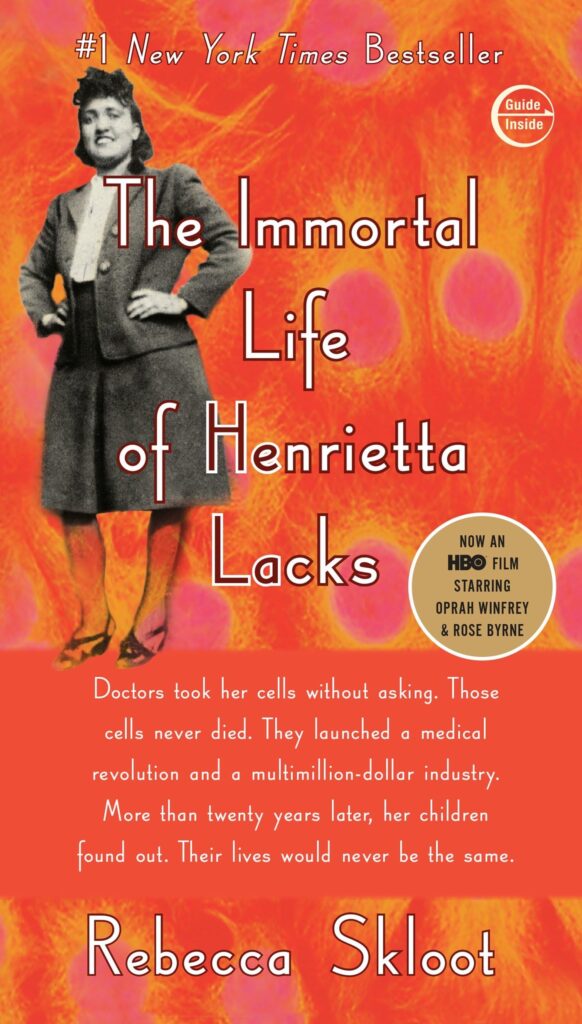
The Immortal Life of Henrietta Lacks
Her cells have been bought and sold by the billions, yet Henrietta Lacks remains virtually unknown. In 1951, doctors at Johns Hopkins Hospital took cells from this poor African American tobacco farmer's cervical tumor without her knowledge. Those cells became the first immortal human cell line ever grown in culture, still alive today more than sixty years after her death. HeLa cells helped develop the polio vaccine, unlocked secrets of cancer and viruses, and led to breakthroughs in cloning, gene mapping, and in vitro fertilization.
But Henrietta's family didn't learn about her immortal cells until more than twenty years after her death. Scientists had been using her husband and children in research without informed consent. Though the cells launched a multimillion-dollar industry, her family never saw any profits and couldn't even afford health insurance.
Rebecca Skloot spent over a decade uncovering this remarkable story, becoming deeply involved with the Lacks family, especially Henrietta's daughter Deborah. Together they explored profound questions about science, ethics, and race. This journey takes readers from the segregated wards of 1950s Baltimore to cutting-edge laboratories, from a small Virginia town to the heart of the debate over who controls the stuff we're made of.
Intimate, astonishing, and impossible to put down, this book captures both the beauty of scientific discovery and its human cost.
Interesting Facts
Decade-Long Research Journey: Rebecca Skloot spent over ten years researching and writing this book, starting when she first heard about Henrietta Lacks in a community college biology class at age 16! She financed much of her research with credit cards and student loans while working various jobs, showing incredible dedication to telling this story right.
Three Nobel Prizes: HeLa cells have contributed to research that won three Nobel Prizes: one for work on viruses and cancer in 2008, another for research on telomeres in 2009, and a third for live viewing of cellular growth in 2014. These cells have truly revolutionized modern medicine in ways most people never realize.
Over 110,000 Scientific Publications: Between 1953 and 2018, more than 110,000 scientific publications cited the use of HeLa cells. These cells helped develop the polio vaccine, advanced cancer research, enabled in vitro fertilization, contributed to gene mapping and cloning, and even played a role in COVID-19 vaccine development.
50 Million Metric Tons: The total weight of all HeLa cells ever grown exceeds 50 million metric tons! These cells double every 20 to 24 hours and just keep multiplying, which is why they became so valuable to researchers worldwide who needed reliable, consistent cells for experiments.
Family Learned 20 Years Later: Henrietta's family didn't discover that her cells were being used in research until more than 20 years after her death in 1951. They found out in the 1970s when scientists started contacting them for blood samples to help identify HeLa cells, which had contaminated other cell cultures in labs around the world.
A Year to Gain Trust: It took Rebecca Skloot more than a year of phone calls and shared research just to gain the trust of Deborah Lacks, Henrietta's daughter. As a white woman approaching a Black family that had been exploited by the medical establishment, Skloot had to prove she genuinely wanted to honor Henrietta's story, not profit from it.
Named Best Book by 60+ Critics: The book was chosen as one of the best books of 2010 by more than 60 media outlets, including Entertainment Weekly, People, and The New York Times. It stayed on The New York Times bestseller list for over six years and eventually reached number one, an extraordinary achievement for a debut nonfiction book.
Won the National Academies Award: The book won the 2011 National Academies Communication Award for best creative work that helps public understanding of topics in science, engineering, or medicine. It also won the Chicago Tribune Heartland Prize for Nonfiction and the Wellcome Trust Book Prize, among many other honors.
Oprah Winfrey Starred in HBO Film: The book was adapted into an HBO film in 2017, with Oprah Winfrey playing Deborah Lacks and also serving as executive producer alongside Alan Ball. Rose Byrne portrayed Rebecca Skloot, and members of the Lacks family served as consultants on the film.
Three-Strand Narrative Structure: Skloot deliberately structured the book as a braid of three narratives: the story of Henrietta and her cells, the story of the Lacks family dealing with this legacy, and the story of Skloot's own journey researching and building trust with the family. This innovative structure allows readers to experience the discovery process alongside the author.
Deborah Never Saw Publication: Tragically, Deborah Lacks, who Skloot described as "the soul of the book" and whose spirit and determination inspired over a decade of work, passed away in 2009, just one year before the book was published. Deborah never got to see the finished tribute to her mother that she helped make possible.
Quotes
"Henrietta’s cells have now been living outside her body far longer than they ever lived inside it."
“She’s the most important person in the world and her family living in poverty.”
"They’d spent months developing a method for keeping cells alive and reproducing indefinitely, so scientists could use them for research."
"Doctors took her cells without asking."
"The world didn’t know Henrietta’s name, but scientists had been using her cells for decades."
"Weeks later, when Henrietta was home with her family, she suddenly felt a sharp pain in her lower abdomen."
"Her cells have been bought and sold by the billions, yet she remains virtually unknown, and her family can’t afford health insurance."
“When I go to the doctor for a checkup, I always say my mother was Henrietta Lacks. I figure if my mother’s cells could help scientists find cures for diseases, her name deserves to be used when they talk about them.”
“I just want to know who my mother was.”
"Cells are everywhere… some may be floating around in this room from your breath."
“Henrietta’s cells multiplied like nothing anyone had ever seen, and they’re still alive today, though she’s been dead for more than sixty years.”
“She's in all of us now.”
“I thought I’d spend my life with my mother, but she was gone before I turned two.”
“This is the story of the woman behind those cells, the story of her family, and of how science and ethics collided in the aftermath.”
"People often say that without Henrietta Lacks, the world of modern medicine would look very different."
Ratings & Reviews
What do you think?
There are no reviews yet. Be the first one to write one.