
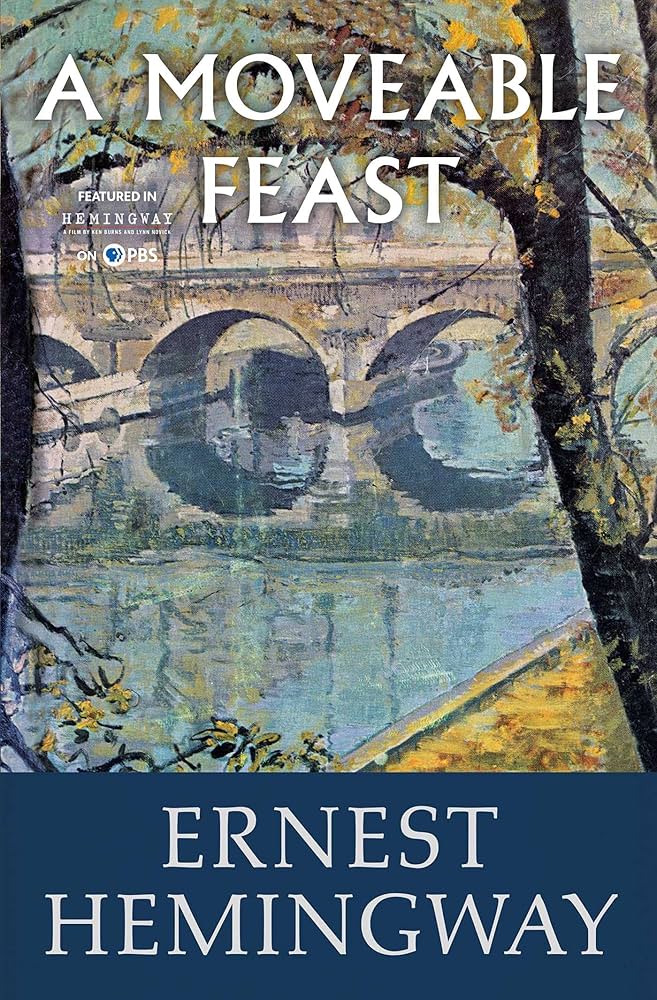
A Moveable Feast
In 1920s Paris, a young and unknown Ernest Hemingway wandered the cobblestone streets of the Left Bank, hungry for food, for love, and for literary greatness. A Moveable Feast is the Nobel Prize-winning author's unforgettable memoir of those formative years as a struggling expatriate writer in the most romantic city on earth.
Written with Hemingway's signature spare and luminous prose, this intimate portrait captures the cafés where he wrote, the cold apartments he shared with his first wife Hadley, and the electric atmosphere of a city brimming with artistic revolution. Here you will encounter the legendary figures who shaped modernist literature, including F. Scott Fitzgerald, Gertrude Stein, Ezra Pound, and James Joyce, all rendered in vivid and often irreverent detail.
But this is more than a literary who's who. It is a meditation on the creative life itself, on hunger as discipline, on the joy of writing one true sentence, and on the bittersweet nature of memory. Hemingway reflects on his craft with rare candor, offering glimpses into the formation of one of the twentieth century's most influential voices.
Published posthumously in 1964, A Moveable Feast remains one of Hemingway's most beloved works. Whether you are a devoted Hemingway reader or new to his world, this book will transport you to a vanished era when Paris was the center of artistic creation, and a young man with nothing but talent and ambition was about to change literature forever.
Interesting Facts
Paris On A Shoestring: Hemingway and his first wife Hadley lived on just $5 a day in 1920s Paris. They survived on café crèmes and the free bread baskets at restaurants.
A Title Hemingway Never Chose: The famous title came from a phrase Hemingway used in conversation with his friend A.E. Hotchner back in 1950. Hotchner remembered Hemingway saying Paris was "a moveable feast" and suggested it as the title after Hemingway's death. It's a clever play on the religious term for holy days that don't fall on fixed dates.
Published Three Years Posthumously: Hemingway died in July 1961, but the book didn't appear until May 5, 1964. His fourth wife Mary Hemingway edited the manuscript and prepared it for publication. She worked from his original notebooks and drafts.
Written From Old Notebooks: In 1957, Hemingway discovered a trunk of old notebooks from his Paris years at the Ritz Hotel. He had filled them with careful handwriting while sitting in his favorite cafés, nursing a café crème. These became the raw material for the memoir.
Fiction Or Memoir? You Decide: In the preface, Hemingway playfully suggests readers can treat the book as fiction if they prefer. He wrote that "there is always the chance that such a book of fiction may throw some light on what has been written as fact." He wanted it both ways.
A Star-Studded Cast Appears: The memoir features an incredible roster of literary and artistic luminaries. Gertrude Stein, Ezra Pound, F. Scott and Zelda Fitzgerald, James Joyce, Ford Madox Ford, and Sylvia Beach all make memorable appearances.
Sylvia Beach's Kindness Shines: When Hemingway couldn't afford books, Sylvia Beach let him join the lending library at Shakespeare and Company at a discounted rate. Her generosity helped sustain a struggling young writer who would become a Nobel laureate.
Two Very Different Editions Exist: A 2009 "Restored Edition" edited by Hemingway's grandson Seán added about 50 pages of previously unpublished sketches. It also restored a lengthy apology to Hadley that Mary Hemingway had cut from the original 1964 edition.
Paris Locations Still Standing: Many of the bars, cafés, and hotels mentioned in the book still exist in Paris today. You can literally walk in Hemingway's footsteps and visit the places he wrote about.
A Symbol Of Defiance After Terror: Following the November 2015 Paris attacks, the book shot to the top of French bestseller lists. The French title "Paris est une fête" (Paris Is a Celebration) became a symbol of cultural defiance. Copies were left among flowers at memorials across the city.
Hunger As Writing Fuel: Hemingway claimed hunger sharpened his prose. He would skip meals deliberately, believing the physical emptiness made his sentences leaner and more honest.
Quotes
"If you are lucky enough to have lived in Paris as a young man, then wherever you go for the rest of your life, it stays with you, for Paris is a moveable feast." - Ernest Hemingway
"But Paris was a very old city and we were young and nothing was simple there, not even poverty, nor sudden money, nor the moonlight, nor right and wrong nor the breathing of someone who lay beside you in the moonlight." - Ernest Hemingway
"You belong to me and all Paris belongs to me and I belong to this notebook and this pencil." - Ernest Hemingway
"The people that I liked and had not met went to the big cafes because they were lost in them and no one noticed them and they could be alone in them and be together." - Ernest Hemingway
"They say the seeds of what we will do are in all of us, but it always seemed to me that in those who make jokes in life the seeds are covered with better soil and with a higher grade of manure." - Ernest Hemingway
"We ate well and cheaply and drank well and cheaply and slept well and warm together and loved each other." - Ernest Hemingway
"Never go on trips with anyone you do not love." - Ernest Hemingway
"I had learned already never to empty the well of my writing; but always to stop when there was still something there in the deep part of the well, and let it refill at night from the spring that fed it." - Ernest Hemingway
"We're always lucky," I said, and like a fool I did not knock on wood." - Ernest Hemingway
"Standing there I wondered how much of what we had felt on the bridge was just hunger. I asked my wife and she said, 'There are so many sorts of hunger. In the spring there are more. But that's gone now. Memory is hunger.'" - Ernest Hemingway
"You expected to be sad in the fall. Part of you died each year when the leaves fell from the trees and their branches were bare against the wind and the cold, wintery light." - Ernest Hemingway
"By then I knew that everything good and bad left an emptiness when it stopped. But if it was bad, the emptiness filled up by itself. If it was good you could only fill it by finding something better." - Ernest Hemingway
"I always worked until I had something done and I always stopped when I knew what was going to happen next. That way I could be sure of going on the next day." - Ernest Hemingway
"There is never any ending to Paris, and the memory of each person who has lived in it differs from that of any other." - Ernest Hemingway
Ratings & Reviews
What do you think?
There are no reviews yet. Be the first one to write one.