
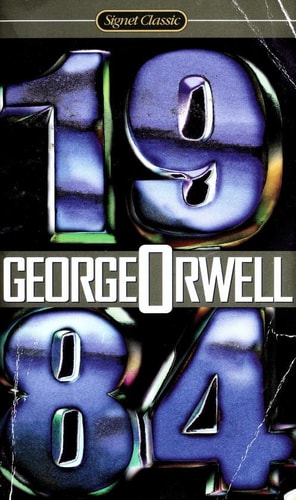
1984
Step into a chilling vision of a totalitarian future in George Orwell's timeless masterpiece.
In the year 1984, the world is divided into three superstates locked in perpetual war. Winston Smith, a 39-year-old member of the Outer Party, lives in Oceania, where the all-powerful Party controls every aspect of life through constant surveillance, propaganda, and fear. Working at the Ministry of Truth, Winston's job is to rewrite history to match the Party's ever-changing narrative. But Winston harbors dangerous thoughts. He secretly despises Big Brother and the Party's iron grip on reality itself. When he begins a forbidden love affair with Julia, a fellow rebel, their relationship becomes an act of defiance against a regime that seeks to crush all human emotion and independent thought. Together, they dare to imagine freedom—but in a world where the Thought Police are always watching and Room 101 awaits those who resist, their rebellion may cost them everything.
A haunting warning about the dangers of totalitarianism, surveillance, and the manipulation of truth, 1984 remains as relevant today as when it was first published in 1949. Orwell's dystopian classic introduced concepts like Big Brother, doublethink, and Newspeak that have become part of our everyday language. This powerful novel will make you question authority, value freedom, and think critically about the world around you.
Interesting Facts
Written on a Remote Scottish Island: Orwell penned most of 1984 at Barnhill, a farmhouse on the Isle of Jura in Scotland, eight miles from the nearest public road. Can you imagine? This wasn't some cozy writer's retreat with room service and WiFi. The house had no electricity, no central heating, and was surrounded by rocky soil and dangerous seas. Yet Orwell chose this "extremely un-get-atable place" (his own words!) to create one of literature's most claustrophobic dystopias. The isolation was deliberate, a way to escape London's distractions and find clean air for his failing lungs.
Tuberculosis Nearly Stopped the Book: While writing 1984, Orwell was battling tuberculosis that would kill him just seven months after publication. He lost 28 pounds, suffered recurring night sweats, and was eventually confined to bed with lung inflammation, but he refused to see a doctor and kept writing. When he became too weak to sit at a desk, he typed the manuscript from his bed, coughing up blood. When no typist could be found for the final draft, Orwell typed it himself at 4,000 words per day, seven days a week. Friends believed he was literally sacrificing his life to finish the book.
Almost Called Something Completely Different: The novel's working title was "The Last Man in Europe," which Orwell considered right up until publication. His publisher, Fredric Warburg, suggested "Nineteen Eighty-Four" as more commercially viable, and thank goodness he did! While "The Last Man in Europe" has a haunting quality, it lacks the iconic punch of 1984. Interestingly, the manuscript shows Orwell originally set the story in 1980, then 1982, before finally settling on 1984 as he continued writing.
Room 101 Was a Real BBC Room: Here's a deliciously ironic detail: Orwell worked as a propagandist for the BBC during World War II, and Room 101 at BBC Broadcasting House was a conference room where he endured torturously boring meetings. He transformed his own personal hell into literature's most terrifying torture chamber, where prisoners face their worst fears. The banality of bureaucratic tedium became the stuff of nightmares!
"Big Brother" Wasn't Orwell's Invention: While Orwell made the phrase iconic, he didn't coin it. According to Anthony Burgess, Orwell borrowed the name from World War II advertising billboards for Bennett College correspondence courses. After the founder's death, his son took over and the posters changed from "Let me be your father" to "Let me be your big brother." Orwell's genius was recognizing how this benevolent-sounding phrase could mask something sinister. The term has since become so ubiquitous that it inspired a reality TV show and countless references to government surveillance.
"2 + 2 = 5" Was Soviet Propaganda: That chilling slogan demonstrating the Party's power to make people deny reality? Orwell didn't make it up. It was an actual Soviet slogan from Stalin's era, used to promise completion of the Five-Year Plan in just four years. Orwell took real totalitarian propaganda and weaponized it to show how authoritarian regimes suspend reality itself. The novel is packed with these borrowed horrors, making it all the more terrifying because they actually happened.
The Thought Police Had Japanese Origins: Orwell based his Thought Police on the Japanese Kempeitai, wartime secret police who literally arrested citizens for "unpatriotic thoughts" during their official "Thought War." This wasn't science fiction, it was documented history. Orwell's brilliance lay in recognizing that the totalitarian playbook was remarkably similar across different regimes, whether fascist Japan, Nazi Germany, or Stalinist Russia.
He Was Under Surveillance While Writing About Surveillance: In a twist worthy of the novel itself, the British government was watching Orwell while he wrote his warning about government surveillance! They'd been monitoring him since he published "The Road to Wigan Pier" because they suspected him of holding socialist opinions. Imagine the irony: Big Brother was already watching as Orwell created Big Brother.
His Second Wife Inspired Julia: According to Orwell's friends and family, his second wife Sonia Brownell (whom he married just three months before his death) was the model for Julia, Winston Smith's love interest. Sonia was an editor at a literary magazine, thoughtful and talented, and after Orwell's death, she became the devoted steward of his work, helping establish the George Orwell Archive at University College London.
A Boating Accident Nearly Killed Him Mid-Writing: In 1947, while working on the manuscript, Orwell took his nephew, nieces, and three-year-old adopted son Richard on a recreational
Quotes
“War is peace. Freedom is slavery. Ignorance is strength.”
“Big Brother is watching you.”
“Perhaps one did not want to be loved so much as to be understood.”
“If you want to keep a secret, you must also hide it from yourself.”
“Freedom is the freedom to say that two plus two make four.”
“In the face of pain there are no heroes.”
“Who controls the past controls the future. Who controls the present controls the past.”
“Power is in tearing human minds to pieces and putting them together again in new shapes of your own choosing.”
“The choice for mankind lies between freedom and happiness and for the great bulk of mankind, happiness is better.”
“We shall meet in the place where there is no darkness.”
Ratings & Reviews
What do you think?
There are no reviews yet. Be the first one to write one.