
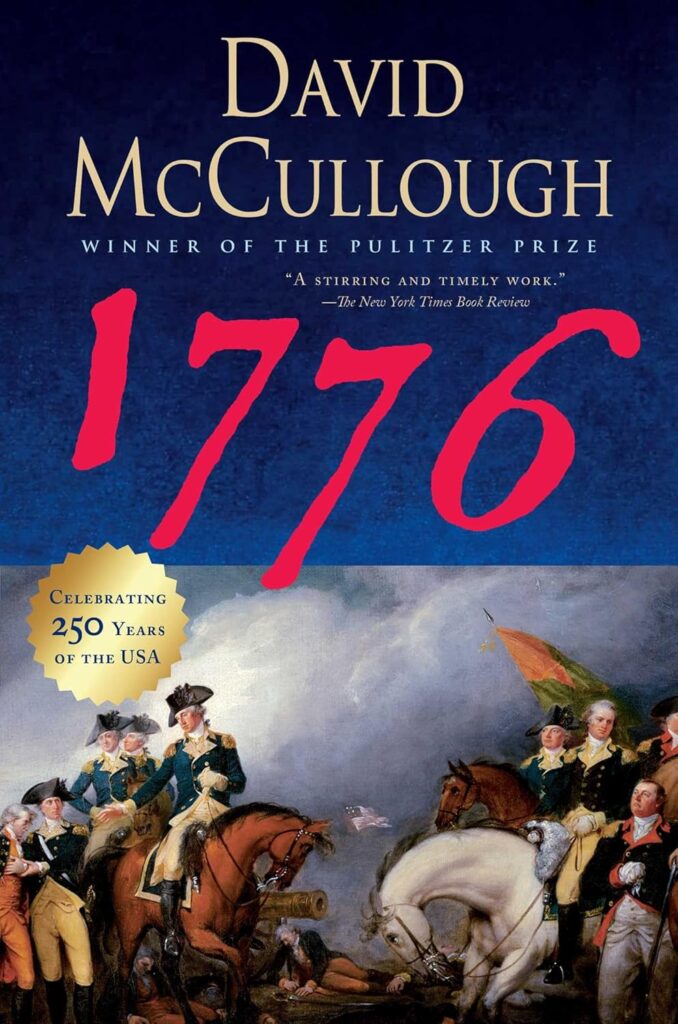
1776
The year is 1776. America's survival hangs by a thread, and George Washington knows it. With a ragtag army of farmers, schoolteachers, and boys barely old enough to shave, he faces the most powerful military force on earth.
Pulitzer Prize winner David McCullough brings this pivotal year to life with breathtaking drama and narrative power. Drawing from extensive research in both American and British archives, he reveals the intensely human story of the men who marched with Washington when the whole American cause was riding on their success. Without their perseverance, the noble ideals of the Declaration of Independence would have amounted to little more than words on paper.
This is not just Washington's story. McCullough introduces us to the young officers who would shape the war, men like Nathanael Greene and Henry Knox. He takes us inside the British command as well, showing us King George III and General William Howe with startling clarity.
From the siege of Boston to the crushing defeat at Long Island, from the desperate retreat across New Jersey to the stunning victories at Trenton and Princeton, 1776 captures a year of catastrophe and triumph. McCullough's masterful storytelling transforms familiar history into an edge-of-your-seat drama that reminds us how close America came to losing everything before the fight had barely begun.
Interesting Facts
Companion to John Adams: This book was written as a companion piece to McCullough's celebrated Pulitzer Prize-winning biography of John Adams, allowing him to explore what else was happening in 1776 beyond the political drama in Philadelphia. While writing the Adams biography, McCullough realized that the Declaration itself would have been nothing but words on paper without the people fighting the war.
Four Years of Research: McCullough spent approximately four years researching and writing this book, traveling to London to pore through British archives and following the path of the rebel army from Boston all the way south. He often wrote first drafts of chapters before visiting the actual locations to see how closely he captured the reality.
Both Sides of the Atlantic: The book draws from extensive research in both American and British archives, giving equal attention to the British perspective. McCullough felt too little had been written about the British in the Revolutionary War and wanted to understand what was happening with those in the British army and those managing the war in London.
Military Focus Over Politics: The signing of the Declaration of Independence is barely mentioned in the text because McCullough deliberately focused on military rather than political events. The book covers battles like Dorchester Heights, Long Island, and Trenton in vivid detail while treating the Second Continental Congress activities in less depth.
Bookseller Turned Artillery Genius: One of the book's heroes is Henry Knox, a 25-year-old Boston bookseller who had the audacious idea of hauling 59 cannons from Fort Ticonderoga to Boston. Knox transported 60 tons of artillery over 300 miles through frozen rivers and snowy mountains in the dead of winter, a feat historian Victor Brooks called one of the most stupendous feats of logistics of the entire war.
The Largest Fleet Ever: McCullough describes the staggering British armada that arrived at Staten Island, numbering nearly 400 ships large and small, including 73 warships. It was the largest fleet ever seen in American waters and the largest expeditionary force of the eighteenth century, with 32,000 troops, more than the entire population of Philadelphia, America's largest city at the time.
Rum-Soaked Army: The book reveals that American soldiers were consuming astonishing amounts of alcohol. A British surgeon observed inordinate quantities of rum surrounding rebel camps, and McCullough's research into primary sources estimates that colonial soldiers were drinking a bottle of rum per day, per man.
Plain Blue Cover: The original book features a strikingly simple design, plain covered in blue with golden embossed numbers spelling out "1776." This minimalist approach became iconic and immediately recognizable.
Illustrated Edition Treasure: An illustrated edition was released in 2007 containing 140 images and 37 removable replicas of source documents, including a personal letter from George Washington to Martha about his commission. These documents are recreated in uniquely designed envelopes secured with the congressional seal throughout the book.
Instant Bestseller Status: The book became both a New York Times and Amazon bestseller and was selected as part of the 2005 and 2006 Chief of Staff of the Air Force Professional Reading Program, demonstrating its appeal to both general readers and military professionals.
Washington's Humanity Revealed: McCullough portrays George Washington not as a flawless hero but as a deeply human figure with marked indecisiveness at crucial moments, questionable military ability, and serious mistakes in judgment. Yet the book shows how experience became his great teacher and how he never gave up, learning steadily through his greatest test.
Self-Educated Leaders: The book celebrates how 1776 was a year when self-educated Americans rose to the occasion through books. Nathanael Greene, who became one of Washington's closest generals at age 33, was a Quaker who walked with a limp and knew little of military life beyond what he had read, embodying the era's faith that one could learn virtually anything through the close study of books.
Quotes
"Their cause was the cause of mankind."
"The fate of unborn millions will now depend, under God, on the courage and conduct of this army."
"We are in the very midst of revolution, the most complete, unexpected, and remarkable of any in the history of nations."
"You are to be dependent on your own exertions."
"There are men in all armies who will make use of every opportunity to plunder and pillage."
"The Continental Army was really nothing more than a collection of local militias, ill-equipped and ill-trained for war."
"The world will little note, nor long remember, what we say here, but it can never forget what they did here."
"Let our object be our country, our whole country, and nothing but our country."
"The difficulties are indeed very great, but we must surmount them."
"We must all hang together, or assuredly we shall all hang separately."
"Discipline is the soul of an army."
"There never was so much cause for consternation as at present."
"This is the crisis that will decide our fate."
"The eyes of all our countrymen are now upon us."
"In truth, the American cause had hung by the slenderest of threads."
Ratings & Reviews
What do you think?
There are no reviews yet. Be the first one to write one.