
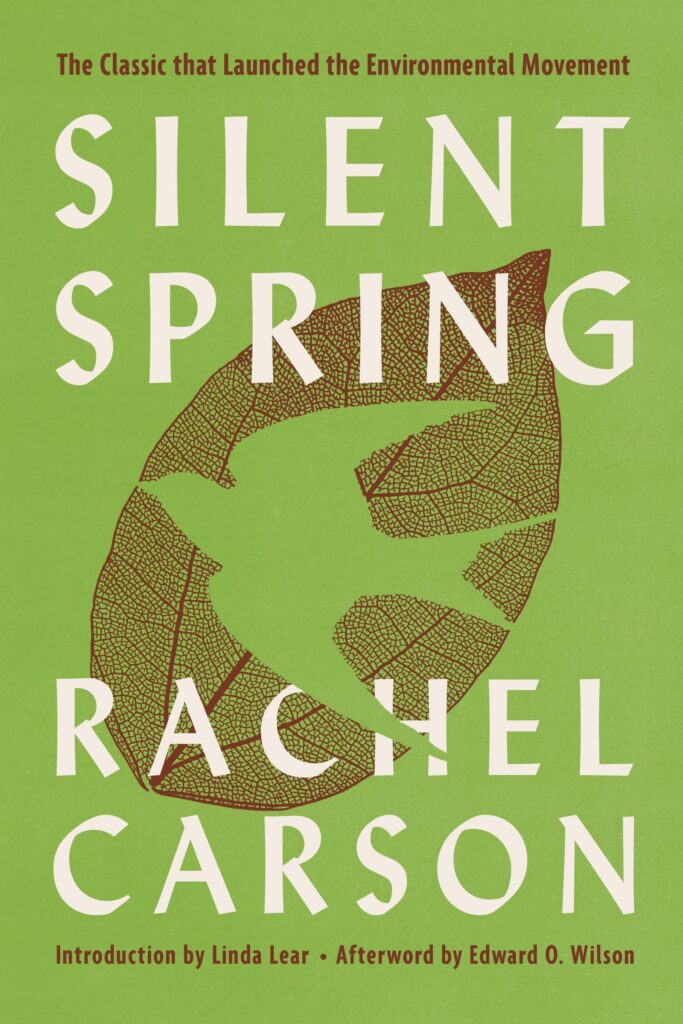
Silent Spring
Imagine a world where birds no longer sing, where spring arrives in eerie silence. In 1962, marine biologist Rachel Carson dared to expose a terrifying truth: the chemicals we spray on our crops are poisoning the planet. Silent Spring is the explosive book that changed everything.
Carson spent over six years meticulously documenting how DDT and other pesticides enter the food chain, accumulate in living tissue, and wreak havoc on ecosystems. She argued these chemicals should be called "biocides" because they kill far more than their intended targets. With moving prose and rigorous science, she revealed how human arrogance was destroying the natural world.
The chemical industry attacked her viciously, calling her an alarmist and worse. But President Kennedy ordered an investigation that vindicated her claims. Her work inspired the modern environmental movement and led to the creation of the Environmental Protection Agency.
This landmark book asks the most urgent question of our time: can we master ourselves before we destroy nature? Carson's prophetic voice rings louder than ever. Silent Spring is not just a warning, it's a call to action that transformed how we see our relationship with the Earth.
Interesting Facts
A Friend’s Letter Sparked Everything: The entire book began because Rachel Carson received a letter in January 1958 from her friend Olga Owens Huckins, who described birds dying around her Massachusetts property after DDT was sprayed to kill mosquitoes. That heartbreaking letter prompted Carson to investigate what would become her most important work.
She Wrote It Like a Lawyer’s Brief: Anticipating the chemical industry’s fury, Carson meticulously compiled Silent Spring with 55 pages of notes and citations, essentially building her case like a legal brief. She even assembled a list of expert scientists who reviewed and approved her manuscript before publication, creating an intellectual fortress around her findings.
Kennedy Read It in The New Yorker: President John F. Kennedy discovered Silent Spring when The New Yorker serialized it in three parts during summer 1962, before the book’s September publication. Kennedy was so moved that he ordered his Science Advisory Committee to investigate Carson’s claims, and their 1963 report completely vindicated her work.
It Became an Instant Bestseller: The book sold over 100,000 hardcover copies in its first three months and more than one million copies within two years. It became a New York Times bestseller and the most talked about book in decades, igniting a national conversation that had been waiting to happen.
The Chemical Industry Spent a Fortune Fighting Her: The pesticide industry spent over $250,000 (equivalent to more than $2.5 million today) trying to discredit Carson and her book. Monsanto even published and distributed 5,000 copies of a parody brochure called “The Desolate Year” depicting a world devastated by banning pesticides.
They Attacked Her as a Communist: Critics called Carson “a fanatic defender of the cult of the balance of nature” and suggested she had Communist sympathies. One California man wrote to The New Yorker claiming her criticism of insecticide manufacturers “probably reflects her Communist sympathies, like a lot of our writers these days.”
She Never Called for Banning All Pesticides: Despite industry claims, Carson never advocated eliminating all pesticide use. She called for responsible, carefully managed use with full awareness of ecological impacts. Her message was about moderation and understanding consequences, not total prohibition.
She Wrote It While Dying of Cancer: Carson battled rapidly metastasizing breast cancer throughout much of the four years she spent writing Silent Spring. She kept her illness secret, fearing the chemical industry would claim her disease made her hysterical or biased. When she testified before Congress in 1963, she wore a wig to hide her hair loss from radiation treatment.
The Title Came from Keats: The haunting title "Silent Spring" was inspired by a line from John Keats's poem "La Belle Dame sans Merci." The poem evokes a desolate landscape where "the sedge is wither'd from the lake, / And no birds sing."
It Created the EPA: Silent Spring directly led to the creation of the Environmental Protection Agency in 1970, just eight years after publication. The book also inspired landmark legislation including the Clean Air Act, Clean Water Act, and the 1972 ban on DDT for agricultural use in the United States.
Fifteen Million Watched Her on TV: A CBS Reports documentary called “The Silent Spring of Rachel Carson” aired on April 3, 1963, drawing an estimated 10 to 15 million viewers. Carson’s calm, dignified demeanor contrasted sharply with the “wild-eyed, loud-voiced” chemical industry spokesman in a white lab coat, making her critics look hysterical instead.
She Died Before Seeing Her Greatest Victories: Carson died of breast cancer on April 14, 1964, less than two years after Silent Spring’s publication. She never lived to see the EPA’s creation, the DDT ban, or the full flowering of the environmental movement she inspired, though she knew she had changed the conversation forever.
Quotes
"Those who contemplate the beauty of the earth find reserves of strength that will endure as long as life lasts. There is something infinitely healing in the repeated refrains of nature - the assurance that dawn comes after night, and spring after winter." - Rachel Carson
"In nature nothing exists alone." - Rachel Carson
"Why should we tolerate a diet of weak poisons, a home in insipid surroundings, a circle of acquaintances who are not quite our enemies, the noise of motors with just enough relief to prevent insanity? Who would want to live in a world which is just not quite fatal?" - Rachel Carson
"We stand now where two roads diverge. But unlike the roads in Robert Frost's familiar poem, they are not equally fair. The road we have long been traveling is deceptively easy, a smooth superhighway on which we progress with great speed, but at its end lies disaster. The other fork of the road — the one less traveled by — offers our last, our only chance to reach a destination that assures the preservation of the earth." - Rachel Carson
"Only within the moment of time represented by the present century has one species - man - acquired significant power to alter the nature of the world." - Rachel Carson
"A Who's Who of pesticides is therefore of concern to us all. If we are going to live so intimately with these chemicals eating and drinking them, taking them into the very marrow of our bones - we had better know something about their nature and their power." - Rachel Carson
"Nature has introduced great variety into the landscape, but man has displayed a passion for simplifying it. Thus he undoes the built-in checks and balances by which nature holds the species within bounds." - Rachel Carson
"How could intelligent beings seek to control a few unwanted species by a method that contaminated the entire environment and brought the threat of disease and death even to their own kind?" - Rachel Carson
"Over increasingly large areas of the United States, spring now comes unheralded by the return of the birds, and the early mornings are strangely silent where once they were filled with the beauty of bird song." - Rachel Carson
"The more clearly we can focus our attention on the wonders and realities of the universe about us, the less taste we shall have for destruction." - Rachel Carson
"No witchcraft, no enemy action had silenced the rebirth of new life in this stricken world. The people had done it themselves." - Rachel Carson
"There was once a town in the heart of America where all life seemed to live in harmony with its surroundings." - Rachel Carson
"We urgently need an end to these false assurances, to the sugar coating of unpalatable facts. It is the public that is being asked to assume the risks that the insect controllers calculate. The public must decide whether it wishes to continue on the present road, and it can do so only when in full possession of the facts." - Rachel Carson
Ratings & Reviews
What do you think?
There are no reviews yet. Be the first one to write one.