
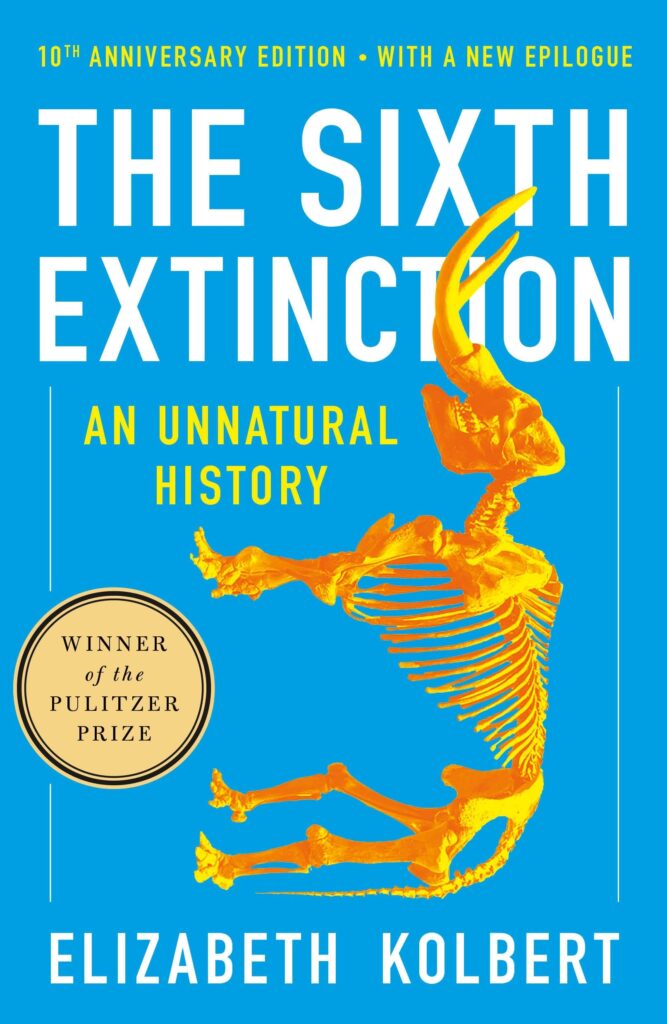
The Sixth Extinction (10th Anniversary Edition) An Unnatural History
The planet has survived five mass extinctions. Now we're living through the sixth, and this time, we're the asteroid. In this landmark 10th anniversary edition with a new epilogue, Pulitzer Prize winner Elizabeth Kolbert takes readers on a gripping journey to the front lines of a catastrophe unfolding in real time.
From the rainforests of Panama to the Great Barrier Reef, from the Andes to remote islands off Australia, Kolbert accompanies scientists studying species on the brink. She introduces us to the Panamanian golden frog, staghorn coral, the great auk, and the Sumatran rhino, creatures already gone or facing oblivion. Through their stories, she reveals how human activity has triggered an extinction event predicted to rival the asteroid impact that killed the dinosaurs.
Over the last half billion years, life on Earth has suddenly and dramatically contracted five times. Scientists now believe the sixth extinction is underway, driven by climate change, ocean acidification, deforestation, and the spread of invasive species across the globe. The evidence has only mounted in the decade since this book first appeared, making its message more urgent than ever.
Blending natural history, field reporting, and interviews with leading researchers, Kolbert traces how the concept of extinction evolved from its first articulation by Georges Cuvier in revolutionary Paris to today's sobering reality. This is likely to be humanity's most lasting legacy, compelling us to rethink what it means to be human.
Interesting Facts
Pulitzer Prize Winner: This book won the 2015 Pulitzer Prize for General Nonfiction and was also named one of The New York Times Book Review’s 10 Best Books of the Year and a National Book Critics Circle Award finalist. Talk about a literary trifecta!
Inspired by Frogs: The entire book was sparked by a 2008 scientific paper titled “Are we in the midst of the sixth mass extinction? A view from the world of amphibians.” Kolbert went frog hunting in Panama for a New Yorker article and realized she’d barely scratched the surface.
The Golden Frog Hotel: When conservation efforts in Panama exceeded capacity in 2006, over 300 endangered Panamanian golden frogs were housed in rooms 28 and 29 of the Hotel Campestre resort, complete with daily cleansing rinses, 24-hour room service, and exotic cricket lunches. Imagine checking into your hotel room and finding hundreds of tiny golden guests!
President Obama’s Praise: Barack Obama publicly endorsed the book, saying it “makes very clear that big, abrupt changes can happen; they’re not outside the realm of possibility. They have happened before, they can happen again.”
Thirteen Emblematic Species: The book is structured around thirteen chapters, each tracking a different species including the American mastodon, the great auk, Panamanian golden frog, staghorn coral, and Sumatran rhino. Some are already extinct, others are teetering on the brink.
Georges Cuvier’s Revolutionary Discovery: The book traces how extinction as a concept was first articulated by French naturalist Georges Cuvier in revolutionary Paris. Before the late 1700s, people believed prehistoric mass extinctions had never occurred and that no natural forces were powerful enough to extinguish species.
Devastating Predictions: Kolbert estimates that between 20 and 50 percent of all living species on Earth could be lost by the end of the 21st century. That’s potentially half of all life disappearing within our children’s lifetimes.
The Deadly Fungus: The chytrid fungus that devastated Panama’s golden frogs causes them to suffer what is essentially a heart attack by interfering with their ability to absorb critical electrolytes through their skin. The fungus is classified by the IUCN as one of the 100 worst invasive alien species on the planet.
Global Field Reporting: Kolbert traveled to Panama, Iceland, Italy, Scotland, Peru, the Amazonian rainforest of Brazil, and the remote One Tree Island off the coast of Australia. She accompanied geologists studying deep ocean cores, botanists following tree lines up the Andes, and marine biologists diving the Great Barrier Reef.
Humans Are the Asteroid: The book’s central revelation is captured in the phrase “This time around, the cataclysm is us.” While previous mass extinctions were caused by natural catastrophes like asteroid impacts, the sixth extinction is entirely human-driven.
Ten Years More Urgent: The 10th Anniversary Edition includes a new epilogue noting that in the decade since original publication, evidence of the Sixth Extinction has continued to mount, making the book’s message more urgent than ever. The crisis hasn’t slowed, it has accelerated.
Quotes
"Though it might be nice to imagine there once was a time when man lived in harmony with nature, it’s not clear that he ever really did." - Elizabeth Kolbert
"A sign in the Hall of Biodiversity offers a quote from the Stanford ecologist Paul Ehrlich: IN PUSHING OTHER SPECIES TO EXTINCTION, HUMANITY IS BUSY SAWING OFF THE LIMB ON WHICH IT PERCHES." - Elizabeth Kolbert
"To argue that the current extinction event could be averted if people just cared more and were willing to make more sacrifices is not wrong, exactly; still, it misses the point. It doesn’t much matter whether people care or don’t care. What matters is that people change the world." - Elizabeth Kolbert
"Somewhere in our DNA must lie the key mutation (or, more probably, mutations) that set us apart—the mutations that make us the sort of creature that could wipe out its nearest relative, then dig up its bones and reassemble its genome." - Elizabeth Kolbert
"Zalasiewicz is convinced that even a moderately competent stratigrapher will, at the distance of a hundred million years or so, be able to tell that something extraordinary happened at the moment in time that counts for us as today. This is the case even though a hundred million years from now, all that we consider to be the great works of man—the sculptures and the libraries, the monuments and the museums, the cities and the factories—will be compressed into a layer of sediment not much thicker than a cigarette paper." - Elizabeth Kolbert
"The current extinction has its own novel cause: not an asteroid or a massive volcanic eruption but one weedy species." - Elizabeth Kolbert
"One of the defining features of the Anthropocene is that the world is changing in ways that compel species to move, and another is that it’s changing in ways that create barriers—roads, clear-cuts, cities—that prevent them from doing so." - Elizabeth Kolbert
"By burning through coal and oil deposits, humans are putting carbon back into the air that has been sequestered for tens—in most cases hundreds—of millions of years. In the process, we are running geologic history not only in reverse but at warp speed." - Elizabeth Kolbert
"By transporting Asian species to North America, and North American species to Australia, and Australian species to Africa, and European species to Antarctica, we are, in effect, reassembling the world into one enormous supercontinent—what biologists sometimes refer to as the New Pangaea." - Elizabeth Kolbert
"The anthropologist Richard Leakey has warned that Homo sapiens might not only be the agent of the sixth extinction, but also risks being one of its victims." - Richard Leakey
"With the capacity to represent the world in signs and symbols comes the capacity to change it, which, as it happens, is also the capacity to destroy it. A tiny set of genetic variations divides us from the Neanderthals, but that has made all the difference." - Elizabeth Kolbert
"One of the many unintended consequences of the Anthropocene has been the pruning of our own family tree. Having cut down our sister species—the Neanderthals and the Denisovans—many generations ago, we’re now working on our first and second cousins. By the time we’re done, it’s quite possible that there will be among the great apes not a single representative left, except, that is, for us." - Elizabeth Kolbert
"Right now we are in the midst of the Sixth Extinction, this time caused solely by humanity’s transformation of the ecological landscape." - Elizabeth Kolbert
Ratings & Reviews
What do you think?
There are no reviews yet. Be the first one to write one.