
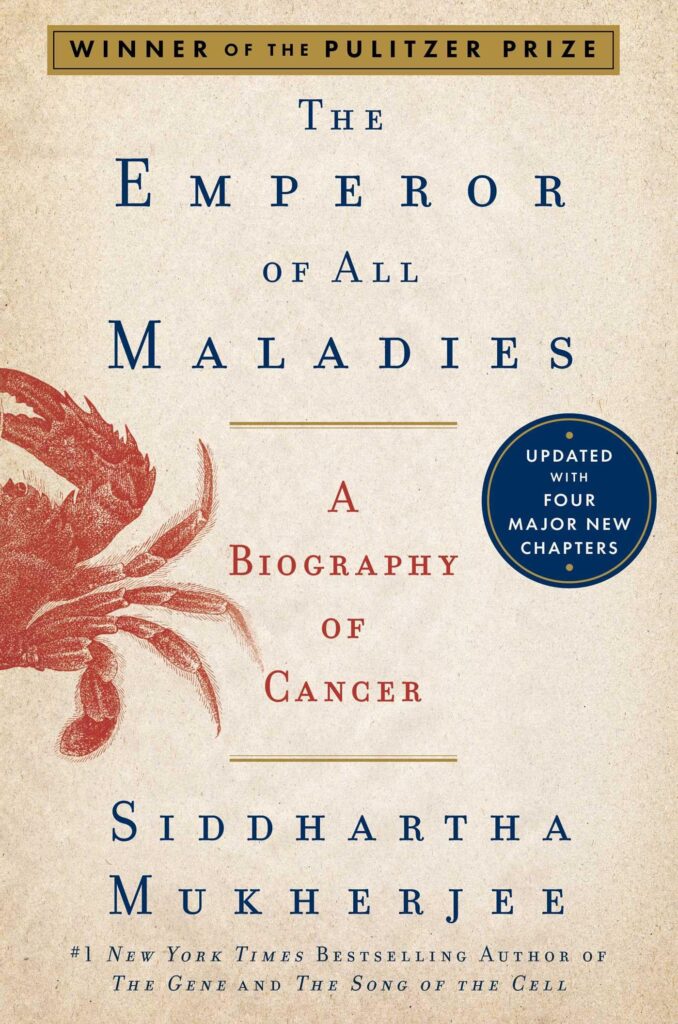
The Emperor of All Maladies: A Biography of Cancer
Cancer is as old as humanity, yet its story has never been told like this. In this gripping narrative, a single disease becomes a character with motives, setbacks, and unexpected turns. From ancient diagnoses scratched into papyrus to modern hospital wards, the book pulls you straight into a battle that spans centuries.
Blending science, history, and deeply human stories, Siddhartha Mukherjee traces how doctors, patients, and researchers have struggled to understand cancer’s strange logic. He introduces pioneers who dared radical ideas, often in the face of skepticism and failure. Their discoveries reveal how cancer grows, adapts, and resists attempts to control it.
The book explores landmark moments such as the rise of chemotherapy, the promise and limits of radiation, and the shift toward targeted therapies. Along the way, it explains complex biology with clarity and grace, making breakthroughs feel urgent and personal. Each advance is shown as hard-won, shaped by both brilliance and error.
At its core, this is also a human history. Mukherjee weaves in the voices of patients and caregivers, showing how treatment reshaped lives, families, and ethics.
Winner of the Pulitzer Prize, this book is both a definitive history and a meditation on progress. It leaves readers with a deeper understanding of cancer and a renewed respect for the long, unfinished fight against it.
Interesting Facts
Pulitzer Prize Winner: This book won the 2011 Pulitzer Prize for General Nonfiction, with the jury calling it an “elegant inquiry, at once clinical and personal.” It also snagged the Guardian First Book Award and the inaugural PEN/E.O. Wilson Literary Science Writing Award, making it a triple crown of literary achievement!
Inspired by a Patient’s Question: Mukherjee wrote this entire 600-page masterpiece as an answer to a single question from one of his patients battling aggressive abdominal cancer who said, “I’m willing to go on fighting, but I need to know what it is that I’m battling.”
Written in Bed: Mukherjee spent nearly five years writing most of the book at night, in bed next to his wife Sarah Sze, an artist and Columbia professor, who read and edited his pages as he wrote them. It’s the ultimate collaborative marriage project!
Ancient Cancer Documentation: The book traces cancer back 4,600 years to the Egyptian physician Imhotep, who documented “bulging masses in women’s breasts” around 2600 BCE and wrote simply about treatment: “There is none.” It’s the first recorded mention of cancer in medical literature.
Literary Heavyweight Status: Time magazine included it in their “All-Time 100 Nonfiction Books,” listing it among the 100 most influential nonfiction works written in English since 1923. The New York Times also named it one of the 100 best works of nonfiction and one of the best books of the 21st century!
The Title’s Origin: The phrase “emperor of all maladies” comes from a 19th-century surgeon who wrote it in a book’s frontispiece, calling cancer “the emperor of all maladies, the king of terrors.” Mukherjee chose it because he wanted to treat cancer as if it were an entity, a personality, giving the disease a biographical treatment.
Ken Burns Documentary: The book was adapted into a six-hour PBS documentary directed by Barak Goodman and executive produced by Ken Burns in 2015. The film was narrated by Edward Herrmann, who was himself suffering from terminal brain cancer during production and died three months before its release, making it his final performance.
Rhodes Scholar Credentials: Mukherjee is a Rhodes Scholar who graduated from Stanford, Oxford, and Harvard Medical School. He’s also an associate professor at Columbia University and was elected to the National Academy of Medicine in 2023, bringing serious academic firepower to his storytelling.
Sidney Farber’s Basement Lab: The book opens with Sidney Farber, called “a doctor of the dead,” working in a damp 14-by-20-foot laboratory in the basement of Boston Children’s Hospital in 1947, waiting for a parcel that would lead to the first chemotherapy breakthroughs in childhood leukemia. Farber appears on page one and becomes a central hero of the narrative!
Updated Edition with New Chapters: The book received a major update with four new chapters added fifteen years after its original 2010 publication, essentially creating “a new book about cancer” that illuminates developments in cancer detection, prevention, treatment, and understanding that have emerged in recent years.
Quotes
“History repeats, but science reverberates.” – Siddhartha Mukherjee
“The art of medicine is long, Hippocrates tells us, “and life is short; opportunity fleeting; the experiment perilous; judgment flawed.”” – Siddhartha Mukherjee
“It remains an astonishing, disturbing fact that in America – a nation where nearly every new drug is subjected to rigorous scrutiny as a potential carcinogen, and even the bare hint of a substance’s link to cancer ignites a firestorm of public hysteria and media anxiety – one of the most potent and common carcinogens known to humans can be freely bought and sold at every corner store for a few dollars.” – Siddhartha Mukherjee
“Doctors are men who prescribe medicines of which they know little, to cure diseases of which they know less, in human beings of whom they know nothing.” – Voltaire
“In God we trust. All others [must] have data.” – Bernard Fisher
“Cancer was not disorganized chromosomal chaos. It was organized chromosomal chaos.” – Siddhartha Mukherjee
“Down to their innate molecular core, cancer cells are hyperactive, survival-endowed, scrappy, fecund, inventive copies of ourselves.” – Siddhartha Mukherjee
“In 2005, a man diagnosed with multiple myeloma asked me if he would be alive to watch his daughter graduate from high school in a few months. In 2009, bound to a wheelchair, he watched his daughter graduate from college. The wheelchair had nothing to do with his cancer. The man had fallen down while coaching his youngest son’s baseball team.” – Siddhartha Mukherjee
“A model is a lie that helps you see the truth.” – Siddhartha Mukherjee
“Cancer’s life is a recapitulation of the body’s life, its existence a pathological mirror of our own.” – Siddhartha Mukherjee
“Cancer is an expansionist disease; it invades through tissues, sets up colonies in hostile landscapes, seeking “sanctuary” in one organ and then immigrating to another. It lives desperately, inventively, fiercely, territorially, cannily, and defensively—at times, as if teaching us how to survive. To confront cancer is to encounter a parallel species, one perhaps more adapted to survival than even we are.” – Siddhartha Mukherjee
“All cancers are alike but they are alike in a unique way.” – Siddhartha Mukherjee
Ratings & Reviews
What do you think?
There are no reviews yet. Be the first one to write one.