
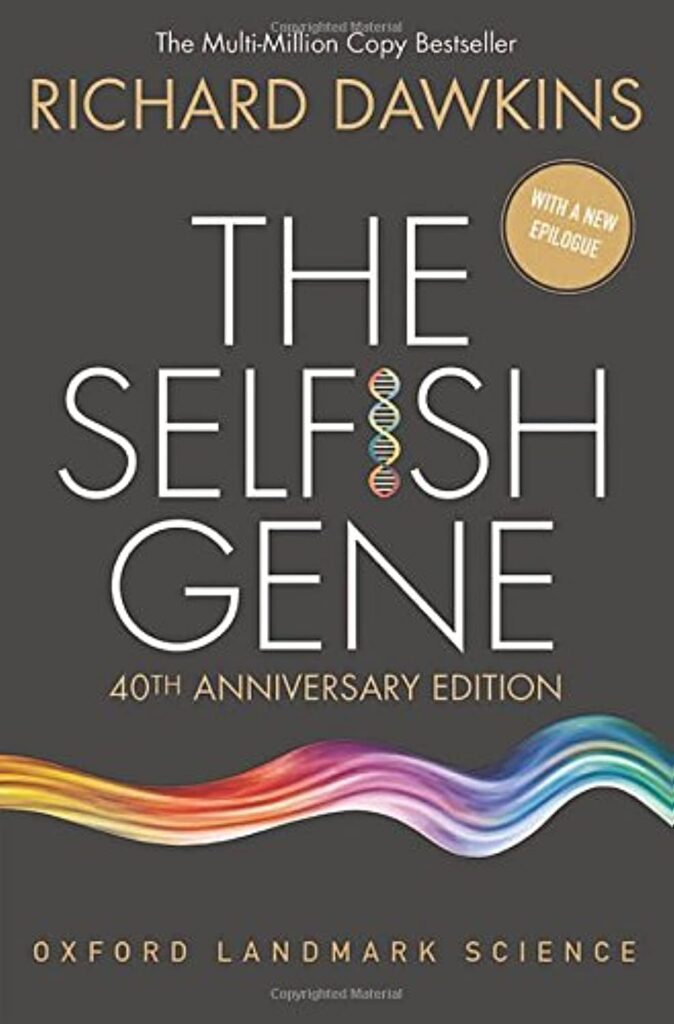
The Selfish Gene
What if you were just a temporary vehicle for something far more ancient and enduring? In this book, Richard Dawkins turns evolution on its head with a radical new perspective: we are not the masters of our own destiny, but rather survival machines built by genes to ensure their own immortal replication. Prepare to see life through an entirely different lens.
First published in 1976, The Selfish Gene revolutionized our understanding of natural selection by placing genes, not organisms or groups, at the center of evolution. Dawkins brilliantly explains how these persistent units of information use our bodies as vehicles for their replication across generations. This gene-centered view illuminates the deepest mysteries of behavior, from the bee that sacrifices itself to protect the hive to the bird that risks its life warning others of danger.
But this book is about far more than selfishness. It explores the paradox of altruism, cooperation, and the evolutionary strategies that shape all living things. Dawkins also introduces the concept of the meme, a cultural replicator that spreads ideas just as genes spread traits. Translated into over 25 languages and selling millions of copies worldwide, this classic work combines rigorous science with stunningly clear prose that makes complex biology accessible to everyone.
Discover why your genes might know more about survival than you do.
Interesting Facts
Dawkins Was Only 35: Richard Dawkins wrote The Selfish Gene when he was just 35 years old, publishing it in 1976 while working as a lecturer at Oxford University. This debut book catapulted him to international fame and remains his most widely read work, with audiences still lining up decades later to have him sign copies of this first book rather than his newer releases!
The Word "Meme" Was Born Here: Dawkins coined the term "meme" in this very book, adapting it from the Greek word "mimeme" meaning "imitated thing." He wanted a monosyllable that sounded like "gene" and should rhyme with "cream." This concept of cultural replication has spawned an entire field called memetics and, of course, gave us internet memes!
The Title Almost Didn't Happen: Publisher Tom Maschler tried to convince Dawkins to call it "The Immortal Gene" instead, arguing that "selfish" was a "down word" while "immortal" was an "up word." Dawkins later admitted he probably should have listened, since too many critics judged the book by its title alone without reading it!
It's Actually About Altruism: Despite the provocative title, much of the book is devoted to explaining the evolution of altruism, not selfishness. Dawkins has repeatedly lamented that people misunderstand this, emphasizing that the word to stress in the title is "gene," not "selfish." The book shows how selfish genes can create altruistic individuals.
Written Before Any Genome Was Sequenced: When Dawkins wrote The Selfish Gene, not a single genome had been fully sequenced. Yet he predicted the existence of purely selfish DNA that serves no function except to replicate itself. Twenty-five years later, the Human Genome Project discovered that half our genome consists of exactly such selfish elements!
Million-Copy Bestseller in 30+ Languages: The book has sold over a million copies and been translated into more than 30 languages. In 2017, a Royal Society poll celebrating 30 years of their Science Book Prize listed The Selfish Gene as the most influential science book of all time!
The Book Keeps Growing: The original 1976 edition had 11 chapters, but the 1989 second edition added two more chapters. The 40th anniversary edition added an epilogue, and the latest versions include even more material from Dawkins's later work The Extended Phenotype. Yet Dawkins insists there's little he would take back from the original!
It Sparked a Silent Revolution: The book caused what one observer called "a silent and almost immediate revolution in biology." It galvanized the biology community, generated massive debate, and stimulated whole new areas of research. The New York Review of Books called it "the best work of popular science ever written."
Bodies Are Just "Survival Machines": Dawkins memorably describes our bodies as "robot vehicles blindly programmed to preserve the selfish molecules known as genes." This radical perspective dealt what some call the final blow to anthropocentrism, showing that even we as individuals are not at the center of natural selection.
It Builds on Hamilton's Genius: The book popularized groundbreaking ideas from W.D. Hamilton and others developed during the 1960s, particularly about inclusive fitness and kin selection. Dawkins credits Hamilton as one of his four named heroes, and Hamilton himself praised the book's "remarkable clarity and simplicity."
Still Fresh After 50 Years: A 50th anniversary edition was published in 2026, with Dawkins reflecting on the book's enduring relevance. Scientists note that four decades on, the book remains "an amazingly fresh read" whose important insights have not aged, continuing to inspire fresh generations of young life scientists!
Quotes
"Let us try to teach generosity and altruism, because we are born selfish."
"We are survival machines – robot vehicles blindly programmed to preserve the selfish molecules known as genes."
"Genes are immortal."
"Individuals are not stable things, they are fleeting."
"Even if we look at the world and see a veneer of cooperation, it is only an appearance."
"The gene is the basic unit of selfishness."
"We are built as gene machines and cultured as meme machines, but we have the power to turn against our creators."
"Nature is not cruel, only pitilessly indifferent."
"Living organisms had existed on earth, without ever knowing why, for over three thousand million years before the truth finally dawned on one of them."
"Science is the poetry of reality."
"Let us understand what our own selfish genes are up to, because we may then at least have the chance to upset their designs."
"A gene is defined as a unit of heredity which segregates and recombines with appreciable frequency."
"Blind faith can justify anything."
"Our genes may instruct us to be selfish, but we are not beholden to them."
"Mistakes are the portals of discovery."
Ratings & Reviews
What do you think?
There are no reviews yet. Be the first one to write one.