
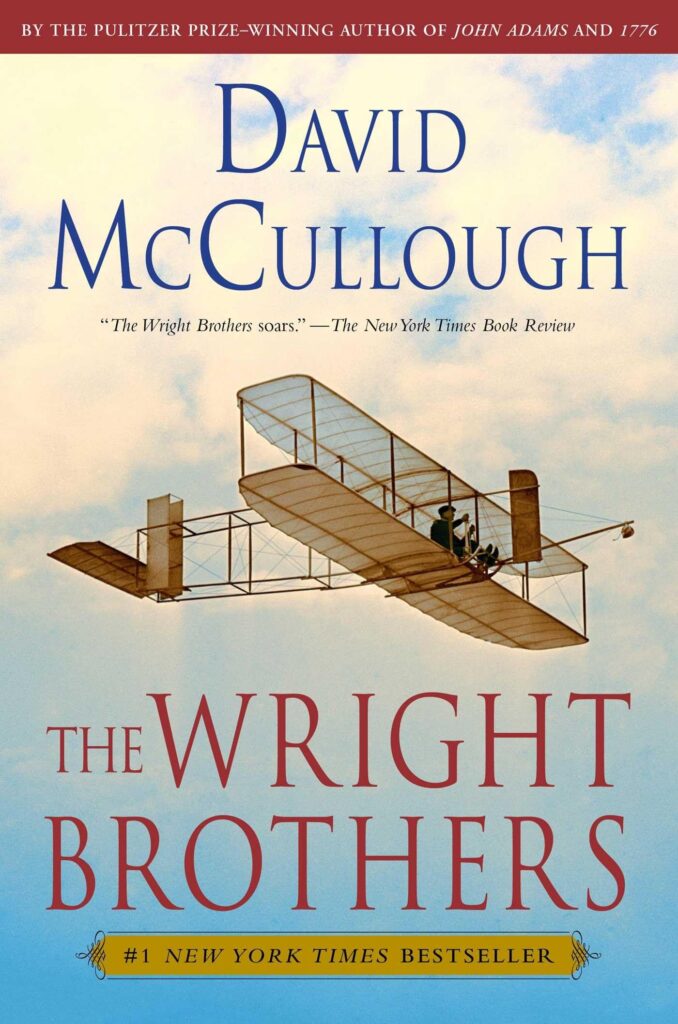
The Wright Brothers
Two bicycle mechanics from Dayton, Ohio, accomplished what the greatest minds and the wealthiest inventors said was impossible. Without college educations, government funding, or public attention, Wilbur and Orville Wright achieved powered human flight. Their story is one of the most thrilling achievements in American history.
From Pulitzer Prize-winning historian David McCullough comes the dramatic story of the courageous brothers who taught the world how to fly. Drawing on the Wrights' personal correspondence and diaries, he reveals the remarkable bond between these two bachelor brothers who supported each other through years of ridicule and failure. Their sister Katharine was equally essential to their success, managing their household, handling correspondence, and becoming their indispensable partner in promoting their invention to the world.
McCullough shows how two men of exceptional courage and curiosity solved the problem that had stumped humanity for centuries. Every time they took off, they risked their lives. Nothing could stop them from pursuing what seemed like an impossible dream.
The drama peaks on December 17, 1903, when human beings defied gravity for twelve seconds. But the real story is what came after, as the Wrights perfected their invention against skepticism, patent battles, and tragedy. This is an inspiring tale of genius, perseverance, and the power of family, proving what two ordinary Americans with extraordinary vision can achieve.
Interesting Facts
A Toy Sparked Everything: The Wright brothers' fascination with flight began when their father, Bishop Milton Wright, brought home a 50-cent French toy helicopter made by Alphonse Pénaud. When he released it from his hands, it flew to the ceiling, and the boys called it "the bat." This simple gift planted the seed that would change history.
High School Dropouts Who Outthought Experts: Neither Wilbur nor Orville finished high school or attended college, yet they taught themselves aeronautics, physics, and engineering through voracious reading. Their father kept an extensive home library filled with classics, scientific treatises, and encyclopedias, and both brothers developed educations comparable to modern four-year college degrees through self-study.
Less Than $1,000 Changed the World: The Wright brothers spent less than $1,000 of their own money from bicycle shop profits to develop their flying machine. Meanwhile, Samuel Langley, a Smithsonian secretary with government backing, spent over $70,000 and failed completely. The Wrights proved that ingenuity and determination trumped resources.
Katharine Was the Indispensable Third Wright: McCullough draws extensively on family papers to reveal how sister Katharine Wright was crucial to the brothers' success. She managed their household, handled correspondence, kept meticulous records, accompanied them to Europe as their spokesperson, and nursed Orville back to health after his 1908 crash. President Taft called her "the most important member of the family."
They Discovered Everything Was Wrong: After testing in 1901, the brothers realized that all the established aeronautical data and calculations they'd relied on were worthless. Rather than give up, they built their own wind tunnel and conducted thousands of experiments to discover the principles of flight themselves.
France Made Them Superstars: When Wilbur demonstrated the Wright Flyer at Le Mans, France in August 1908, crowds grew from 200 to 10,000 within a week. Eventually 100,000 people a day came to watch him fly. His demonstrations silenced European skeptics who had dismissed the brothers as liars, and overnight they became the world's first global celebrities.
Wilbur Was an Art Connoisseur: McCullough discovered that Wilbur frequently visited the Louvre during his time in France and was deeply moved by Gothic art and French cathedrals. His letters reveal sophisticated aesthetic sensibilities that went far beyond what anyone expected from a "simple bicycle mechanic."
Their Letters Were Literary Treasures: The book relies heavily on over 1,000 letters from the Wright family correspondence. McCullough noted that none of the four family members (the father, Katharine, Wilbur, and Orville) were capable of writing a short or boring letter. They were all superbly written, allowing readers intimate access to their thoughts and personalities.
They Risked Death Every Single Flight: McCullough emphasizes that every time the brothers took off, they faced the self-evident reality that they could be killed. They studied birds obsessively, with Orville noting that learning flight's secret from a bird was "a good deal like learning the secret of magic from a magician."
Orville Disowned Katharine Over Marriage: When Katharine married newspaperman Harry Haskell at age 52 in 1926, Orville was devastated and refused to attend the wedding or speak to his sister. He believed she violated a family pact to remain unmarried. Only when she was dying of pneumonia in 1929 did their brother Lorin convince Orville to visit her bedside.
They Only Flew Together Once: The brothers had promised their father they would never fly together to avoid a double tragedy. On May 25, 1910, they received special permission from Milton for a single six-minute flight together at Huffman Prairie. It was the only time both Wright brothers were airborne simultaneously.
The Book Became an Instant Bestseller: Published in 2015, The Wright Brothers spent seven weeks on The New York Times Non-Fiction Best Sellers list and became a number one bestseller. McCullough's research was so detailed that critics wondered "how it was all collected," praising his ability to make readers feel the marvel of what the Wrights accomplished.
Quotes
"The brothers liked to say that no bird soars in a calm."
"Courage is the essential quality for anyone who hopes to make a living in the air."
"They were men of the old American kind — practical, inventive, and not unpaid to hard, persistent work."
"To be sure, they had certain advantages. They had each other."
"The best dividends on the labor invested have invariably come from seeking more knowledge rather than more power."
"It is not necessary to look too far into the future; we see enough already to be certain it will be magnificent."
"No bird soars in a calm — a lesson in perseverance."
"Never in the history of the world had anything like what they were attempting been done before."
"The desire to fly is an idea handed down to us by our ancestors who, in their grueling travels across trackless lands in prehistoric times, looked enviously on the birds soaring freely through the space at full speed, above all obstacles, on the infinite highway of the air."
"The Wrights were doing something that required intelligence and invention, but more than that, required faith and resolve."
"They set to work, working patiently, knowing that progress was incremental and could not be rushed."
"They did not let setbacks or slow progress discourage them."
"By much hard work, they figured out the answers that others had missed."
"They were self-confident, but never overconfident."
"Their story is, at its heart, one of perseverance, passion, and an unwavering commitment to learning."
Ratings & Reviews
What do you think?
There are no reviews yet. Be the first one to write one.