
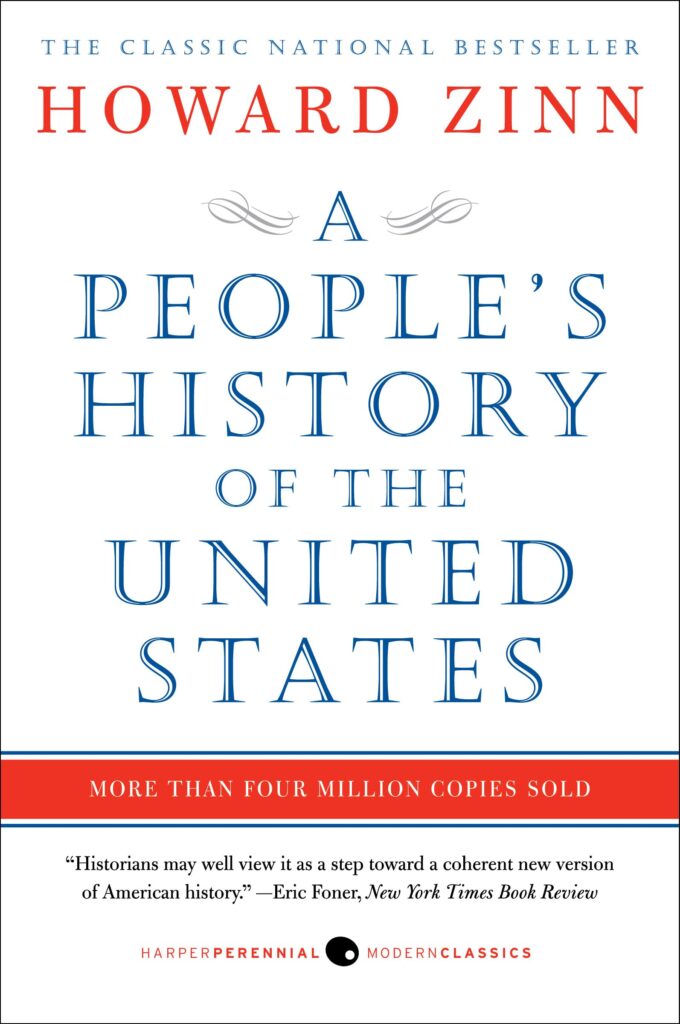
A People's History of the United States
What if American history wasn't just about presidents and generals? What if the real story was happening in the streets, factories, and homes of ordinary people fighting for their lives and dignity? Howard Zinn's influential book throws out the official narrative and tells America's story from the bottom up.
This bestseller gives voice to those left out of traditional textbooks. Women, factory workers, African Americans, Native Americans, immigrant laborers, and the working poor finally take center stage. Their struggles, told in their own words, reveal the true forces that shaped our nation.
From Columbus's arrival through the Clinton administration, Zinn chronicles the grassroots battles that defined America. The fights for fair wages, the eight-hour workday, child labor laws, women's rights, and racial equality weren't gifts from above. They were hard-won victories against brutal resistance, driven by powerful social movements that changed the course of history.
With over four million copies sold, this award-winning classic continues to revolutionize how we understand our past. Known for its lively prose and rigorous scholarship, A People's History challenges everything you thought you knew about the United States. Discover the hidden history that textbooks won't teach you.
Interesting Facts
Published in 1980: Howard Zinn's groundbreaking book first hit shelves in 1980, offering a radical departure from traditional American history textbooks by telling the story from the perspective of workers, women, Native Americans, and other marginalized groups rather than presidents and generals.
Over Four Million Copies Sold: As of 2025, more than four million copies in English have been sold, and the book has been translated into more than a dozen languages, making it one of the bestselling history books in American history.
Runner-Up for National Book Award: The book was a runner-up in 1980 for the prestigious National Book Award, signaling early recognition of its significant contribution to historical scholarship.
Sales Increase Every Year: In a publishing phenomenon that's virtually unheard of, Zinn's editor at HarperCollins noted that for two decades, the book sold more copies each year than it sold the year before, with 128,000 copies sold in a single year two decades after publication.
Matt Damon Connection: The book became a cultural icon partly thanks to the 1997 film Good Will Hunting, where Matt Damon's character tells his therapist to read it because it will "knock you on your ass." Damon grew up next door to Zinn in Massachusetts, and the Zinns occasionally babysat the Damon boys.
Featured on The Sopranos: By 2002, the book had become so mainstream that it was referenced in an episode of HBO's The Sopranos, where A.J. Soprano's teacher compared Christopher Columbus to Slobodan Milosevic based on Zinn's perspective.
Inspired a 2009 Documentary: The People Speak, a documentary film produced by Matt Damon and Josh Brolin and co-directed by Zinn himself, aired on the History Channel in 2009, featuring dramatic readings by Morgan Freeman, Sean Penn, Viggo Mortensen, and others, with musical performances by Bob Dylan, Bruce Springsteen, and Eddie Vedder.
Millionth Copy Celebration: In spring 2003, to commemorate the sale of the one millionth copy, a dramatic reading was held at the 92nd Street Y in New York City featuring Danny Glover, James Earl Jones, Marisa Tomei, Kurt Vonnegut Jr., Alice Walker (who was Zinn's former student at Spelman College), and Alfre Woodard.
Changed Historical Teaching: The book has been assigned as reading in countless high schools and colleges across the United States, not just in history courses but also in economics, political science, anthropology, cultural studies, women's studies, ethnic studies, Chicano studies, and African American studies, fundamentally changing how American history is taught.
Started With Modest Expectations: The book began with a modest initial press run of just 4,000 copies when radical movements were fading, and its chances for success seemed slight, yet it became what one scholar called "the bestselling U.S. history book in U.S. history."
Airport Bookstore Phenomenon: Despite being written by a radical historian, it became probably the only book by a radical historian that you can buy in an airport, demonstrating its remarkable crossover from counterculture to mainstream American consciousness.
Quotes
"The memory of oppressed people is one thing that cannot be taken away, and for such people, with such memories, revolt is always an inch below the surface."
"History is important. If you don't know history, it is as if you were born yesterday. And if you were born yesterday, anybody up there in a position of power can tell you anything, and you have no way of checking up on it."
"The cry of the poor is not always just, but if you don't listen to it, you will never know what justice is."
"There is no flag large enough to cover the shame of killing innocent people."
"If patriotism were defined, not as blind obedience to government, but rather as loyalty to the principles of justice and democracy, then patriotism would require us to disobey our government at certain times."
"When truth is found to be lies, and all the joy within you dies."
"In the long run, the oppressor is also a victim."
"But I suppose the most revolutionary act one can engage in is… to tell the truth."
"The most important thing is not to stop questioning. Curiosity has its own reason for existence."
"The history of any country, presented as the history of a family, conceals fierce conflicts of interest, sometimes exploding, most often repressed; sometimes—a slaveholder and slave, landlord and tenant, factory owner and worker, conqueror and conquered, governor and governed."
"Governments are not neutral, they represent the dominant economic interests, and… their main concern is with a stable climate for investment."
"Small acts, when multiplied by millions of people, can transform the world."
"They have learned nothing from history, because they have never read it. The present has always been corrupt."
"The American system is the most ingenious system of control in world history."
"Protest beyond the law is not a departure from democracy; it is absolutely essential to it."
Ratings & Reviews
What do you think?
There are no reviews yet. Be the first one to write one.