
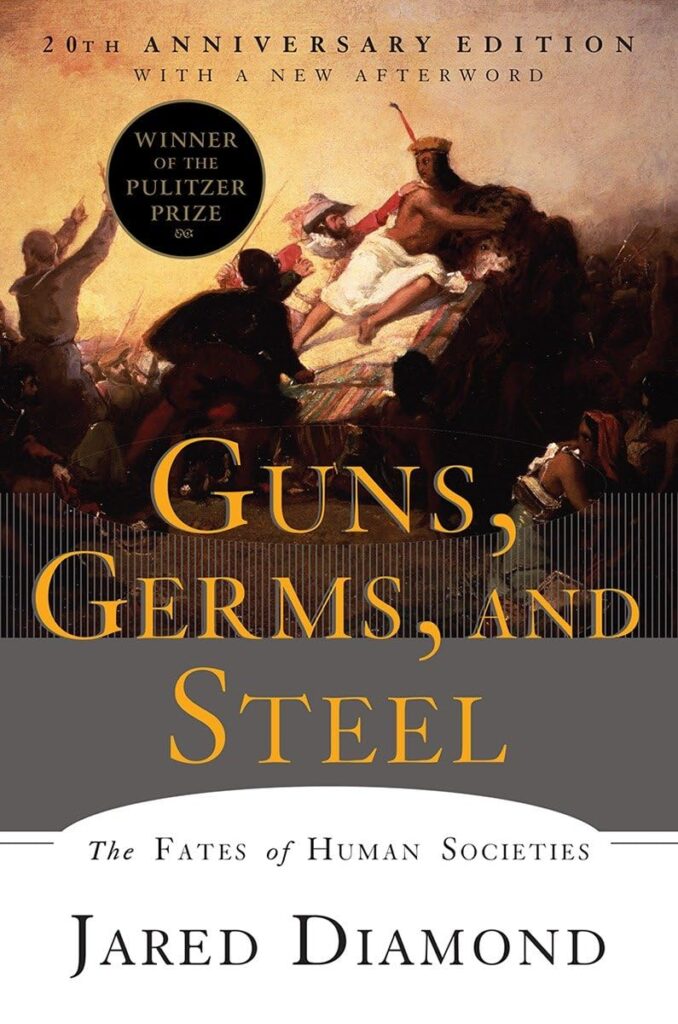
Guns, Germs, and Steel: The Fates of Human Societies
Why did some civilizations conquer the world while others struggled to survive? This Pulitzer Prize winner tackles history's most explosive question with a revolutionary answer that will change how you see the world. Jared Diamond reveals that the fate of societies was determined not by intelligence or genetics, but by the luck of geography.
Journey back 13,000 years to when all humans lived as hunter-gatherers. Watch as certain societies gained crushing advantages through access to domesticable plants and animals, while others were left behind through no fault of their own. Diamond shows how these early agricultural societies developed food surpluses that allowed specialization, leading to writing, technology, organized government, and devastating epidemic diseases.
The title says it all. Guns provided military dominance. Germs wiped out millions who lacked immunity. Steel forged the tools of conquest. But the real story is how geography shaped everything, from Eurasia's east-west axis that allowed rapid spread of crops and livestock, to the barriers that isolated other continents.
Diamond dismantles racist theories of history with compelling evidence from biology, anthropology, linguistics, and archaeology. He explains why 168 Spanish conquistadors could defeat 80,000 Inca warriors, why Europeans colonized Africa and not vice versa, and why your ancestors' environment, not their abilities, determined their destiny. This masterwork of comparative history spans continents and millennia to answer the question that defines our modern world.
Interesting Facts
Pulitzer Prize Winner in 1998: This groundbreaking book won the Pulitzer Prize for General Nonfiction in 1998, just one year after its publication in March 1997, along with the Phi Beta Kappa Award in Science and the Royal Society's Rhône-Poulenc Prize for Science Books. The recognition came for Diamond's powerful synthesis of multiple disciplines including biology, geography, anthropology, and history.
Born from a Beach Conversation: The entire book emerged from a single question posed to Diamond in 1972 by Yali, a Papua New Guinean politician, during a beach walk in New Guinea. Yali asked why white people developed so much "cargo" (material goods) while his people had little of their own. Diamond spent 25 years researching before publishing his answer.
Translated into 36 Languages: The book has been translated into 36 languages, including all major publishing languages plus smaller markets like Estonian and Serbian, demonstrating its global reach and appeal across diverse cultures.
Over Two Million Copies Sold: This academic work has sold more than two million copies worldwide, a remarkable achievement for a serious scholarly book that tackles 13,000 years of human history.
Only 14 Domesticable Large Mammals: Diamond identifies just 14 species of large mammals that were domesticated before the 20th century worldwide. Thirteen of these were Eurasian species, with only the llama/alpaca coming from the Americas. This geographical accident profoundly shaped human history.
East-West Axis Advantage: Eurasia's dominant east-west orientation gave it a massive advantage over Africa and the Americas, which run north-south. Crops and livestock could spread more easily along similar latitudes with consistent climates, allowing farming practices to transfer from the Fertile Crescent to Europe while staying at the same latitude.
Became a PBS Documentary: National Geographic produced a three-part documentary based on the book, starring Jared Diamond himself, which aired on PBS in July 2005, bringing the book's arguments to an even wider television audience.
Charlie Munger Read It Twice: Warren Buffett's business partner Charlie Munger called it one of the best books of its kind he had ever read and one of the rare books he actually read twice, praising its comprehensive approach to understanding human history.
Bill Gates Called It Fascinating: The book received enthusiastic endorsements from influential figures including Bill Gates, who praised it as "fascinating," helping propel it to bestseller status and onto college reading lists nationwide.
The Fertile Crescent's Self-Pollinating Plants: The Fertile Crescent had a uniquely high percentage of hermaphroditic plants that self-pollinate, meaning they produce identical offspring that retain desirable traits. The first eight significant crops domesticated there were all "selfers," giving early farmers predictable, reliable harvests.
95 Percent Died from Disease: Diamond estimates that 95 percent of Native American casualties throughout North and South America resulted from disease rather than military conquest. Smallpox alone killed about 50 percent of the Incas in the first epidemic, demonstrating how germs were more deadly than guns.
Steel Gets Lightest Treatment: Despite featuring prominently in the title, steel and metallurgy actually receive the lightest treatment in the book compared to guns and germs. Some readers have joked the book should have been titled "Guns, Germs, and Seeds" given the extensive focus on plant domestication.
Quotes
"History followed different courses for different peoples because of differences among peoples’ environments, not because of biological differences among peoples themselves."
"Technology, in short, has to be invented or adopted."
"The hand of history’s course is guided by environment, not by race."
"Eurasia’s east-west axis, rather than the north-south axes of the Americas and Africa, meant crops and animals could spread more easily."
"Much of human history has consisted of unequal conflicts between the haves and the have-nots."
"All human societies go through similar stages of development, achieving similar kinds of social complexity given similar kinds of resources."
"Those societies that possessed domesticable plants and animals became advantaged early on."
"People living in areas with the most productive crops and animals became the richest and most powerful."
"Ironically, the colonization of Africa by Europeans was facilitated by the diseases they brought."
"Food production was the prerequisite for the development of guns, germs, and steel."
"Geographic luck, not superiority, made Eurasians the conquerors."
"The band societies from which we all descend were organized in ways radically different from our own states."
"The mere existence of many competing societies ensured that innovation would flourish."
"History is not just the happenstance form of geography or climate but is shaped by them."
"The differences in power and technology between human societies originate primarily in environmental differences, not in biological differences."
Ratings & Reviews
What do you think?
There are no reviews yet. Be the first one to write one.