
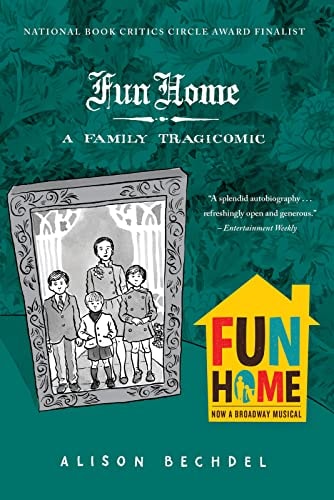
Fun Home A Family Tragicomic
Fun Home: A Family Tragicomic is a groundbreaking graphic memoir that explores Alison Bechdel's complex relationship with her father and her journey to understanding her own identity. Growing up in rural Pennsylvania, Alison's childhood was anything but ordinary. Her father, Bruce Bechdel, was a high school English teacher and funeral home director—a place the family nicknamed the "Fun Home." When Alison came out as a lesbian in college, she discovered that her distant, exacting father was also gay. Just weeks after this revelation, he died in what may have been suicide, leaving behind a legacy of secrets and unanswered questions.
Through stunning illustrations and raw honesty, Bechdel weaves together themes of family secrets, sexuality, literature, and loss. Her memoir is filled with literary allusions that reflect how her father saw the world, while also capturing the emotional distance that defined their household. This is a powerful coming-of-age story that examines how a daughter makes sense of the parent she thought she knew.
A New York Times bestseller and Time Magazine's #1 Book of the Year, Fun Home has been adapted into a Tony Award-winning musical and is widely considered one of the best graphic novels ever created. It's an unforgettable portrait of a family and a deeply moving exploration of identity, memory, and understanding.
Interesting Facts
Seven Years in the Making: Creating Fun Home was an epic labor of love that took Alison Bechdel seven years to complete! Her painstaking process included photographing herself in every single pose for each human figure she drew, ensuring authenticity in every panel. Can you imagine the dedication?
Time Magazine's Top Book: When Fun Home was published in 2006, Time Magazine didn't just praise it, they crowned it their number one Book of the Year! Entertainment Weekly called it the best nonfiction book of the year too. This graphic memoir shattered expectations about what the form could achieve.
The Title's Dark Irony: "Fun Home" was the family's nickname for their funeral home business, but the title carries layers of painful irony. It refers both to the literal funeral parlor where the Bechdel children did chores and to their deeply unhappy household, where Bruce's tyrannical perfectionism made actual "fun" nearly impossible.
Tony Award History Makers: The 2015 Broadway musical adaptation made history when Lisa Kron and Jeanine Tesori became the first all-female writing team to win the Tony Award for Best Original Score! The show won five Tonys total, including Best Musical, out of twelve nominations.
Nearly 1,000 Frames: The book contains close to 1,000 meticulously crafted frames, each packed with visual detail. Bechdel deliberately designed every panel so readers would need to study the images as carefully as they read the text, creating a gradual unfolding of meaning that mirrors memory itself.
Literary Allusions Everywhere: Every single chapter title is a literary reference! From Joyce's "Old Father, Old Artificer" to Camus's "A Happy Death," Bechdel uses literature as a framework because, as she writes, her parents are "most real to me in fictional terms." The memoir references Proust, Fitzgerald, Oscar Wilde, and countless others.
A MacArthur Genius: Bechdel received a MacArthur Fellowship (the prestigious "Genius Grant") in 2014 for "changing our notions of the contemporary memoir and expanding the expressive potential of the graphic form." The recognition came with a no-strings-attached award to support her work.
The Bechdel Test Connection: Yes, THAT Bechdel! Before Fun Home made her a literary sensation, Alison Bechdel created the famous "Bechdel Test" in her 1985 comic strip Dykes to Watch Out For. The test asks whether a work of fiction features at least two women who talk to each other about something other than men.
Pulitzer Prize Finalist: The Broadway musical was a finalist for the 2014 Pulitzer Prize for Drama, though it didn't win. The show had already swept up awards including the Lucille Lortel Award for Outstanding Musical, the New York Drama Critics' Circle Award for Best Musical, and the Obie Award for Musical Theater.
Bruce's Mysterious Death: Alison's father Bruce died when she was nineteen, just four months after she came out to her parents and two weeks after her mother filed for divorce. He stepped in front of a Sunbeam Bread truck, and while officially ruled an accident, Alison believes it was suicide, calling it her father's "final artifice."
Banned and Challenged: Despite its critical acclaim, Fun Home has faced numerous challenges and bans. In 2014, South Carolina's House of Representatives cut funding to the College of Charleston for selecting it as a summer reading book. More recently, it's been removed from school libraries in Missouri, South Dakota, Wisconsin, and Alberta, often labeled as "pornographic" or "sexually explicit."
Youngest Obie Winner: When the musical premiered Off-Broadway, ten-year-old Sydney Lucas (who played Small Alison) won an Obie Award for her performance, becoming the youngest person ever to receive that honor! She also earned a Tony nomination, showcasing the show's multigenerational appeal.
Quotes
“I suppose that a lifetime spent hiding one's erotic truth could have a cumulative renunciatory effect. Sexual shame is in itself a kind of death.”
“Then there were those famous wings. Was Daedalus really stricken with grief when Icarus fell into the sea? Or just disappointed by the design failure?”
“It was not a triumphal return. Home, as I had known it, was gone.”
“It was a vicious cycle, though. The more gratification we found in our own geniuses, the more isolated we grew.”
“I'd been upstaged, demoted from protagonist in my own drama to comic relief in my parents' tragedy.”
“Feminism is the theory. Lesbianism is the practice.”
“What would happen if we spoke the truth?”
“It's imprecise and insufficient, defining the homosexual as a person whose gender expression is at odds with his or her sex.”
“My father once nearly came to blows with a female dinner guest about whether a particular patch of embroidery was fuchsia or magenta. But the infinite gradations of color in a fine sunset – from salmon to canary to midnight blue – left him wordless.”
“The maples had sheltered the west side of our house for over a hundred years, and left, as fallen trees do, a void so absolute you couldn't possibly have imagined it beforehand.”
Ratings & Reviews
What do you think?
There are no reviews yet. Be the first one to write one.