
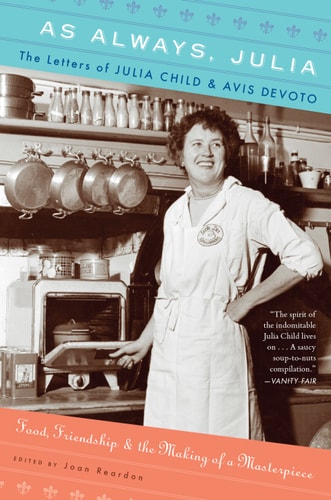
As Always, Julia
As Always, Julia brings together more than 200 letters exchanged between legendary chef Julia Child and Avis DeVoto, her friend and unofficial literary agent. This correspondence chronicles the creation of Mastering the Art of French Cooking, one of the most influential cookbooks ever written, while revealing an intimate portrait of Julia Child's inner thoughts and the blossoming of an extraordinary friendship. The letters span from the early 1950s through 1961, following Julia from her days as a newlywed in Paris through her husband's diplomatic postings to Nice, Germany, and Norway.
Frank, bawdy, funny, and occasionally agonized, these letters capture two remarkable women discussing everything from French cooking techniques and the lack of good wine in America to McCarthyism, sexual mores, and the challenges of domestic life. Food historian Joan Reardon provides insightful commentary throughout, placing the correspondence in historical context. The letters reveal not just the turbulent process of creating a groundbreaking cookbook, but also an America on the verge of political, social, and gastronomic transformation. This collection offers readers an unprecedented look at Julia Child before she became a household name, showing her passion, humor, and determination as she worked to bring French cuisine to American kitchens.
Interesting Facts
A Friendship Born from Knives: This extraordinary friendship began in 1952 when Julia Child, living in Paris, sent a 70-cent carbon steel paring knife to historian Bernard DeVoto after reading his Harper's article complaining about dull American stainless steel knives. His wife Avis answered the letter, and a legendary friendship was born.
Over 200 Letters Revealed: The book contains more than 200 letters exchanged between Julia and Avis from 1952 to 1961, chronicling nearly a decade of intimate correspondence that had never been published before. These weren't just recipe exchanges but deeply personal conversations between two brilliant women.
The Letters Were Sealed: Julia's letters to Avis were housed in the Avis DeVoto papers at Harvard's Schlesinger Library with the stipulation they remain closed for 30 years. This treasure trove of correspondence finally became available for Joan Reardon's research, giving us unprecedented access to Julia's private thoughts.
Avis Was Julia's Literary Godmother: Avis DeVoto served as Julia's unofficial literary agent and was instrumental in getting Mastering the Art of French Cooking published, first steering it to Houghton Mifflin in 1954, then later helping push it to its eventual home at Alfred A. Knopf after the initial rejection.
They Met Two Years Later: Despite their intense correspondence beginning in 1952, Julia and Avis didn't meet in person until 1954, when Julia arrived at the DeVoto home in Cambridge with a station wagon loaded to the roof with pots and pans, took over the kitchen, and cooked for their cocktail party guests.
Frank Talk About Everything: These letters are described as bawdy, funny, and exuberant, covering topics far beyond cooking including McCarthyism, sexual mores, politics, aging, marriage frustrations, and the lack of good wine in 1950s America. The women held nothing back in their correspondence.
Julia's Political Fire Surprises: The letters reveal a politically passionate Julia Child that most people never knew from her television persona. She was deeply engaged with the volatile politics of the 1950s and wasn't shy about expressing strong opinions on McCarthyism and government affairs.
The Recipe Testing Was Staggering: Julia and her co-author Simone Beck tested and re-tested 524 recipes for Mastering the Art of French Cooking. At one point, they were working on 100 chicken recipes alone, and the original version of volume one was over 700 pages dedicated just to chicken and sauces.
Julia Had Deep Self-Doubt: Contrary to the supremely confident television personality we know, these letters reveal Julia experienced significant self-doubt and pessimism, especially when her revised manuscript was rejected. Avis served as her constant cheerleader and sounding board through the difficult publishing journey.
Avis Was an Ingredient Detective: Living in Cambridge while Julia was in Europe, Avis provided crucial feedback about what ingredients were actually available to American housewives in the 1950s. She'd tell Julia things like "Nobody knows about shallots!" helping ensure the cookbook would work for its intended audience.
Julia Called It "Cookery-Bookery": Julia coined the adorable term "cookery-bookery" to describe their cookbook discussions, though their conversations quickly expanded far beyond recipes to encompass their entire lives, families, and the changing world around them.
The Book Shows America Transforming: These letters capture America on the verge of massive political, social, and gastronomic transformation during the 1950s, offering a fascinating window into domestic life, the role of housewives, and how two intellectually curious women navigated that era while dreaming of better food for everyone.
Quotes
“To think that we might easily have gone through life not knowing each other, missing all this free flow of love and ideas and warmth and sharing… We share really almost everything.”
“Well, all I know is this—nothing you ever learn is really wasted, and will sometime be used.”
"The only real stumbling block is fear of failure. In cooking, you've got to have a what-the-hell attitude."
“I’m getting stale. I always do this time of year. I keep my nose to the grindstone and put in long hours and rustle up good meals and do all the chores and run errands and get along with people — and have a fine time doing it and enjoy life. Then I realize, bang, that I’m tired and I don’t want to wait on my family for a while and I wish I could go away somewhere and have people wait on me hand and foot, and dress up and go to restaurants and the theater and act like a woman of the world. I feel as if I’d been swallowed up whole by all these powerful DeVotos and I’d like to be me for a while with somebody who never heard the name.”
“But how nice it is that one can come to know someone just through correspondence, and become really passionate friends.”
“You have come nearer to mastering a good many aspects of cooking than anyone except a handful of great chefs, and some day it will pay off. I know it will. You will just have to go on working, and teaching, and getting around, and spreading the gospel until it does.”
“I am in a state about all of this. I comb the newspapers. I listen to the commentators. And I get into fights all over the place. If a Republican knows his place and hates McCarthy and wishes to God Eisenhower would get more aggressive about these bastards, well and good and I will admit him to the brotherhood. If he says nasty things about Truman (who is rapidly becoming the Man I Love although I have been sore enough at him in my time) or still thinks taxes are coming down and we can get out of Korea and we ought to fire all the Democrats in Washington and don’t worry, McCarthy-ism will blow over … well, dear, I am no lady and I argue loudly and lose my temper and it’s disgraceful.”
“Of course, an old wine is like an old lady, and traveling can disturb her.”
“My, I get so depressed after a poor meal; that's why I can never stay in England for more than a week.”
“It is horrible how people will use anything as a political monkey wrench and to hell with the country.”
“I am chewing my nails off to the elbow, like Noel Coward’s lady.”
“We share really almost everything.”
Ratings & Reviews
What do you think?
There are no reviews yet. Be the first one to write one.